

-
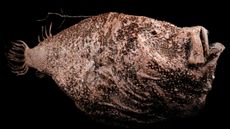 Anglerfish entered the midnight zone 55 million years ago and thrived by becoming sexual parasites
Anglerfish first colonized the ocean's midnight zone 55 million years ago, during a period of extreme global warming, a new study finds. The bizarre fish adapted to thrive in the deep sea by becoming sexual parasites, the researchers said.
fish -
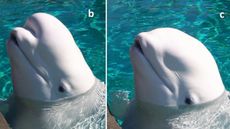 Beluga whales appear to change the shape of their melon heads to communicate, scientists discover
Beluga whales appear to change the shape of their heads during encounters with one another in what scientists believe is a form of visual communication among this highly social species.
whales -
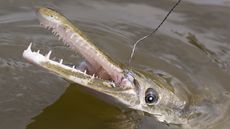 Prehistoric fish with giant jaws filled with razor-sharp teeth are the ultimate living fossils
Gars have the slowest rate of evolution of all jawed vertebrates, having barely changed since first appearing at the time of the dinosaurs.
fish -
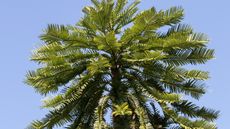 'Living fossil' tree frozen in time for 66 million years being planted in secret locations
Wollemi pines — thought to have gone extinct 2 million years ago — were rediscovered in 1994. Scientists are now hoping to reintroduce the species in the wild in a conservation effort that could take centuries.
plants -
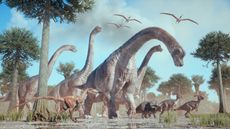 Dinosaurs dominated our planet not because of their massive size or fearsome teeth — but thanks to the way they walked
Dinosaurs may have ruled Earth for over 160 million years because the way they walked gave them a big advantage during the drying climate of the Triassic.
dinosaurs -
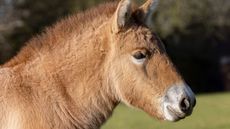 Cloned Przewalski's horses are 'resurrected stallions' that could help species thrive, scientists say
Przewalski's horses cloned from a stallion that died in 1998 could help reintroduce much needed diversity to the species that was once declared extinct in the wild.
land-mammals -
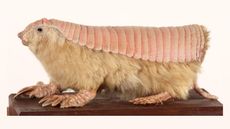 'Peculiar' pink fairy armadillos have a weird double skin not seen in any other mammal
Pink fairy armadillos, which are just 6 inches long, appear to have evolved a strange double skin millions of years ago as they moved underground in response to the climate becoming more arid.
land-mammals -
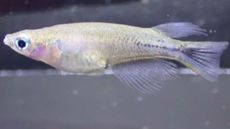 Color-changing fish turns black with rage when provoked
Aggressive little male fish from Indonesia turn black when angry to show their dominance, scientists discover.
fish -
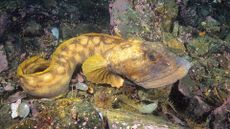 Ocean pout: The fish with antifreeze blood
Ocean pout live in frigid waters from Labrador in Canada to North Carolina and have evolved a blood protein that serves as antifreeze.
fish -
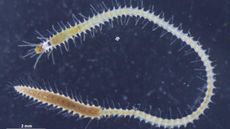 Strange sea worms have butts that grow a brain before wriggling off to find a mate
Scientists have worked out how Japanese green syllids grow a butt with a brain that can swim away to reproduce.
animals -
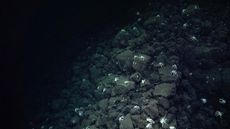 Trail of crabs leads scientists to remarkable underwater discovery
Scientists have discovered a never-before-seen hydrothermal vent teeming with life off the Galápagos Islands by following a long trail of squat lobsters.
animals -
 Elephants give each other names — the 1st non-human animals to do so, study claims
Elephants in Kenya's Amboseli National Park appear to call to each other with individual names using low, complex "rumbles," a study has found.
elephants -
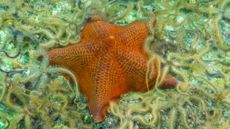 'A disembodied head walking about the sea floor on its lips': Scientists finally work out what a starfish is
Scientists have discovered something strange happened to starfish over the course of their evolution, and they ended up as heads scampering around the seafloor.
animals -
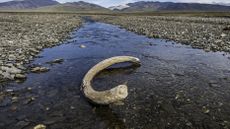 Girl discovers 100,000-year-old mammoth bones in Russian river while fishing with dad
An 8-year-old girl discovered the bones of a woolly mammoth and a prehistoric bison after a landslide along the banks of a river in western Russia.
extinct-species -
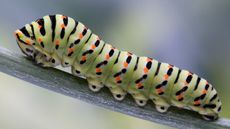 Caterpillars evolved their weird chubby little 'prolegs' from ancient crustaceans
The extra legs caterpillars have appear have origins in the primitive crustaceans that insects evolved from during the Ordovician period over 400 million years ago.
insects -
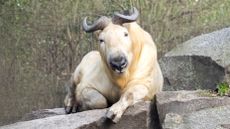 Takins: Strange, mountain-dwelling mammals with mythical golden fleeces
These weird-looking stocky mammals roam Alpine zones and forested valleys in Asia, using their specially adapted split hooves help them traverse the steep, rocky terrain.
land-mammals -
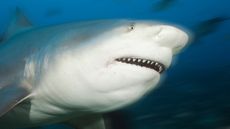 The strange story of sharks that lived in a golf course pond for 20 years — then vanished
In the 1990s, a group of juvenile bull sharks were left stranded in a golf course pond in Australia, where they thrived for decades. Now scientists are trying to understand why.
sharks -
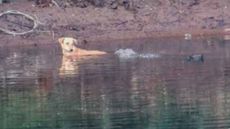 Indian crocodiles seen saving dog from feral pack attack, but scientists divided over what it means
Crocodiles appeared to rescue a dog that had been chased into a river, and scientists said this unusual behavior could indicate empathy — but others are skeptical.
alligators-crocodiles -
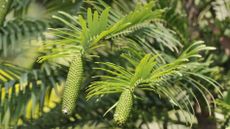 Mystery of 'living fossil' tree frozen in time for 66 million years finally solved
The Wollemi pine was thought to have gone extinct 2 million years ago until it was rediscovered by a group of hikers in 1994. Now, scientists have decoded its genome to understand how it's survived — almost unchanged — since the time of the dinosaurs.
plants -
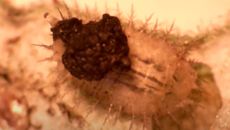 Tortoise beetle larvae use their telescopic anuses to build shields from shed skin and poop
Many tortoise beetle larvae create shields for themselves using faeces and old skin. Scientists have now looked at how and why they create these poop parasols.
insects -
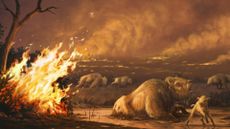 'Like a bomb has gone off': Ancient humans may have set megafires that turned Southern California into an uninhabitable 'wasteland' for 1,000 years
Ice-age humans may have set fires that led to the extinction of large mammals across what is now Southern California.
archaeology -
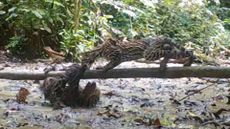 Watch sloth fight off ocelot in incredibly rare footage from deep in the Amazon rainforest
The footage from a camera trap in Yasuní Biosphere Reserve in eastern Ecuador appears to be the first time a fight between a sloth and an ocelot has been caught on film.
animals


