

-
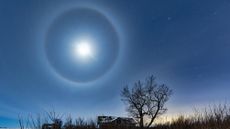 Why does the moon sometimes have a 'halo'?
The moon's halo is always 22 degrees wide in the night sky when it appears. So what causes it?
planet-earth -
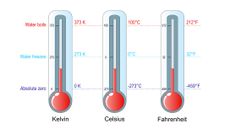 What is the third law of thermodynamics?
Reference According to the third law of thermodynamics, the entropy of a perfect crystal is zero when the temperature of the crystal is equal to absolute zero (0 kelvin).
Reference -
 Do trees exist (scientifically speaking)?
Trees don't fit into a species, family or even an order. So do they really exist, scientifically speaking?
plants -
 Should you exercise if you're sick?
Here's a good rule of thumb for how to approach exercise when you're sick, according to a sports medicine doctor.
exercise -
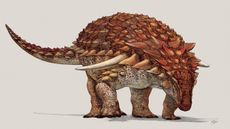 What color were the dinosaurs?
Here's how scientists know which colors dinosaurs flaunted.
dinosaurs -
 Why are scabs so itchy?
Here's the science behind itchy scabs and the best way to help your skin heal.
health -
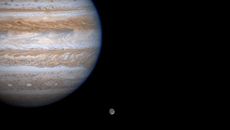 Are there any moons that are made of gas?
There aren't any gaseous moons in the solar system, but here's what it would take for one to exist elsewhere.
the-moon -
 Physicists create bizarre quantum 'domain walls' in new experiment
Strange 'domain walls' act like independent quantum object in the new experiment.
quantum-physics -
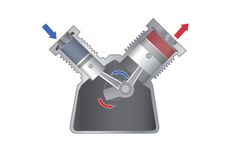 What is the first law of thermodynamics?
Reference The first law of thermodynamics states that energy cannot be created or destroyed, but it can be transferred from one location to another and converted to and from other forms of energy.
Reference -
 How do snakes hiss if they don't have front teeth?
Here's how snakes can hiss even though they don't have front teeth.
snakes -
 What would happen if Russia bombed Chernobyl?
Russian troops have captured the Chernobyl nuclear power plant, which still contains nuclear waste that could pose a threat to the surrounding area.
nuclear-energy -
 What is Faraday's law of induction?
Reference Faraday’s law of induction describes how an electric current produces a magnetic field and, conversely, how a changing magnetic field generates an electric current in a conductor.
Reference -
 What is the second law of thermodynamics?
Reference The Second Law of Thermodynamics says, in simple terms, entropy always increases. This principle explains, for example, why you can't unscramble an egg.
Reference -
 What is thermodynamics?
Reference Thermodynamics is the branch of physics that deals with the relationships between heat and other forms of energy.
Reference -
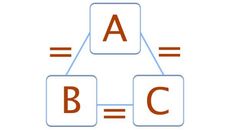 What is the zeroth law of thermodynamics?
Reference The zeroth law of thermodynamics states that if two bodies are each in thermal equilibrium with some third body, then they are also in equilibrium with each other.
Reference -
 What is a scientific theory?
Reference A scientific theory is based on careful examination of facts. It is much different from the non-scientific use of the word.
Reference -
 Why are tigers orange?
Tigers may be orange, but their prey don't see them that way. Here's why it doesn't matter that these giant cats are brightly colored.
cats -
 Why does electricity make a humming noise?
Here's why you sometimes hear a hum when you turn on an electric device or walk near a transformer.
energy -
 Science and the scientific method: Definitions and examples
Science is a systematic and logical approach to discovering how things in the universe work.
planet-earth -
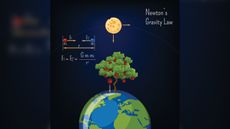 What is a law in science?
A scientific law is the description of an observed phenomenon. It doesn't explain why the phenomenon exists or what causes it.
human-behavior -
 Are daddy longlegs really the most venomous spiders in the world?
Is there any truth to the tale that daddy longlegs are the most venomous spiders?
spiders-arachnids -
 Physicists crack unsolvable three-body problem using drunkard's walk
The three-body problem, which has plagued science since the days of Isaac Newton, is closer to being solved, scientists say.
physics-mathematics -
 Does every star have planets?
Some stars don't have planets orbiting them. Here's why.
planets -
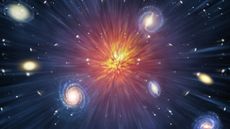 Weird quantum objects known as Q balls could explain why we exist
Bizarre quantum objects called Q balls could explain why the universe if filled with matter and ultimately why we exist.
quantum-physics


