

-
 The universe had a secret life before the Big Bang, new study hints
The secrets of black holes and dark matter could lie before the Big Bang, a new study of "bouncing" cosmology hints.
cosmology -
 Huge cosmological mystery could be solved by wormholes, new study argues
The universe is expanding at an ever accelerating rate — and tiny wormholes that bore through the fabric of space-time might be to blame, a new study proposes.
cosmology -
 Antimatter detected on International Space Station could reveal new physics
Eight years ago, the International Space Station detected weird antimatter particles that challenge our entire understanding of physics. Now, researchers have proposed that mysterious cosmic "fireballs" could help explain the detection.
particle-physics -
 Study finds black holes made from light are impossible — challenging Einstein's theory of relativity
New theoretical research finds that it's impossible to form a black hole with the energy of light particles alone, poking a hole in Einstein's theory of general relativity.
black-holes -
 'Immortal' stars at the Milky Way's center may have found an endless energy source, study suggests
Strange stars clustered near the Milky Way's center are much younger than theory predicts is possible. New research suggests their youth could actually be eternal — and fueled by annihilating dark matter.
cosmology -
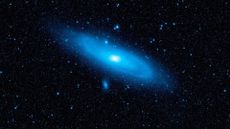 A new theory of quantum gravity could explain the biggest puzzle in cosmology, study suggests
A new theory of quantum gravity, which attempts to unite quantum physics with Einstein's relativity, could help solve the puzzle of the universe's expansion, a theoretical paper suggests.
physics-mathematics -
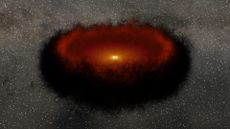 Black hole singularities defy physics. New research could finally do away with them.
Black hole singularities defy the laws of physics. New research presents a bold solution to this puzzle: Black holes may actually be a theoretical type of star called a 'gravastar,' filled with universe-expanding dark energy.
cosmology -
 Tweak to Schrödinger's cat equation could unite Einstein's relativity and quantum mechanics, study hints
Physicists have proposed modifications to the infamous Schrödinger's cat paradox that could help explain why quantum particles can exist in more than one state simultaneously, while large objects (like the universe) seemingly cannot.
quantum-physics -
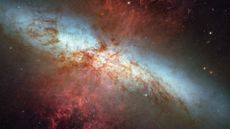 Mysterious 'unparticles' may be pushing the universe apart, new theoretical study suggests
New theoretical research suggests that a mysterious form of matter called "unparticles" could be the driving force behind the expansion of the universe.
particle-physics -
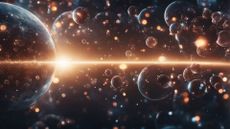 Our universe is merging with 'baby universes', causing it to expand, new theoretical study suggests
The universe is expanding faster and faster, but not all scientists agree that dark energy is the cause. Perhaps, instead, our universe keeps colliding with and absorbing smaller 'baby universes,' a new theoretical study suggests.
cosmology -
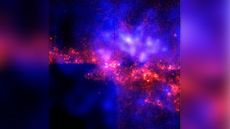 Dark matter could be gently wobbling space-time around us — and scientists may finally know how to detect it
A new paper suggests we may finally be able to uncover the identity of dark matter using the same technology that detects ripples in space-time known as gravitational waves.
cosmology -
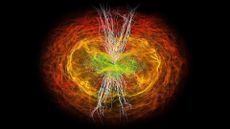 Physicists want to use gravitational waves to 'see' the beginning of time
Gravitational waves are ripples in the fabric of space. Waves that originated in the early universe could carry important information about the phenomena that occurred there.
cosmology


