













Babylon's Ishtar Gate may have a totally different purpose than we thought, magnetic field measurements suggest
Archaeologists measured the magnetic fields found in clay bricks to determine the construction date of Babylon's Ishtar Gate.
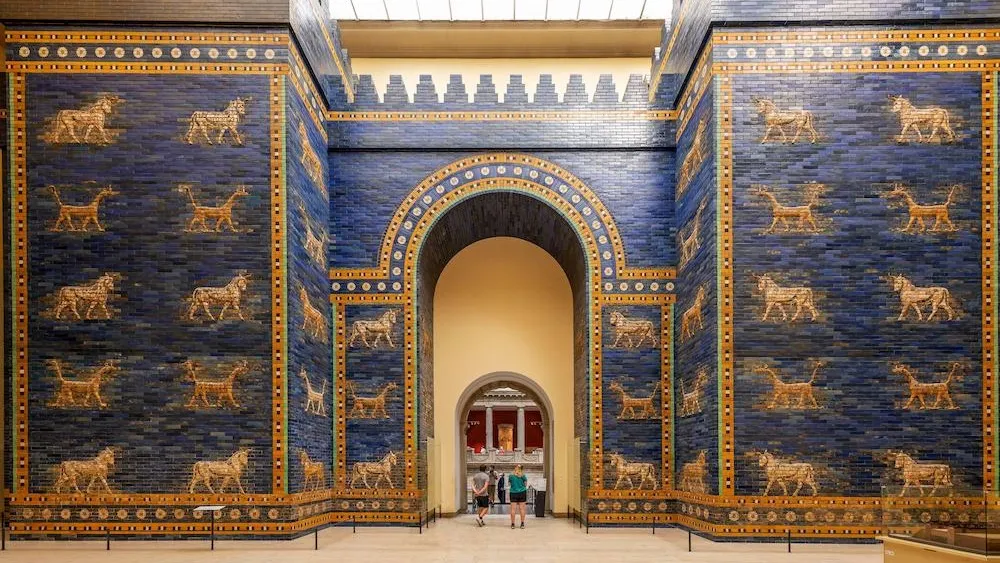
Babylon's bright-blue Ishtar Gate was thought to have been built to celebrate the conquest of Jerusalem — but a new analysis finds that it may have been erected years later.
The iconic glazed-brick edifice, which King Nebuchadnezzar II ordered to be built and decorated with wild bulls and mušhuššu-dragons while ruling the Babylonian empire from 605 to 562 B.C., was constructed in three phases and served as the entrance to the ancient city of Babylon, located in southern Mesopotamia. However, the exact dates of each construction phase have long been up for debate, according to a study published Wednesday (Jan. 17) in the journal PLOS One.
While it's known that Nebuchadnezzar II ordered the first phase, as these bricks are inscribed with his name, it was less clear if some time had passed before the second and third phases were completed, according to the study. Some researchers even wondered if Nebuchadnezzar II had died before the gate's completion.
To set the record straight, archaeologists collected tiny samples from five of the fired mud bricks from the Ishtar Gate (now reconstructed at the Pergamon Museum in Berlin) spread across the three phases and measured the geomagnetic fields of each one in a process known as archaeomagnetism.
Related: Cuneiform inscription from last king of Babylon discovered in Saudi Arabia
Archaeomagnetism measures the effect of Earth's magnetic field that's preserved in the archaeological record of an object, according to the McClung Museum of Natural History and Culture at the University of Tennessee, Knoxville. It offers an even more accurate time stamp than radiocarbon dating, the most common method of archaeological measurement.
This new analysis determined that there were no "significant chronological gaps" between each construction phase and that the "gate complex was constructed some time after the Babylonian conquest of Jerusalem" that took place in 586 B.C. During the conquest of Jerusalem, the Babylonians destroyed Solomon's Temple, also known as the First Temple; burned down the city; and exiled the Jews to southern Mesopotamia, also known as Babylonia.
Get the world’s most fascinating discoveries delivered straight to your inbox.
The researchers concluded that because all of the magnetic-field measurements in the five bricks were similar, the reconstructions were executed around the same time: 583 B.C., according to the study.
RELATED STORIES
"The age is based on the period of the reign of Nebuchadnezzar II, during which the order to build the gate was given," the team wrote in the study, indicating that the king was alive at the gate's completion.
The finding suggests that the Ishtar Gate didn't change style through the construction process but rather that "phases II and III are related to the original design of the gate and reflect the construction process rather than later additions, detached from the original construction of phase I," the authors wrote.
The researchers hope to perform similar archaeomagnetic analyses on other ancient structures in Mesopotamia, since fired mud bricks have proved to be reliable sources for this technique and were a common building material during that era.
Jennifer Nalewicki is former Live Science staff writer and Salt Lake City-based journalist whose work has been featured in The New York Times, Smithsonian Magazine, Scientific American, Popular Mechanics and more. She covers several science topics from planet Earth to paleontology and archaeology to health and culture. Prior to freelancing, Jennifer held an Editor role at Time Inc. Jennifer has a bachelor's degree in Journalism from The University of Texas at Austin.