













Archaic human 'hobbits' were even shorter than we thought, 700,000-year-old teeth and bone reveal
A new analysis of teeth and a bone found on an Indonesian island reveal that "hobbits" were more than 2 inches shorter than we thought.
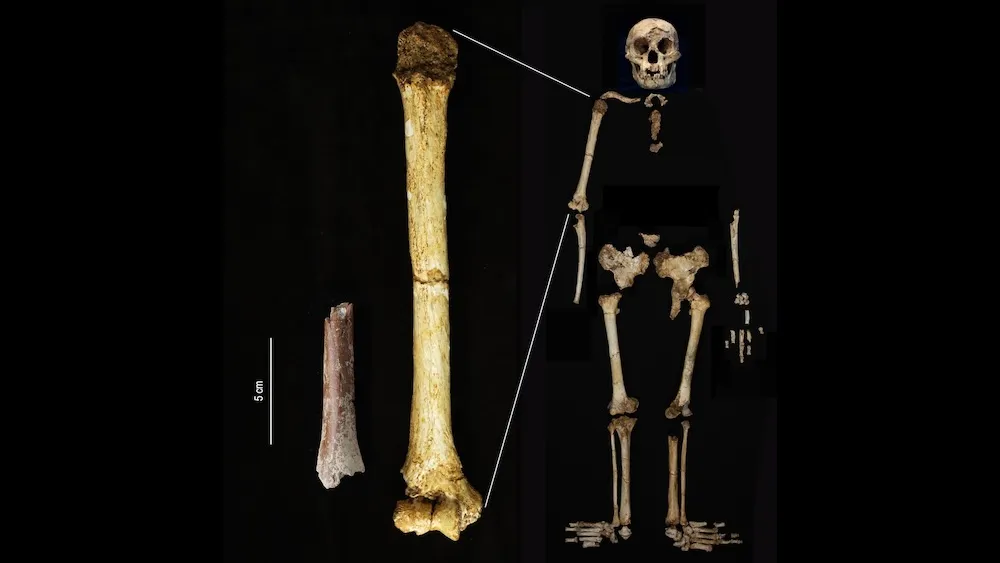
Early hominins known colloquially as "hobbits" may have been shorter than scientists thought, a new analysis of teeth and bones has revealed.
The 700,000-year-old fossilized remains belonged to Homo floresiensis, an extinct species of exceedingly small humans that once inhabited Flores, an island south of mainland Indonesia, according to a study published Tuesday (Aug. 6) in the journal Nature Communications.
The new research may shed light on when H. floresiensis first evolved its diminutive height.
"Acquiring a large body and large brain and becoming clever is not necessarily our destiny," lead author Yosuke Kaifu, a professor at the University Museum at the University of Tokyo, told Live Science in an email. "Depending on the natural environment, there were diverse ways of evolution not only for animals in general but also for humans."
Until recently, it was thought that H. floresiensis stood 3 feet, 2 inches (1 meter) tall, on average. However, this new research shows that the species, which is an offshoot of Homo erectus, was 2.4 inches (6 centimeters) shorter, on average, according to a statement. H. erectus is an extinct human lineage that lived between 2 million and 250,000 years ago and had similar body sizes to modern humans.
Prior to this study, the smallest known H. floresiensis bones were found at Liang Bua, a cave on Flores located south of Manta Menge, where the new remains were found.
Related: See the face of the 'hobbit,' an extinct human relative
Get the world’s most fascinating discoveries delivered straight to your inbox.
For the analysis, researchers examined a newfound set of fossils, including teeth and a partial upper arm bone (humerus), unearthed at the site. They determined that the humerus may be the "smallest ever reported from an adult individual," according to the statement.
The researchers quickly concluded that the bones weren't from a child.

The partial upper arm bone (humerus) found at the site.
"Adult bones leave traces of metabolism (we call it remodeling for bones) more than those of children," Kaifu said. "We detected a strong signal of such trace in the Mata Menge humerus, through microscopic observation of a sliced bone sample."
Kaifu added, "The Mata Menge fossils we report here showed that the extremely small body size of Homo floresiensis evolved within the first 300,000 years of their history on the island … and then after that the small body size was maintained for more than 600,000 years. Why this happened is another difficult question."
On one hand, evolving a smaller body size could simply be a matter of island natural selection. For instance, island elephants have sometimes become smaller over time.
RELATED STORIES
There may be "no need to be large on the islands because there are no lions and tigers there," Kaifu said.
Meanwhile, being large has notable disadvantages: It requires eating more and more time to grow and breed. The archaic humans marooned on an isolated island may have become smaller because of those pressures, Kaifu added.
"We tend to think that humans are special among animals," Kaifu said. "But the evidence from Flores indicates that we humans are, like other animals, also under control of natural selection and could evolve toward unexpected directions."
Jennifer Nalewicki is former Live Science staff writer and Salt Lake City-based journalist whose work has been featured in The New York Times, Smithsonian Magazine, Scientific American, Popular Mechanics and more. She covers several science topics from planet Earth to paleontology and archaeology to health and culture. Prior to freelancing, Jennifer held an Editor role at Time Inc. Jennifer has a bachelor's degree in Journalism from The University of Texas at Austin.