
-
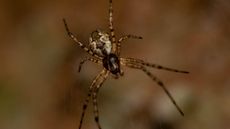 Asian hermit spider: The arachnid that gets stronger after ejecting its own penis
Female Asian hermit spiders gobble up their partners after mating, so males detach their penises and sometimes offer up an amputated leg to escape.
6 Commentsspiders-arachnids -
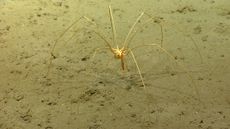 Watch enormous deep-sea spiders crawl around sub-Antarctic seafloor
The giant sea spiders can have leg spans of up to 20 inches (51 centimeters).
spiders-arachnids -
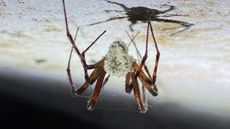 'Zombie' spiders infected by never-before-seen fungus discovered on grounds of destroyed Irish castle
A new fungus that infects cave spiders and turns them into "zombies" was discovered in a Victorian gunpowder store at Castle Espie in Northern Ireland during filming for a TV show.
15 Commentsspiders-arachnids -
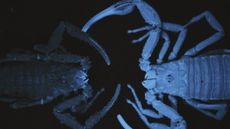 Scientists discover rare venom-spraying scorpion in Colombia
Newly described scorpion can spray and inject its venom — the first South American species known to do this.
spiders-arachnids -
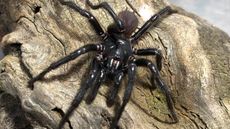 'Big boy' spider becomes Australia's largest deadly funnel-web after surprise discovery
The Sydney funnel-web spider has extremely dangerous venom, but according to a new study this spider is actually three different species — one of which, the "Newcastle big boy," is much larger.
spiders-arachnids -
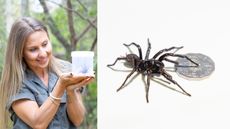 Giant funnel-web spider with fangs so big it could bite through a human fingernail arrives at Australian zoo
Hemsworth, a colossal funnel-web spider recently donated to the Australian Reptile Park, could make significant contributions to the park's life-saving venom-milking program, keepers say.
spiders-arachnids -
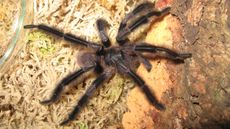 Hairy giant tarantula: The monster among mini tarantulas with 'feather duster' legs
The newly discovered tarantula Trichopelma grande has unusually hairy legs for a ground-dwelling species. It's also much bigger than its relatives — and scientists aren't sure why.
spiders-arachnids -
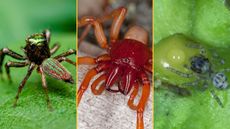 Three remarkable spiders: A vegetarian, a vampire and a predator that uses 'pincer, fork and key'
In this extract from "The Lives of Spiders: A Natural History of the World's Spiders," author Ximena Nelson examines three species of spider with unusual diets — plants, blood and pillbugs.
spiders-arachnids -
 Wolf spiders: Behavior, bites and other facts
REFERENCE Wolf spiders are a large family of hairy and athletic arachnids that chase down prey on the ground rather than catching food in webs.
REFERENCE


