















3 remarkable spiders: A vegetarian, a vampire and a predator that uses 'pincer, fork and key'
In this extract from "The Lives of Spiders: A Natural History of the World's Spiders," author Ximena Nelson examines three species of spider with unusual diets — plants, blood and pill bugs.


There are an estimated 50,000 species of spider living on Earth, from behemoths like the giant huntsman and goliath birdeater, down to the tiniest, the dwarf orb weaver and Patu digua. In this extract from "The Lives of Spiders: A Natural History of the World's Spiders" (Princeton University Press, 2024), author Ximena Nelson looks at the three species with unusual diets — plants, blood and pill bugs.
Vegetarian spider

The diet of Bagheera kiplingi is almost exclusively plant-based.
Scientific name: Bagheera kiplingi
Family: Salticidae
Body length: 1∕5–¼ in (5–6 mm)
Notable anatomy: Males have iridescent green markings on cephalothorax and abdomen
Memorable feature: Primarily vegetarian
A spider is an unlikely vegetarian, but Bagheera kiplingi almost fits the bill. Supplementing its diet with nectar, ant larvae, and nectar-feeding flies, this jumping spider feeds almost entirely on Beltian bodies, the detachable fat and protein-rich leaf tips of Vachellia acacia shrubs.
Get the world’s most fascinating discoveries delivered straight to your inbox.
Bagheera is so dependent on Beltian bodies that it is an obligate resident of Vachellia plants, where it lives in areas that are not well patrolled by the resident Pseudomyrmex ants. There is such host specificity to the plant that the spider’s geographic range is limited by the presence of Vachellia.
Plant mutualisms
Ants can be helpful to plants because they tend to be aggressive and keep herbivorous insects away. Consequently, many plants make an effort to lure ants as bodyguards and keep them around by producing accessible nectar through extrafloral nectaries. This continuous source of food is irresistible to ants, but often is also exploited by spiders, especially wandering spiders that roam to hunt their prey.
This includes many species of jumping spiders, where nectarivory may be a common tactic to obtain a meal with less risk of injury than hunting. Nectarivory can increase spider longevity and reproductive output. Importantly, for the tiny spiderlings, nectar may provide much-needed energy that allows them to hunt prey inevitably larger than themselves. In addition to extrafloral nectar, Vachellia species produce nutritious Beltian bodies to keep Pseudomyrmex ants nearby.
Related: We now know why tarantulas are hairy — to stop army ants eating them alive
The defense put up by the ants is formidable, and few animals can encroach it. Bagheera exploits the mutualism by harvesting the Beltian bodies and extrafloral nectar produced by the acacia without providing defense to the plant. Being able to see ants from a distance, Bagheera largely seems to avoid encounters with them — unless craftily stealing a larva being carried by one.
An unusual diet
Depending on location, plant-derived food accounts for between 60 and 90% of Bagheera’s diet, making this the only near-herbivorous spider known and a rather extreme outlier in a group known for its predatory behavior. As spiders cannot ingest solids, the Beltian bodies must be enzymatically broken down prior to being consumed, which can happen in a matter of minutes. Although this may be an easily available source of food, the spiders appear to need a lot of it to get by: They feed on many Beltian bodies in a single feeding bout, and about 30 Beltian bodies are required to provide the nutrition of a single insect prey.
Vampire spider

Evarcha culicivora, which feeds on mosquitos that have recently eaten blood.
Scientific name: Evarcha culicivora
Family: Salticidae
Body length: 1∕8–2∕5 in (3–10 mm)
Notable anatomy: Males have bright-red band under forward–facing eyes
Memorable feature: Specializes in hunting the vectors of Anopheles (malaria) mosquitoes
Living in the Lake Victoria region of Africa, Evarcha culicivora is possibly the pickiest animal on Earth. The media-named "vampire spider" does not feed directly on human blood, but does so indirectly by preying on blood-fed female mosquitoes. In fact, Evarcha actively chooses Anopheles mosquitoes, which are attracted to feed on human blood and are hence vectors of malaria.
By feeding on blood-fed female Anopheles at a time of day when the mosquitoes tend to rest after a blood meal, sexually mature spiders attain a "perfume" that makes them alluring to the opposite sex. This suggests that, unusually, their prey preference may be at least partly driven by sexual selection. As a coup, E. culicivora may play a small role in mitigating the transmission of malaria by preventing mosquitoes carrying the parasite from biting and infecting another person.
An affinity for blood
The vampire spider has an approximate hierarchy of preferences, with blood-fed female Anopheles at the top, followed by other kinds of local blood-fed female mosquitoes, then non-blood-fed female Anopheles, male Anopheles, and finally the most common prey type in its habitat: midges. Juveniles even have an Anopheles-specific method of hunting, which they don’t use for other prey. Odors associated with humans may attract the spiders to houses, where they are likely to encounter the Anopheles, but it is their visual decision-making that we understand best.
Anopheles has a specific resting posture, and Evarcha uses this to differentiate it from other mosquitoes. The spider judges how "fat" the abdomen appears as an indication that it is full of blood. To determine sex, it also looks at how feathered the antennae are, as female mosquitoes have barer antennae.
Paradoxical plants
Aside from houses, a popular hunting spot is on Lantana camara shrubs, where mosquitoes sometimes rest and eat nectar. The spiders also feed on Lantana’s nectar, which gives them a nutrition boost that allows them to hunt prey many times their size. Paradoxically, Evarcha’s prey preference is no longer expressed when the spider is exposed to the dominant volatile compound of Lantana, β-caryophyllene. This is because the plant odors reduce the time Evarcha spends visually assessing its prey. The fact that the spider is prone to identification errors of its preferred prey illustrates a trade-off in Evarcha’s ability to process information when faced with a diversity of stimuli involving multiple sensory modalities.
Woodlice-eating spiders

Dysdera crocata, which is one of the few predators to hunt pill bugs
Scientific name: Dysdera crocata
Family: Dysderidae Females
Body length: Females c. ½–c. 3∕5 in (11–15 mm), males c. 2∕5 in (9–10 mm)
Notable anatomy: Has very noticeable and broad chelicerae
Memorable feature: Specializes in hunting woodlice
Woodlice are terrestrial crustaceans (isopods) with a thick carapace, which they use as a shield when they roll into a ball or cling to a surface to avoid attack. Despite being slow-moving, many species have noxious secretions, making them formidable foes. Some spiders in the genus Dysdera, the most famous being Dysdera crocata, are among the few predators to hunt them.
Pincer, fork and key
Species that specialize in catching woodlice have specially adapted chelicerae. Unlike nonspecialist Dysdera species, these specialists use one of three main tactics to grasp prey: the pincer, the fork, and the key. Each strategy is associated with a particular mouthpart morphology.
Species with elongated chelicerae, like D. crocata, use the pincer approach, rapidly penetrating the unprotected underside of a woodlouse with one chelicera before it can roll up and defend itself, while simply holding the armored side to keep the prey in place. If the woodlouse manages to roll into a ball or cling hard, the spider patiently waits, unmoving and ready, until it gets another chance to attack.
The fork tactic is used by species that have chelicerae with a concave upper surface. Here, attacks consist of quicky grabbing the woodlouse with its first pair of legs, slipping the chelicerae under the isopod, and rapidly biting the underside of the woodlouse before it has time to adopt a defensive posture. The key tactic requires flattened chelicerae. Like fitting a key into a lock, the spiders slide one chelicera between the armored segments of the carapace of the woodlouse, inserting its fang to bite — voilà!
Woodlice gradient
RELATED STORIES
Of the Dysdera species that largely consume woodlice, there is variation in how much they rely on these prey. However, it is likely that all need to eat at least some woodlice to grow and develop quickly, suggesting a metabolic need for this food source. Furthermore, there is a correlation between the level of modification of the chelicerae and woodlouse specialization, with those that are almost obligate specialists having the most strongly reshaped mouthparts. This is matched by behavior, with species with less modified mouthparts exhibiting markedly less prey preference, and by their ability to extract key nutrients from their prey.
Adapted from THE LIVES OF SPIDERS: A NATURAL HISTORY OF THE WORLD’S SPIDERS. Copyright © 2024 by Ximena Nelson. Reprinted by permission of Princeton University Press.
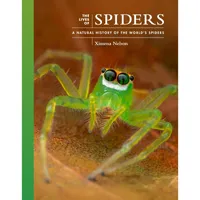
The Lives of Spiders: A Natural History of the World's Spiders (The Lives of the Natural World) by Dr. Ximena Nelson is available now — $30.47 on Amazon
Spiders are dominant predators in virtually every terrestrial ecosystem on the planet. A marvel of evolution with species numbering in the tens of thousands, they have been walking the earth since before the dinosaurs. Spiders manipulate the silk strands of their webs to act as a sensory field, which vibrates across wide frequencies that they can read in detail, while young spiders spin silk lines that interact with the electrical fields in the atmosphere, enabling them to balloon across huge distances. Some spiders even gather in groups to impersonate ants in astonishing displays of collective mimicry.
The Lives of Spiders explores these and other wonders, blending stunning imagery, lively writing, and the latest science to explore the natural history of the world’s diverse arachnid life.

Ximena Nelson is Professor of Animal Behavior at the University of Canterbury, New Zealand. Her work has been published in a range of scientific journals, including Biological Reviews, Animal Behaviour, Journal of Experimental Biology, and Animal Cognition.