













Ancient Chinese tombs hold remains of warriors possibly buried alive
The tombs belong to a wealthy clan from 3,000 years ago.
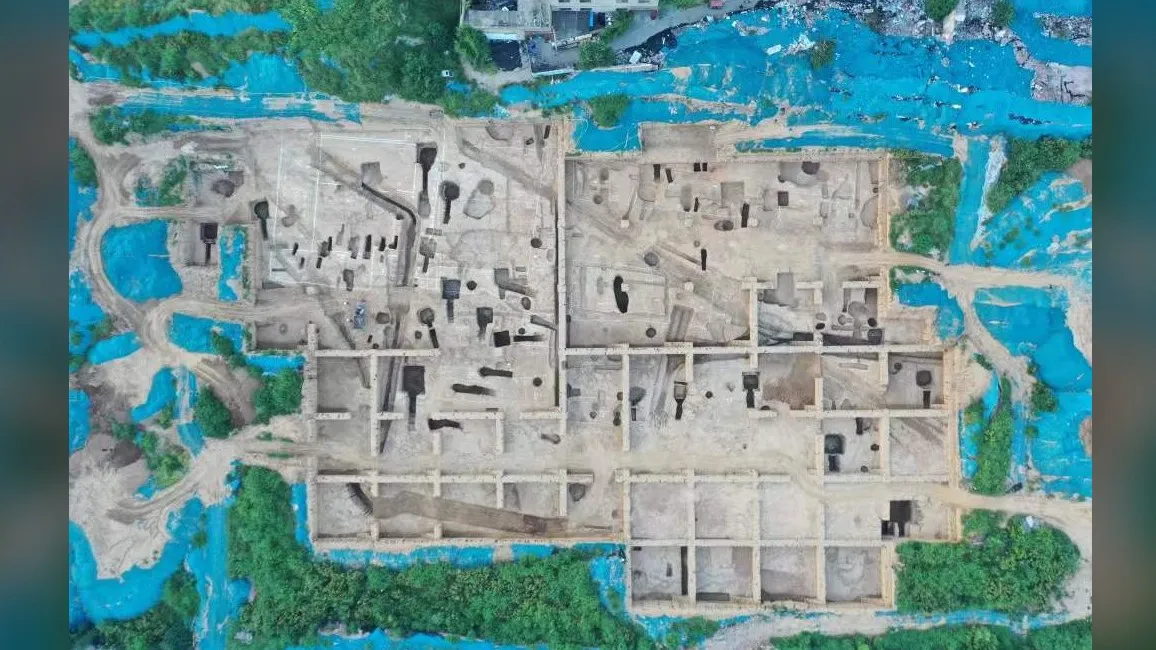
The 3,000-year-old tombs of a wealthy clan, including the remains of warriors and warhorses that seem to have been sacrificed at their funerals, have been unearthed in an ancient capital city of China.
The complex of 24 tombs was discovered at an archaeological site within the city of Anyang in Henan province, less than 2 miles (2.4 km) from the UNESCO World Heritage archaeological site of Yinxu at the city's center. The ruins there are from the ancient city of Yin, the capital of the Shang dynasty, which ruled between about 1600 B.C. to 1046 B.C. — the earliest dynasty ever recorded in China.
The newfound tomb complex includes several pits that hold war chariots, the remains of horses that drew them and the remains of warriors. Some of the warriors were wearing hats decorated with strings of shells when they died, while the foreheads of some of the horses were decorated with gold veneer and a bronze backing, according to a statement from the government's Xinhua news agency.
Related: 25 cultures that practiced human sacrifice
"This is very rare among the ancient discoveries of Anyang, reflecting the extraordinary status and power of the chariot owner," said Kong Deming, the director of the city's Institute of cultural relics and archaeology.
As a study at Penn State University notes, the practice of the "ritual suicide" of servants, or "volunteering" to be buried alive at the funerals of their high-status masters was common in Shang dynasty China.
Ancient clan
Archaeologists from Anyang have excavated the site for about two years. So far, they have found the foundations of 18 ancient buildings, as well as 24 tombs and burial pits for six chariots that also contain the remains of the sacrificed men and horses.
Get the world’s most fascinating discoveries delivered straight to your inbox.
Archaeologists think the ancient site was a major living center for a clan called "Ce." The Ce people seem to have been buried there as well, indicated by the finely-made bronze vessels inscribed with the Chinese character "Ce" (册 - Wiktionary) found in some of those tombs.
Kong said there was a record of a "Ce" clan in the oracle bone inscriptions found at Yingxu, which were written on turtle shells and animal bones and comprise the earliest known Chinese writings.


View Original
View Original
View Original
View Original
View Original
View Original
View Original
"The 'Ce' clan emblem appears on many of the bronzes found at the site, so we believe that the clan was active in this area," he said.
As well as the bronzeware, archaeologists also found other relics in the tombs including objects made from jade, stone, bone and shell. Many were lavishly decorated, which suggested the clan was wealthy.
Although grave robbers may have plundered one of the largest tombs, the other tombs contained relics that are diverse and relatively well-preserved, he said.
The archaeologists now hope to learn more about the social status of the clan, their division of labor and their relationship with the Shang royal family.
Shang dynasty
The archaeologists have found the foundations of several buildings, including steps and a decorative wall, which can provide clues to how Shang dynasty houses were built, Kong said.
Preliminary dating suggests the new finds at Anyang come from a late stage of the Shang dynasty, which was also known as the Yin dynasty after its ancient capital city.
In a separate find, several ancient tombs, houses, kilns and wells dating from the same period, as well as more than 170 artifacts made from bronze, pottery, jade and bone, were unearthed at a different archaeological site in Anyang last year, according to Xinhua.
RELATED CONTENT
The Shang dynasty ruled the middle and lower parts of China's Yellow River valley — a region widely considered the birthplace of Chinese civilization — until 1046 B.C., when it was overthrown by the Zhao dynasty, according to National Geographic.
Although traditional Chinese history mentions some earlier dynasties, the Shang dynasty is the first supported by archaeological evidence.
The earliest examples of Chinese writing date to the Shang period, but they are already of such sophistication and complexity that some archaeologists think the script was developed before that.
Originally published on Live Science.
Tom Metcalfe is a freelance journalist and regular Live Science contributor who is based in London in the United Kingdom. Tom writes mainly about science, space, archaeology, the Earth and the oceans. He has also written for the BBC, NBC News, National Geographic, Scientific American, Air & Space, and many others.