













Wolverine Seen in Colorado Is First Since 1919

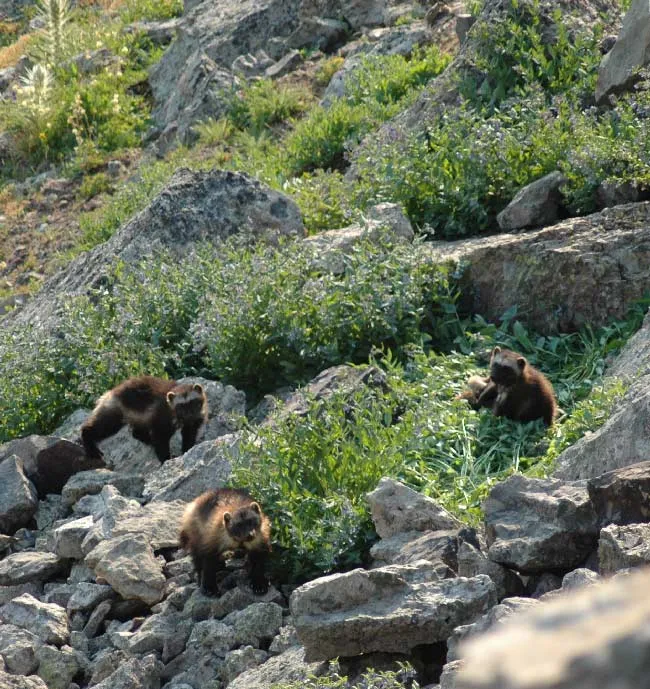
A wolverine that researchers have tracked since early April has crossed into northern Colorado, the first known incidence of a wolverine in the state for 90 years.
Wolverines are the largest land-dwelling members of the weasel family. Adult wolverines average about 30 pounds. Resident adults occupy arctic habitats in Alaska and Canada, and range south into the lower 48 states only high in mountains where near-arctic conditions exist.
The Colorado wolverine, a young male labeled M56, was captured near Grand Teton National Park and traveled approximately 500 miles during April and May, successfully navigating significant man-made features including Interstate 80, wildlife officials announced today.
Wildlife Conservation Society (WCS) researchers affixed a radio-tracking collar to the wolverine as part of an ongoing study to understand these wide-ranging little-known animals. A growing body of research is showing that wolverines need large areas to survive and that the young often disperse long distances between mountain ranges to find a territory and mates.
A wolverine's home range is often as large as a grizzly bear's, scientists explained in a statement. The size of a wolverine's territory, as much as 500 square miles for some adult males, limits the number of individuals that a given area can support. Adults tend to inhabit areas above timberline where there are snow-covered avalanche chutes and freezing temperatures much of the year.
"Wolverines are the real 'iron men' of the animal kingdom traveling seemingly non-stop in some of the most rugged country in North America," said Robert Inman, director of WCS's Yellowstone Wolverine Program. "It is great news that this animal has ventured into Colorado where it hasn't been documented in 90 years, but it also underscores the need to manage this species at a multi-state, landscape scale."
The wolverine was once native to the mountainous areas of Washington, Idaho, Montana, Wyoming, Utah, Colorado, and California. Records indicate that populations were nearly wiped out by about 1930, according to the WCS. Recovery has occurred to some degree during the previous 80 years. However, vast areas of suitable habitat on public lands in California, Utah and Colorado do not appear to have breeding populations at present.
Get the world’s most fascinating discoveries delivered straight to your inbox.
"This is certainly an interesting event and could give us some initial information on wolverines in Colorado," said Rick Kahn, Terrestrial Section Manager for the CDOW. "But the occurrence of a single animal needs to be treated as somewhat of an anomaly."
In 2008 and again in 2009, a lone male wolverine thought to be from a Rocky Mountain population was photographed by a remote-controlled camera in Tahoe National Forest of northern California.
"The single instances of male wolverines being documented in California during 2008 and now Colorado are encouraging," said Shawn Sartorius of the U.S. Fish and Wildlife Service. "But it remains to be seen if females can make similar movements that would be required to establish populations."
One thing is clear, biologists say: the dispersal of young wolverines from one mountain range to another where there are unrelated individuals is essential.
- Hilarious Video: The Bear Rub
- Top 10 Most Incredible Animal Journeys
- World's Ugliest Animals
