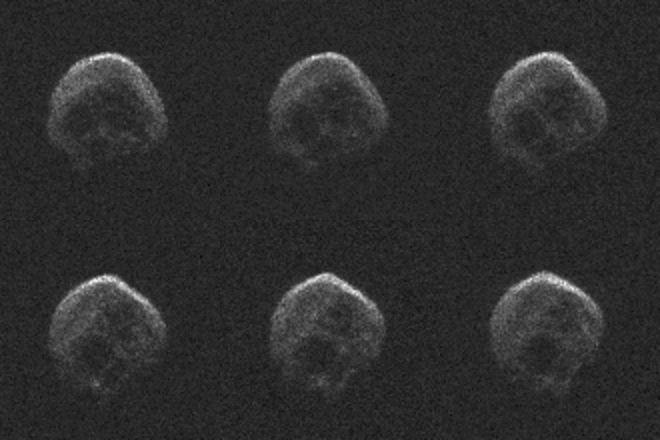
An artist's illustration of the "Halloween Asteroid" 2015 TB145, which looks much like a skull from certain angles. The asteroid flew harmlessly by Earth on Oct. 31, 2015 and will return in November 2018.
Astronomers will soon get another look at the big, ghoulishly weird space rock that buzzed Earth on Halloween three years ago.
The roughly 2,100-foot-wide (640 meters) Halloween asteroid 2015 TB145 gave Earth a close shave on Oct. 31, 2015, coming within just 300,000 miles (480,000 kilometers) of our planet. (For perspective, the moon orbits at an average distance of about 239,000 miles, or 384,600 km.)
Astronomers also determined that the asteroid likely completes one rotation every 2.94 hours and that it reflects just 5 or 6 percent of the sunlight that hits it.
This image of asteroid 2015 TB145 was generated using radar data collected by the National Science Foundation's Arecibo Observatory in Puerto Rico.
(Image credit: NAIC-Arecibo/NSF)
"This means that it is very dark, only slightly more reflective than charcoal," Pablo Santos-Sanz, an astrophysicist at the Institute of Astrophysics of Andalusia in Spain, said in a statement today (Dec. 20). He co-authored a study about 2015 TB145's characteristics that was published in February 2017 in the journal Astronomy & Astrophysics.
The asteroid may actually be an extinct comet that has lost its water and other volatile materials after many laps around the sun, researchers have said. Each of those laps takes 3.04 Earth years — which means 2015 TB145 will make another swing by our planet in mid-November 2018.
This next flyby won't be nearly as dramatic as the last one; the asteroid will zoom past at about 105 Earth-moon distances. But Santos-Sanz and other researchers are still looking forward to it.
Sign up for the Live Science daily newsletter now
Get the world’s most fascinating discoveries delivered straight to your inbox.
"Although this approach shall not be so favorable, we will be able to obtain new data which could help improve our knowledge of this mass and other similar masses that come close to our planet," Santos-Sanz said in the statement.
Michael was a science writer for the Idaho National Laboratory and has been an intern at Wired.com, The Salinas Californian newspaper, and the SLAC National Accelerator Laboratory. He has also worked as a herpetologist and wildlife biologist. He has a Ph.D. in evolutionary biology from the University of Sydney, Australia, a bachelor's degree from the University of Arizona, and a graduate certificate in science writing from the University of California, Santa Cruz.