Get the world’s most fascinating discoveries delivered straight to your inbox.
You are now subscribed
Your newsletter sign-up was successful
Want to add more newsletters?
Delivered Daily
Daily Newsletter
Sign up for the latest discoveries, groundbreaking research and fascinating breakthroughs that impact you and the wider world direct to your inbox.
Once a week
Life's Little Mysteries
Feed your curiosity with an exclusive mystery every week, solved with science and delivered direct to your inbox before it's seen anywhere else.
Once a week
How It Works
Sign up to our free science & technology newsletter for your weekly fix of fascinating articles, quick quizzes, amazing images, and more
Delivered daily
Space.com Newsletter
Breaking space news, the latest updates on rocket launches, skywatching events and more!
Once a month
Watch This Space
Sign up to our monthly entertainment newsletter to keep up with all our coverage of the latest sci-fi and space movies, tv shows, games and books.
Once a week
Night Sky This Week
Discover this week's must-see night sky events, moon phases, and stunning astrophotos. Sign up for our skywatching newsletter and explore the universe with us!
Join the club
Get full access to premium articles, exclusive features and a growing list of member rewards.
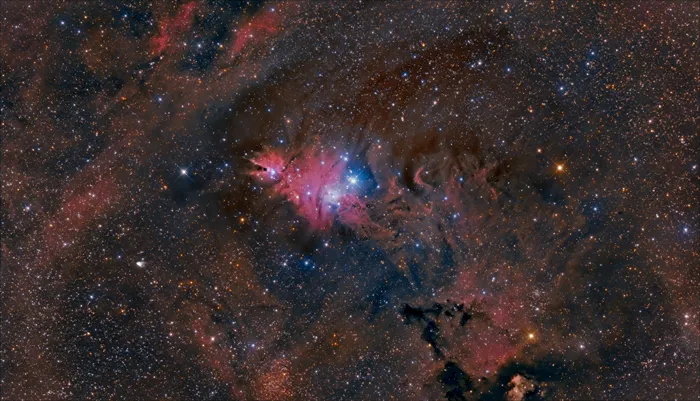
Two Michigan-based astrophotographers combined their skills to capture this brilliant image of the Cone Nebula, the Christmas Tree star cluster and the Fox Fur Nebula.
Avid night sky photographer Terry Hancock of DownUnder Observatory in Fremont, Mich., used a QHY11S monochrome CCD cooled camera, Takahashi Epsilon E-180 and Paramount GT-1100S German Equatorial Mount.
Robert Fields of Irving Observatory in Howell Township, Mich., used a STL 11000 monochrome CCD camera, Takahashi FSQ 106 APO Refractor and Takahashi NJP German Equatorial Mount. The image was sent to Space.com on April 11. [Amazing Night Sky Photos for April 2014]
The Cone Nebula (left of center), the Christmas Tree star cluster (the top of the tree is next to the Cone Nebula) and the Fox Fur Nebula (center) are located roughly 2,700 light-years in the constellation Monoceros. One light-year is the distance light travels in a single year, which is about 6 trillion miles (10 trillion kilometers).Hubble's Variable Nebula, or Caldwell 46, also appears toward the lower left of the image.
To see more amazing night sky photos submitted by Space.com readers, visit our astrophotography archive.
Editor's note: If you have an amazing night sky photo you'd like to share for a possible story or image gallery, please contact managing editor Tariq Malik at spacephotos@space.com.
Follow Space.com on Twitter @Spacedotcom. We're also on Facebook & Google+. Original article on Space.com.
Get the world’s most fascinating discoveries delivered straight to your inbox.