













How Birds Evolved From Small Meat-Eating Dinosaurs
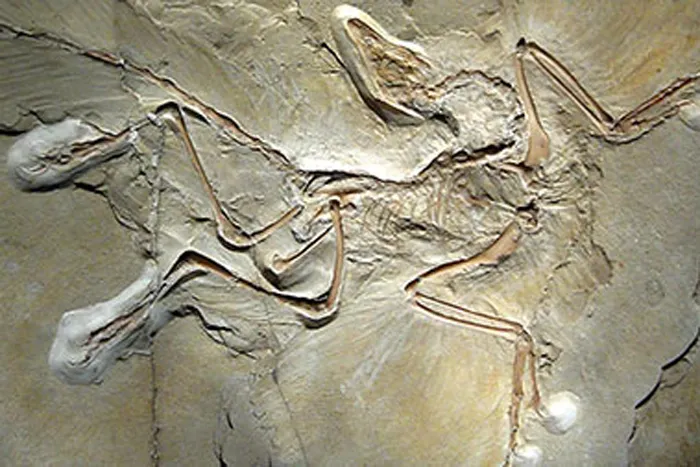
(ISNS) -- Some time, perhaps 150 million years ago, small-feathered dinosaurs called maniraptorans began to develop longer arms and shorter hind legs, kick- starting the evolutionary process to becoming the birds we see today.
All of today's 10,000 bird species, from the hummingbird to the condor, evolved from that simultaneous physiological change, posits a paper published in the journal Evolution by Hans Larsson, a macroevolution researcher at McGill in University's Redpath Museum in Montreal, and Alexander Dececchin, a graduate student now at the University of South Dakota in Vermillion. Their research was based on dozens of data sets from fossil records.
Before the transformation began, the relationship between the size of the maniraptorans' limbs and body had been steady through millions of years, they said. Not only that, the species were surviving just fine on the ground, not in trees, as earlier theories about maniraptorans suggested.
"There is really no anatomical support for them to be arboreal. The hind limbs' morphology is more similar to dogs and horses," Larsson said.
Their long legs helped them run fast, and their short arms probably evolved to help them collect food, according to Gregory Erickson, a paleobiologist at Florida State University in Tallahassee, who specializes in dinosaurs. They were mostly carnivorous.
So, how and why the creatures' bodies started to change is a good question, Larsson said. The maniraptorans had already developed feathers, but they were probably for display purposes or to help regulate temperatures rather than to aid flight.
But, the little dinosaurs probably didn't just start flying, of course.
Get the world’s most fascinating discoveries delivered straight to your inbox.
Some of the creatures had longer wings and maybe shorter legs than others and found they could run faster and be more maneuverable than others. From there, natural selection took over.
Gradually, the limbs of the maniraptorans changed in proportion to their bodies, Larsson said. Their bodies got smaller, their forearms larger, the rear limbs shorter.
What happened then? One possible -- if simplistic -- scenario is that one day, one of the creatures with longer arms, while leaping over a hole, or snapping at something to eat, or trying to avoid being eaten, spread its forearms, and left the ground for a second or two. He or she tried it again, maybe flapping the arms, and suddenly he or she was flying.
According to this possible scenario, the more the maniraptorans relied on the lift from their arms, the less they needed to put weight on their feet, so as the forearms transformed into wings, the hind limbs became smaller, reducing drag when the animals were airborne and giving the creatures more control over their flight. To this day, birds tuck their legs into their body when they fly. The shorter legs also let the creatures hold on to tree limbs and other objects off the ground, according to Erickson.
Eventually, they became quicker and more agile in the air than on the ground, which opened a completely new evolutionary niche, Larsson said. This, of course, happened over millions of years.
The change in limb size in relation to the body is called a "decoupling," and Larsson said the decoupling happened in the arms and legs simultaneously.
"Flight was a much more efficient way of capturing prey and avoiding predators," Larsson said.
They were not alone in the skies, however. Another group of dinosaurs, the pterosaurs, had already evolved to fly, maybe in the same way.
When the dinosaurs were wiped out in the great Cretaceous extinction about 66 million years ago, the creatures that flew survived, and the ones that flew best survived longest, Erickson said. This is why we have feathered birds not flying reptiles in our air. The ones evolving into birds were better at flying than their rivals.
Bats, which are mammals, probably evolved the same way, Erickson said.
"It's hard to reconstruct the capacity for flight," he said. To fully understand the process scientists would need to apply "forensic science to the fossil record" because scientists don't have samples of the muscles. Larsson's study, he said, was the best done so far, but it is still an educated guess.
"We'll never really know," Erickson said.
This story was provided by Inside Science News Service. Joel Shurkin is a freelance writer based in Baltimore. He is the author of nine books on science and the history of science, and has taught science journalism at Stanford University, UC Santa Cruz and the University of Alaska Fairbanks. He tweets at @shurkin.