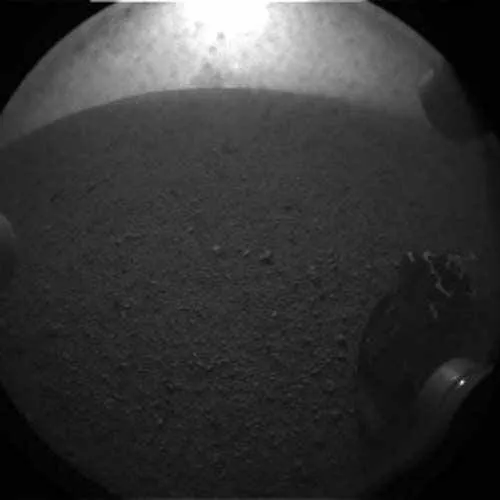
This photo shows one of the six wheels of NASA's huge rover Curiosity on Mars just after the rover's Aug. 5 PDT, 2012 landing in Gale Crater. This image is an enlarged version from the original 256-pixel image.
NASA's Mars rover Curiosity has beamed back an incredible image of its surroundings, showing a spectacularly clear view of the enormous mountain that it will clamber up in the next few years.
The photo — with one of the rover's wheels visible in the bottom left corner, the rover's shadow stretched out in front, and the huge Mount Sharp looming in the background — was released by NASA today (Aug. 6) in a news briefing from the agency's Jet Propulsion Laboratory in Pasadena, Calif.
The image was sent back to Earth less than 24 hours after Curiosity (also known as the Mars Science Laboratory, or MSL) touched down on the Red Planet late Sunday night (Aug. 5 PDT; Aug. 6 EDT and GMT).
The photo is a full-resolution image that was taken by one of the rover's Hazard Avoidance cameras, or Hazcams, said Joy Crisp, MSL deputy scientist at JPL.
Mount Sharp is a giant Martian peak that rises 3 miles (5 kilometers) from the center of Gale Crater. The mountain's many geological layers are particularly intriguing to mission scientists, as they could hold a record of how the Red Planet has changed over time.
In the newly released image, Mount Sharp is clearly visible in the background.
"It's taller than any mountain in the lower 48 states, [so it's] pretty spectacular," Crisp said. "What catches your eye are the dark dunes piled up along the base of Mount Sharp." [1st Photos of Mars by Curiosity Rover (Gallery)]
Sign up for the Live Science daily newsletter now
Get the world’s most fascinating discoveries delivered straight to your inbox.
The photo reveals that there are no major obstacles directly in front of Curiosity that could block its path to the mountain, Crisp added.
From the photo, Crisp and her colleagues were able to determine that Mount Sharp is located roughly 4 miles (6.5 kilometers) away from Curiosity. Mission controllers aim to eventually drive up part of the mountain to explore the layers of Martian rocks and soil.
This full-resolution version of one of the first images taken by a rear-left Hazard-Avoidance camera on NASA's Curiosity rover, was released on Aug. 6, 2012.The image was originally taken through the "fisheye" wide-angle lens, but has been "linearized" so that the horizon looks flat rather than curved. Part of the rim of Gale Crater can be seen from the top-middle to the top-right of the image, and one of the rover's wheels is pictured at the bottom right.
(Image credit: NASA/ JPL-Caltech)
A separate Hazcam photo, taken by a camera on the rover's rear-left side, was also released during today's news briefing. The photo captures the view behind Curiosity, looking at the horizon and the northwest rim of Gale Crater, which is located approximately 17 miles (28 km) away, Crisp said.
"We can see the wheel of the rover," she explained. "It's very flat with these pebbles — no obstacles for driving. We'll be able to drive front or rearwards."
In the coming days, scientists will continue to receive and analyze photos from Curiosity, including a series of images taken as the rover descended to the surface of Mars.
These images, from the rover's Mars Descent Imager (MARDI), provide insight into the rover's thrilling seven-minute journey through the Martian atmosphere. Early MARDI images show the spacecraft's heat shield falling away shortly before it touched down on the surface of the Red Planet.
Denise Chow was the assistant managing editor at Live Science before moving to NBC News as a science reporter, where she focuses on general science and climate change. Before joining the Live Science team in 2013, she spent two years as a staff writer for Space.com, writing about rocket launches and covering NASA's final three space shuttle missions. A Canadian transplant, Denise has a bachelor's degree from the University of Toronto, and a master's degree in journalism from New York University.