Why Time Seems to Slow Down in Emergencies

In The Matrix, the hero Neo could dodge bullets because time moved in slow motion for him during battles. Indeed, in the real world, people in danger often feel as if time slowed down for them.
This warping of time apparently does not result from the brain speeding up from adrenaline when in danger. Instead, this feeling seems to be an illusion, scientists now find.
To see if danger makes people experience time in slow motion, scientists at Baylor College of Medicine in Houston tried scaring volunteers. However, roller coasters and other frightening amusement park rides did not cause enough fear to make time warp.
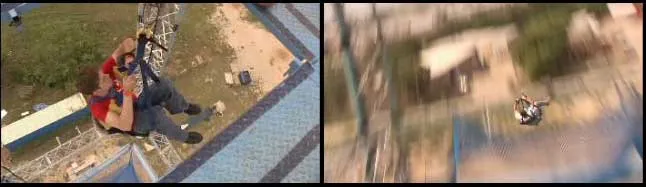
Instead, the researchers dropped volunteers from great heights. Scientists had volunteers dive backward with no ropes attached, into a special net that helped break their fall. They reached 70 mph during the roughly three-second, 150-foot drop.
"It's the scariest thing I have ever done," said researcher David Eagleman, a neuroscientist at Baylor College of Medicine. "I knew it was perfectly safe, and I also knew that it would be the perfect way to make people feel as though an event took much longer than it actually did."
Indeed, volunteers estimated their own fall lasted about a third longer than dives they saw other volunteers take.
To see if this meant people in danger could actually see and perceive more—like a video camera in slow motion can—Eagleman and his colleagues developed a device called a "perceptual chronometer" that was strapped onto volunteers' wrists. This watch-like device flickered numbers on its screen. The scientists could adjust the speed at which numbers appeared until they were too fast to see.
Get the world’s most fascinating discoveries delivered straight to your inbox.
If the brain sped up when in danger, the researchers theorized numbers on the perceptual chronometers would appear slow enough to read while volunteers fell. Instead, the scientists found that volunteers could not read the numbers at faster-than-normal speeds.
"We discovered that people are not like Neo in The Matrix, dodging bullets in slow-mo," Eagleman said.
Memory trick
Instead, such time warping seems to be a trick played by one's memory. When a person is scared, a brain area called the amygdala becomes more active, laying down an extra set of memories that go along with those normally taken care of by other parts of the brain.
"In this way, frightening events are associated with richer and denser memories," Eagleman explained. "And the more memory you have of an event, the longer you believe it took."
Eagleman added this illusion "is related to the phenomenon that time seems to speed up as you grow older. When you're a child, you lay down rich memories for all your experiences; when you're older, you've seen it all before and lay down fewer memories. Therefore, when a child looks back at the end of a summer, it seems to have lasted forever; adults think it zoomed by."
This work could help better understand disorders linked with timing, such as schizophrenia. Still, in the end, "it's really about understanding the virtual reality machinery that we're trapped in," Eagleman told LiveScience. "Our brain constructs this reality for us that, if we look closely, we can find all these strange illusions in. The fact that we're now seeing this with how we perceive time is new."
Eagleman and his colleagues detailed their findings online Dec. 11 in the journal PLoS ONE.
- Video: Eagleman's Wild Time Experiments
- Top 10 Mysteries of the Mind
- Time Travel: Is it Possible?