














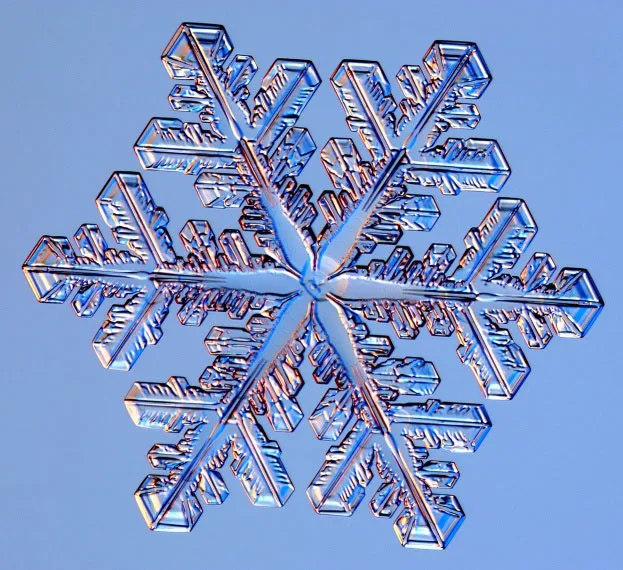
Windswept from cloud to cloud until they flutter to Earth, snowflakes assume a seemingly endless variety of shapes. Some have the perfect symmetry of a six-pointed star, some are hexagons adorned with hollow columns, whereas others resemble needles, prisms or the branches of a Christmas tree.
Scientists as far back as Johannes Kepler have pondered the mystery of snowflakes: Their formation requires subtle physics that to this day is not well understood. Even a small change in temperature or humidity can radically alter the shape and size of a snowflake, making it notoriously difficult to model these ice crystals on a computer. But after a flurry of attempts by several scientists, a team of mathematicians has for the first time succeeded in simulating a panoply of snowflake shapes using basic conservation laws, such as preserving the number of water molecules in the air.
Harald Garcke of the University of Regensburg in Germany and his colleagues, John Barrett and Robert Nürnberg of Imperial College London, described their findings in an article posted at the physics preprint server, arXiv.org, on February 15. In that sense, Garcke and his collaborators “have done the whole megillah,” says physicist and snowflake maven Ken Libbrecht of the California Institute of Technology. “They have solved a problem that other people have tried and failed to do.”
To model a growing snow crystal on the computer, researchers must accurately simulate how the crystal surface changes with time. The surface is usually approximated by a series of interlocking triangles, but the triangles often deform and collapse in simulations, leading to singularities that bring the simulation to an abrupt halt, Garcke says.
Garcke’s team got around this difficulty by devising a method to describe the curvature and other geometric information about the snowflake surface so that it could be appropriately encoded into a computer. In doing so, the team found a way of avoiding problems other researchers had encountered.
Moreover, they found a new way to model the two main types of snowflake growth simultaneously: faceted growth, in which flat plates, such as hexagons and triangles, dominate the process, and dendritic growth, in which the flakes form treelike branches that themselves beget branches, just as dendrites extend out from nerve cells.
Previous attempts to model snowflakes using a similar approach could not reproduce both growth characteristics. "Our team is the first to do both faceted and dendritic growth, using basic conservation laws and thermodynamics," Garcke says. With the model, Garcke and his colleagues found unexpected aspects of snowflake formation, such as the strong influence of bonds between surface molecules in the crystal. They also found that the speed at which the sharp tips of snowflakes grow is directly proportional to the amount of water vapor in the atmosphere.
Get the world’s most fascinating discoveries delivered straight to your inbox.
Crucially, the team’s approach is based on more realistic physics than past approaches. In their Physical Review E paper from 2009, mathematicians Janko Gravner of University of California, Davis, and David Griffeath of the University of Wisconsin–Madison approximated flake formation using a technique known as cellular automata. Although their work remains a milestone in successfully reproducing the intricate shapes, the method assumed that only neighboring molecules interacted—neglecting processes that occur over a continuum of distance scales.
The new work by Garcke and his collaborators, Griffeath says, opens an avenue to using powerful mathematical constructs called partial differential equations to study complex snowflake dynamics. Because the differential equations describing the geometry of an evolving snow crystal appear in a similar form in other applications, “we could use our approach for many other problems in which surfaces evolve in time,” Garcke notes. Using variations on their computer model, “we have already computed the shape of red blood cells, soap bubble clusters and the evolution of polycrystalline materials,” he says.
Despite the new advances in modeling snowflake growth, Libbrecht says, the fundamental mystery about snowflakes—how they form in the first place—is still far from solved. To understand how they grow, “we have to marry the mathematics with the physics, and that’s not been done, partly because we don’t know the right physics,” he says.
In a recent paper, Libbrecht, who spent a snowy childhood in North Dakota and has built a machine to make snowflakes in the laboratory, suggested that some of the missing physics may be related to a previously overlooked instability in the changing shape of ice crystals. Libbrecht has urged Garcke to incorporate the proposed instability, which transforms thick prismlike snow crystals into thin plates, in the team’s simulations. Garcke says he and his colleagues are now considering doing so, although he believes other effects may be more important.
Garcke notes that his university town of Regensburg has a special link to snowflake studies. Johannes Kepler, the 17th-century astronomer and mathematician who was the first researcher to write about snowflake formation, died there in 1630 during a brief visit to the city. As Garcke wrote in a recent e-mail about his team’s simulation, he had only to look out the window to contemplate the real thing. After a week of 10-degree Celsius weather, he said, snow had resumed falling.
This article was first published on Scientific American. © 2012 ScientificAmerican.com. All rights reserved. Follow Scientific American on Twitter @SciAm and @SciamBlogs. Visit ScientificAmerican.com for the latest in science, health and technology news.