'Invisibility Cloak' Hides 3-D Objects From Naked Eye

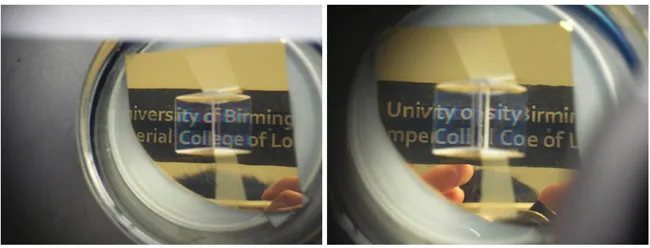
An "invisibility cloak" that's able to hide items thousands of times larger than before now exists, scientists say.
The first hints that cloaking devices might one day become more than just a "Star Trek" fantasy began emerging five or so years ago, and since then researchers have made such cloaks a reality by warping light.
Light is often bent in nature. For instance, mirages form when desert sands heat air that bends light rays from up above, creating illusions of water that are really reflections of the sky. The cloaking devices that scientists have created smoothly guide rays of light completely around objects so they proceed along their original trajectory as if nothing were there.
However, the first cloaking devices researchers made were useless against the human eye. To start with, they were only effective on microwave rays, not visible light. They also only worked in two dimensions, and thus could not hide three-dimensional objects.
In 2010, scientists created the first cloak that worked for three-dimensional objects against light nearly visible to humans. Still, the cloaked area was only 30 microns wide, or about one-third the width of a human hair.
Now researchers have developed a cloak that can hide three-dimensional objects against red and green lasers and ordinary white light. Although the cloaked region they demonstrated is only three-quarters of an inch (2 centimeters) wide, "there is actually no limit on the size of the cloak," researcher Shuang Zhang, a physicist at the University of Birmingham in England, told LiveScience.
All invisibility cloaks demonstrated until now were made of artificial composite structures known as metamaterials. The fabrication techniques for these metamaterials are complex and time-consuming, yielding only tiny cloaks that could only hide similarly tiny objects limited to only a few wavelengths of light in size.
Get the world’s most fascinating discoveries delivered straight to your inbox.
In contrast, this new cloak is made of prisms of naturally occurring calcite. These crystals are each about three-quarters of an inch wide on their longest sides, much larger than the parts seen in previous cloaks.
The scientists glued two of these prisms together, forming an arrowhead shape when seen from the side. The space, or bump, under the notch of this arrowhead and whatever is within is cloaked from view.
"The cloaks can be readily scaled up to hide larger objects," Zhang said. "It really depends on how large a calcite crystal we can find in nature. According to the literature, the largest calcite crystal has a scale of 7 meters by 7 meters by 2 meters (23 feet by 23 feet by 6.5 feet). Such a crystal would enable the construction of an invisibility cloak that can conceal object a few meters wide and at least 40 centimeters (16 inches) high."
This cloak does have a significant drawback — it depends on polarization of light. One can think of all light waves as either rippling up and down, left and right, or at any angle in between, a property known as polarization. This cloak only works for light of a specific polarization — "the bump will be seen by light of other polarizations," Zhang said.
Nevertheless, the cloak might still work in the real world, Zhang said. For instance, if the sun is low in the sky, sunlight streaming into the water "will be largely polarized, and an invisibility cloak sitting on the water floor will become invisible," he said. "There could be military applications — for example, to hide something such as submarine on the seafloor."
Also, while the bump at the bottom of the cloak is invisible, the cloak itself is still visible due to a slight reflection at the interface between the cloak and its surroundings. "This reflection can be significantly reduced by putting antireflection coating on the cloak or some other means," Zhang said.
"It is still challenging to make a 'Harry Potter' type of invisibility cloak that works in air and can hide very large objects," Zhang said. "Metamaterials could be a solution, but we will have a long way to go."
Zhang and his colleagues detailed their findings online Feb. 1 in the journal Nature Communications.