













Fiber Optics Could ‘Humanize’ Future Prosthetic Limbs

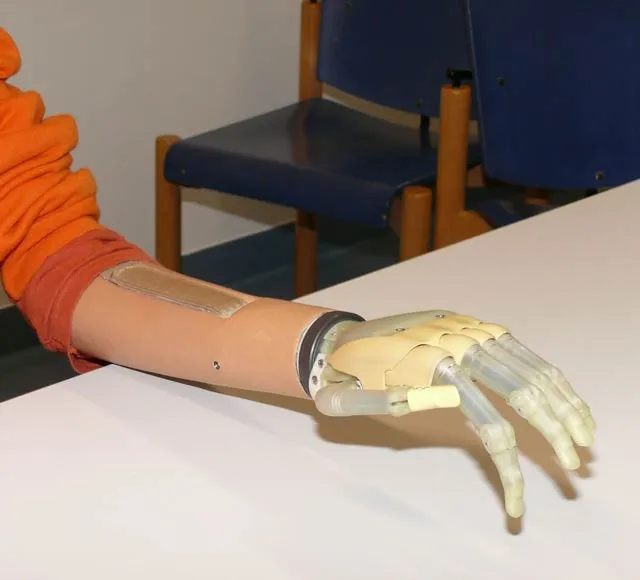
The latest prosthetic limbs are giving real flesh a run for its money, but connecting these high-tech appendages to the human nervous system has proved to be a challenge. Now, with $5.6 million in funding, researchers at the Neurophotonics Research Center plan to give amputees the ability to move their prosthetic legs, arms and hands in more natural ways.
The researchers hope to develop a type of fiber-optic interface – which uses light to carry information rather than wires – that would allow the nerves in the body and the artificial limb to communicate with one another – a must for humanlike movement.
“Advanced robotic arms for prosthetics exist,” said Marc Christensen, a professor at Southern Methodist University and director of the research center. “What we haven’t had is a good interface for them."
[Read also "Pet Prosthetics: Bionic Devices Let Injured Animals Roam Again."]
Current shortcomings
There are two types of interfaces available today. The first is electronic, and because it uses physical wires to connect nerve endings with, say, a robotic arm, it’s limited in the number of signals it can sense.
“You could conceive of a robotic arm that could move up and down and open and close its hand, [but] not too much more complexity than that,” Christensen said.
Get the world’s most fascinating discoveries delivered straight to your inbox.
The second type of interface allows for hundreds to thousands of signals. The problem with these is they don’t last much more than six months, Christensen said.
Christensen and his team expect to prove that their concept works in a lab setting within the next six months, and to begin human trials in the next five to 10 years.
To make their biological-robotic interface, the researchers will use fiber-optic cables attached to thousands of spherical sensors, each half the width of a human hair.
Here’s how they would work: When the brain tells the body to move the arm in a particular way, it fires nerves attached to arm muscles. For amputees, these nerves still fire but there is no connection between this firing nerve and the artificial limb. The sensors and fiber-optic cables would provide this connection.
When a nerve fires, the spherical sensors near that nerve would change shape, alerting the fiber- optic cable, which would then send a light signal to a computer chip. The computer chip would tell the robotic “muscle” what to do.
Beyond prosthetics
The system would require some programming so the correct nerve firing would signal the appropriate movement. Think of a video-game controller whose wires have been cut, Christensen said.
“If you knew which wire connected to what you could put it back together,” he told TechNewsDaily.
The cut wires are like the nerve endings and the Nintendo controller is the prosthetic limb. The setup process would basically map out the function of each nerve ending and feed this information to the computer chip responsible for converting the light signal into an instruction that the prosthetic limb could then follow.
The team thinks their research could be used beyond prosthetics.
“There’s potential here for a spinal cord injury,” Christensen said. “We could build a patch cord that [jumps] around the injury site so you’d sense all the signals traveling down the spinal cord above the injury and then re-create them just below the injury."
