













Scientists Create Tiniest-Ever Alphabet Soup

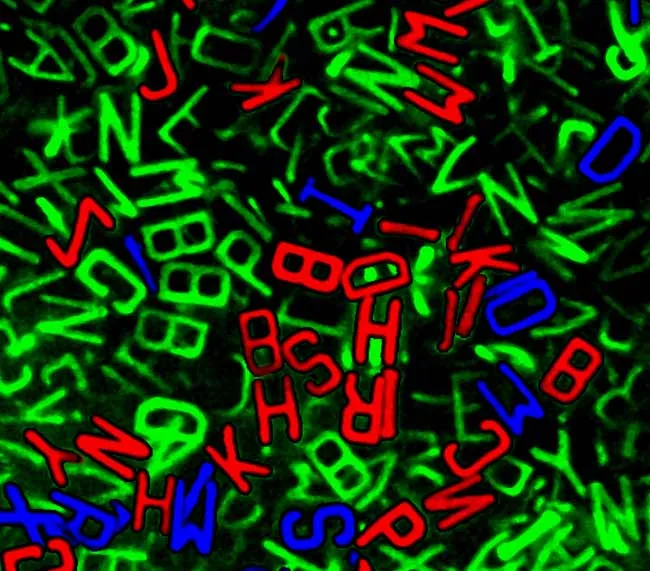
Scientists have created the tiniest-ever alphabet soup by designing and producing billions of microscale fluorescent particles in the shapes of the 26 letters, all in one font and suspended in a liquid.
The UCLA researchers said they can pick up the letters with lasers and reposition and reorient them in a microscale version of Scrabble. However, the game can only be seen with a microscope.
Each of the letters created by Carlos J. Hernandez is about the size of a fungus, mold or mushroom spore—more than 10 times smaller than the diameter of a typical human hair.
That puts the letters in the microscale range, but the method also works in the "nanoscale," 1,000 times smaller, said Hernandez, whose results are detailed on the Journal of Physical Chemistry C.
More than a geek party trick, the point was to show that chemists down the line could control and direct the assembly of miniscule components to make tiny pumps, engines, tags and motors that could have security and medical applications, such as identifying and eliminating cancer cells from the human body.
The letters, which Hernandez calls lithoparticles, are made of large molecules with lots of repeating structural units or elements, dispersed in a liquid. Each letter is precisely designed, and the entire alphabet is highly uniform in size. Under a microscope, the letters stand out in high fidelity.
Thomas G. Mason, Hernandez's colleague on the project at UCLA, said the objects can be assembled in lock-and-key relationships.
Get the world’s most fascinating discoveries delivered straight to your inbox.
"We can mass-produce complex parts having different controlled shapes at a scale much smaller than scientists have been able to produce previously," he said, in a prepared statement. "We have a high degree of control over the parts that we make and are on the verge of making functional devices in solution. We may later be able to configure the parts into more complex and useful assemblies."
The movement of the letters, as in a game of Scrabble, is achieved with what are known as laser tweezers. They work by focusing laser light to create a spot of very intense electric field, Mason said.
Particles can get sucked into this region of intense electric field and held there ("tweezed") if they wander near the spot.
"We moved a spot of red laser light relative to the microscope slide to grab and position the letters in order to spell UCLA," Mason told LiveScience.
- Image Gallery: Micromachines
- Video: Tiny Driver, The First Bacteria-Driven Motor
- Scientists Create Molecule-Size Keypad Lock

Robin Lloyd was a senior editor at Space.com and Live Science from 2007 to 2009. She holds a B.A. degree in sociology from Smith College and a Ph.D. and M.A. degree in sociology from the University of California at Santa Barbara. She is currently a freelance science writer based in New York City and a contributing editor at Scientific American, as well as an adjunct professor at New York University's Science, Health and Environmental Reporting Program.