













An Idea That Just Might Fly
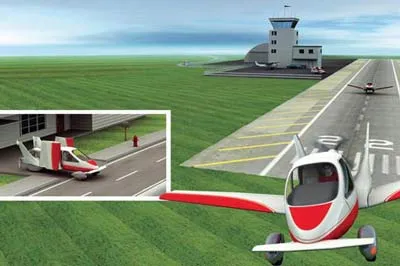
Even though you’ll park it in your garage, drive it to your nearest airstrip, and pilot it to your destination, don’t think of the Transition as a flying car. Carl Dietrich, the MIT aeronautical-engineering graduate student who is designing the vehicle, prefers the term “roadable aircraft”—meaning a plane that drives, not a car that flies.
“We try to steer away from The Jetsons,” Dietrich says. “It’s a step in that direction, but a baby step.”
Two hinges lock into place when the wings extend, securing the plane for takeoff. Images: John MacNeill
Still, in an age of hub-centric commercial flights, Dietrich thinks the ability to cruise between two of the 4,800 small airports nationwide and then drive to a final destination, whether your office or vacation home, will be irresistible to amateur pilots.
He and his team are finishing a one-fifth-scale model for wind-tunnel tests. They hope to build a prototype within two years and to have the first Transitions rolling down runways by 2010.
The projected price tag? About $150,000, roughly the price of a fully loaded Ford GT sports car.
Leaving home: A fender bender could ruin the aerodynamics of the plane, so the big challenge is to make the Transition both flight- and road-ready. In car mode, the tail folds up, revealing a bumper. The control surfaces of the twin vertical stabilizers fold inward, shielding the propeller from debris.
Driving: With only two seats and no trunk space, the Transition won’t be ideal for trips to Costco. But the 6.5-foot-high car will be able to reach highway speeds, Dietrich says, and could be refueled at any gas station that sells super-unleaded gas. Expected mileage on the road: a not-too-shabby 40 miles per gallon.
Get the world’s most fascinating discoveries delivered straight to your inbox.
Transformation: On the runway, a flip of a switch starts the metamorphosis. The tail folds down, the wings flatten and lock into place, and the control surfaces of the vertical stabilizers line up. A security system, such as a thumbprint scanner, will keep Junior from “taking off” with the car.
Flight: With an air-cruising speed of 120 miles an hour, the Transition will be able to fly 500 miles on a single tank of gas. Inside the cockpit, “it’s all conventional general- aviation controls,” Dietrich says, “so it should be familiar to pilots.” In bad weather, you could simply divert to the nearest airport and drive the rest of the way.