













First 'Telecloning' Experiment Works ... Sort Of
In science fiction, teleportation is not always perfect. Improperly maintained teleporters can result in "poor fidelity" during transmission—and a mess on the floor of the transporter room.
In one celebrated instance, the use of the teleporter even involved creating a copy.
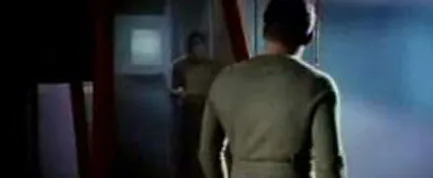
In the Star Trek episode "The Enemy Within," first broadcast in 1966, the transporter aboard the Enterprise malfunctions, creating a copy of Captain Kirk. The copy demonstrates less than 100 percent fidelity, however; it embodies only his most selfish and angry qualities.
The first experimental demonstration of quantum telecloning has just been accomplished by scientists at the University of Tokyo, the Japan Science and Technology Agency and the University of York. Telecloning is a combined achievement; it combines quantum teleportation with quantum cloning into a single step.
In ideal quantum teleportation, the original particle is destroyed and its exact properties are transmitted to a distant particle. In telecloning, the original is destroyed and its properties are sent to two distant particles with an accuracy of less than 100 percent. The Heisenberg principle limits cloning fidelity; researchers would otherwise be able to make enough clones to learn everything about the original particle.
In their telecloning experiment, researchers cloned a beam of laser light, transmitting its electric field amplitude and phase - but not its polarization - to two distant beams with 58 percent fidelity. The theoretical limit on the experiment was 66 percent.
This demonstration may cause problems in another field of application for quantum teleportation. Until now, quantum cryptography had offered a perfectly secure communication standard. Now, however, an enemy within your communication center might arrange to send a copy of the message to a distant eavesdropper.
Get the world’s most fascinating discoveries delivered straight to your inbox.
For more information, see Deterministic Quantum-State Teleportation Achieved With High Fidelity and Quantum Dot Switches.
Read the Physics News update and press release on telecloning.
(This Science Fiction in the News story used with permission from Technovelgy.com - where science meets fiction.)