















Secrets of Ancient Pompeii Households Revealed in Ruins

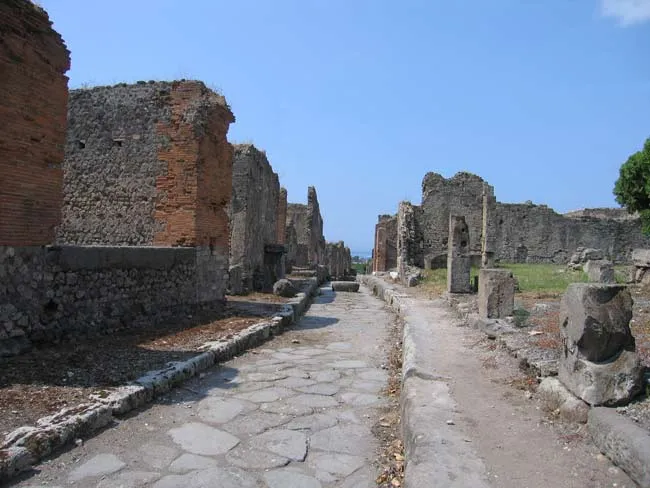
Residents of Pompeii ate their meals on the run, just like many Americans do today, according to a new archaeological study of how households functioned in the ancient Roman city buried by volcanic ash. Completely destroyed by the eruption of Mount Vesuvius in 79 A.D., Pompeii is one of the most famous archaeological sites in the world. Besides its risqué statues and frisky frescoes, however, few of its artifacts have been studied in depth. Excavating a neighborhood block that includes one of Pompeii's grandest mansions, scientists have recently shed a lot more light on the day-to-day tasks undertaken by its citizens. "I am looking at pots and pans and how houses actually functioned," said archaeologist Penelope Allison of the University of Leicester, in the United Kingdom. "I am interested in revealing the utilitarian side of life rather than its glamorous side, in slaves and servants and how they lived side by side with their masters." Allison's complete findings are published in a new book, "The Insula of the Menander at Pompeii Volume III" (Oxford University Press, 2007). Pompeii was destroyed quickly and thus preserved like a time capsule, so the Allison's findings may also carry over to other Roman towns from the same period, she said. A non-gadget world The ins and outs of domestic life—ranging from where food was cooked to who patched up cuts and scrapes—was the main focus of Allison's research. Though ancient Rome was an advanced society, it can't be assumed household units worked the same way they do today, she said. Even simple tools that were found, such cooking vessels, could be interpreted in a number of different ways. "Today we have hundreds of very specific gadgets," she said, "but in a non-gadget world you have a number of things used for a variety of purposes, such as pots that might have been wine dippers and spindle whorls that were used as furniture ornamentation." Jacks-of-all-Roman-trades People also filled a number of different roles when necessary, the findings suggest. When a child cut their knee, it didn't mean a trip to the local medical clinic, necessarily; Pompeii may have been a town full of "Dr. Moms". "We believe that whenever we find medical instruments, they belonged to doctors. But I think that a lot more high-level first aid went on within households," Allison said. "We have found surgical instruments in domestic contexts, and I think someone in the house was responsible for sewing up injured people." Weaving looms found in the homes also imply that women—or perhaps even men—did much of the sewing for their own families rather than purchasing clothes ready-made, she said. Ancient fast food? With all the sewing—of wounds and clothes—among other daily chores, busy residents of Pompeii probably had little time left for long, relaxing meals at the dinner table. There was an absence of formal dishware sets but an abundance of small grilling vessels (like barbecues) found in the residences studied, indicating that people were eating-and-running on the go, Allison said. Some things don't change.
Get the world’s most fascinating discoveries delivered straight to your inbox.
