















How the Gulf Oil Spill Containment Dome Will Work

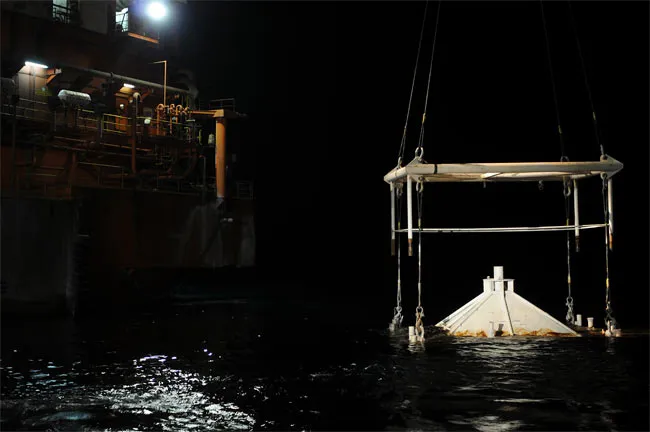
BP is taking extreme caution as they lower a containment dome about as tall as a four-story building to the bottom of the Gulf of Mexico today in an effort to stem the flow of oil still gushing from a damaged pipe after the Deepwater Horizon rig exploded and sank on April 22.
This is the first time an oil recovery system like this has been used in such deep waters. Though there are risks and uncertainties, if successful, the dome could collect 85 percent of the leaking oil, which is currently gushing out at a rate of 5,000 barrels a day.
"This has never been done in these sorts of depths at all before," BP spokesperson Jon Pack told LiveScience. "This is 5,000 feet. We're taking a lot of time to do it properly and to do it as safely as we can. The dome is currently on its way down, and it's about 500 feet [152 meters] from the seabed."
At least a few more hours will be needed before the dome hits the seafloor, Pack said in a telephone interview early Friday afternoon.
"Because you're aiming for a terribly tiny target, you really have to take that very slowly indeed," he said. "The operation of putting the dome in place has been likened to heart surgery."
The device weighs about 125 tons and measures 14 feet by 24 feet by 40 feet (4 meters by 7 meters by 12 meters). As for why it's dome-shaped, Pack said curves are always stronger than straight edges, meaning a curved container will do better at keeping all that oil trapped. [Graphic: Putting the Dome in Place]
How it will work
Get the world’s most fascinating discoveries delivered straight to your inbox.
Once lowered, remotely operated vehicles (ROVs) will carefully position the dome over the end of a pipe (also called the riser) where the source of the largest leak is occurring and which is about 600 feet (183 meters) from the well head. There are several slots on the sides of the dome with sliding doors so the dome can be clamped around the broken riser. The dome will actually go into the seabed.
The ROVs are equipped with powerful lights and cameras, as well as the robotic arms they'll use to do the positioning. Images of the process will be transmitted to computers onboard the ship, so officials can monitor what's going on.
The goal is to create a seal between the seabed and the dome, which can be tricky.
"As you can imagine, the seabed floor is not flat," John Curry, BP's Director of External Affairs, said in a telephone interview. "The ROVs have to do whatever they can to prepare the floor so we can get the dome in place," which includes sweeping the area of debris and other objects that could interfere with the massive dome's placement.
Then, a 5,000-foot (1,524 meters) riser will be connected to the top of the containment dome, and that riser will go up to the Deepwater Enterprise.
Once sealed to the seabed, it will take a couple of days to get everything hooked up, Pack said. Then, it will take time to "get the balance of liquids right." That's because as the oil flows out of the ground and travels higher up the pipe, gases that are beginning to come out of solution can form hydrates. These hydrates are like ice crystals and can reduce the internal diameter of the pipe and so block it (like plaques blocking an artery). In order to prevent the formation of hydrates, warm seawater is being pumped down in the space between the drill pipe (where the oil is flowing to the ship) and the outer pipe.
When the collection process gets going, oil will fill up the dome and then under its own pressure, it will flow up the riser and be collected on the ship, where it will the oil will be separated from the water and gas and temporarily stored before being transferred back to shore.
Risks involved
Because this method of containment has never been tried at such depths, there are real risks. BP has to rely on ROVs to ensure that the dome is correctly lowered over the end of the riser pipe, where the vast majority of oil is spewing.
"They are our eyes, arms and legs down there," Curry said. "We have to make sure we lower it in the right place, and the ROVs are helping us do whatever we can to enhance our chances of success."
Previously, collection domes were used in the Gulf of Mexico after Hurricane Katrina in 2005, but only at depths of less than 1,200 feet (366 meters).
"My understanding is that they were successful at those depths," Curry said. "Obviously they were successful enough that we thought it was a viable idea at 5,000 feet."
Permanent solution?
The containment dome is not a permanent solution, as it doesn't stem the flow of oil but rather enables cleanup crews to collect it onshore.
Meanwhile, BP has started drilling a relief well, which will take an estimated 90 days to complete. The relief well could be a long-term solution, Curry said, since it would actually keep more oil from gushing out of the ground.
ROVs have also been deployed to try to activate the blowout preventer, which is a large valve at the top of the well that can prevent more oil from leaking. So far they haven't been able to activate this shut-off valve.
If either or both of these techniques work, the dome will have a shorter stay on the Gulf seabed. If not, it'll be there longer.
"Once it's down there it will stay there as long as it needs to be there," Pack said.
In addition, BP officials are investigating what is called "top kill," in which very heavy fluid is put through the current blowout preventer, acting like a blanket to prevent the oil from the well from rising to the surface.
Cleanup crews have been able to cut off one of the three leaks by capping the drill pipe and placing a valve over the end to shut off the flow. While the drill pipe was not a significant source of leaking oil, it represents a small victory for a cleanup operation that has encountered a great deal of adversity.
To contain the third leak, BP has another collection dome being built, but the timeline for its completion and deployment is still uncertain, Curry said.
BP is hopeful that the containment domes will collect and contain a significant amount of the leaking oil, but are still simultaneously employing other oil cleanup methods, such as applying dispersant directly at the source of the leak and skimming the water's surface.
"We can't guarantee this is going to work because it has never been tried before," Curry said. "We've done the best we can, and if this doesn't work, we'll continue to try other methods."
- Top 10 Worst Oil Spills
- Images: SOS! Major Oil Disasters at Sea
- 7 Surprising Uses of Oil
Jeanna Bryner is managing editor of Scientific American. Previously she was editor in chief of Live Science and, prior to that, an editor at Scholastic's Science World magazine. Bryner has an English degree from Salisbury University, a master's degree in biogeochemistry and environmental sciences from the University of Maryland and a graduate science journalism degree from New York University. She has worked as a biologist in Florida, where she monitored wetlands and did field surveys for endangered species, including the gorgeous Florida Scrub Jay. She also received an ocean sciences journalism fellowship from the Woods Hole Oceanographic Institution. She is a firm believer that science is for everyone and that just about everything can be viewed through the lens of science.