













WikiLeaks Secrets: Is Gossip Good?

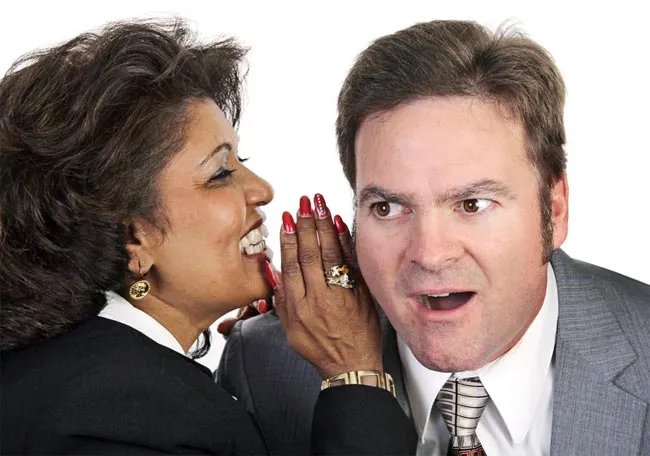
The latest WikiLeaks document dump made public thousands of U.S. embassy cables, revealing decades of behind-the-scenes diplomatic chatter. But it turns out diplomats aren't so diplomatic in their off-hours: Between references to North Korean leader Kim Jong-Il's flab and Italian Prime Minister Silvio Berlusconi's "wild parties," the cables described Kazakhstan's prime minister's animated disco-dancing and dished about the "voluptuous" Ukrainian nurse who apparently accompanies Libyan President Muammar Gaddafi everywhere.
If these assessments seem more high school than high diplomacy, it's no surprise. Research has shown that gossip is rampant among close-knit groups, from junior-high students to State Department diplomats. And while some types of gossip can be destructive, social scientists argue that talking about others can help us deal with important social information.
"Groups, much against the prevailing view of them, do have a quest to squeeze the truth out of things," Charles Walker, a psychologist at St. Bonaventure University in New York, told LiveScience. "It's kind of informal news-making… People don't just try to titillate one another."
The gossip that binds
Although it's often frowned upon, gossip is rarely false, Walker said. Nor is it always malicious. Walker's studies have found that less than 10 percent of gossip out there is deliberately false "scandal gossip." The rest is usually an attempt to get at the truth and sort out social norms in the group, he said. (In contrast, Walker said, rumors are usually false and often deal with broad, uncontrollable fears.)
Some researchers have argued that the tendency toward jawing about our neighbors is rooted in our evolutionary past. In his book "Grooming, Gossip, and the Evolution of Language," (Harvard University Press, 1998), Oxford anthropologist Robin Dunbar argues that gossip and language evolved as primate groups got too large to bond by grooming. In other words, instead of picking lice off each other, humans buy "US Weekly."
That's not to say gossip is all sunshine and bonding (though Walker noted there is a subcategory of gossip, called "veneration gossip," devoted entirely to saying nice things about people). When people don't feel that anyone is keeping track of their words, they're more likely to engage in negative gossip, Walker has found. The highest levels of negative gossip top out around 60 percent to 70 percent of all gossip, he said. People become more positive when asked to write their gossip down or to say it into a tape recorder.
Get the world’s most fascinating discoveries delivered straight to your inbox.
Checks and balances
Either way, though, it's the negative stuff that seems to spread. In one study, Walker played the role of rumormonger, releasing two false stories on his university campus. One story was a positive "wish rumor" — the kind of story people wish were true. In this case, it was that more university restaurants would be accepting student ID cards as payment. The second story was a negative "dread rumor" about higher penalties for breaking dorm visitation rules.
A few weeks after releasing the rumors to two equivalently sized groups, Walker and his team called up students they knew hadn't heard the stories firsthand. The question they hoped to answer: Which rumor would spread the fastest and reach the most ears? The answer: Bad news really does travel faster than good.
"This is part of a well-known phenomenon in psychology," Walker said. "For some reason, bad is worse than good is good. Bad is more powerful."
But even negative gossip isn't always a bad thing, Walker said, as long as it's true.
"Bill Clinton did, in fact, have sexual relationships with Monica Lewinsky, and just by talking about it, you are not harming Bill Clinton," Walker said. "The group has to digest something like this… People have a right to talk."
Contrary to childhood games of "Telephone" (where a phrase or piece of gossip is passed from person to person), gossip actually gets closer to the truth as it spreads, Walker said. Unlike Telephone, the world is full of checks and balances.
"Because of those checks and balances, there does tend to be a purification process that hearsay goes through," Walker said. "Falsehoods in it tend to get dropped out, and the truth of it tends to be more concentrated."
Wikileaks = Facebook?
For the subjects of the Wikileaks gossip, the chatter will likely have "rather minimal long-term effects," said Gary Alan Fine, a sociologist at Northwestern University in Illinois and author of "The Global Grapevine: Why Rumors of Terrorism, Immigration and Trade Matter" (Oxford University Press, 2010). Fine, who has studied historical reputation-building, said the dish would likely be used by those in politics to try to shape reputations. However, he said, most people don't much care "what the foreign minister of Turkey is doing in his spare time."
(Fine chose that position as an arbitrary example, but Turkish Foreign Minister Ahmet Davutoglu did in fact make an appearance in the leaked documents. One memo called him "exceptionally dangerous.")
The leaks will likely be more salient for those in the diplomatic community, Fine said, because "gossip only matters when you know someone either personally or by reputation." The officials in the documents may not have known how much surveillance of their personal lives was going on in diplomatic circles, Fine said, but they certainly knew they were being discussed.
"It's like high school," Fine said. "Everyone knows that everyone is talking about each other, and that's okay. But if that talk suddenly gets put on Facebook, then people have to deal with the reality of the talk they always knew existed."
- Understanding the 10 Most Destructive Human Behaviors
- Top 10 Things That Make Humans Special
- The Most Powerful Modern Women Leaders
You can follow LiveScience Senior Writer Stephanie Pappas on Twitter @sipappas.

Stephanie Pappas is a contributing writer for Live Science, covering topics ranging from geoscience to archaeology to the human brain and behavior. She was previously a senior writer for Live Science but is now a freelancer based in Denver, Colorado, and regularly contributes to Scientific American and The Monitor, the monthly magazine of the American Psychological Association. Stephanie received a bachelor's degree in psychology from the University of South Carolina and a graduate certificate in science communication from the University of California, Santa Cruz.