













Cannibalism Rife in Mormon Cricket Swarms
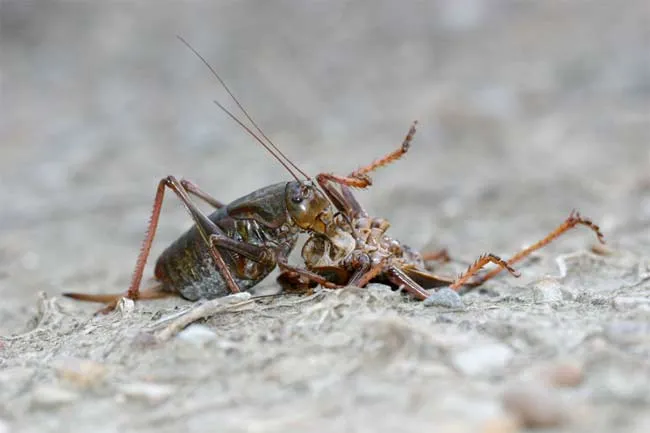
Every year, millions of Mormon crickets swarm in a frenzied search for food. Turns out the dinner plate is often heaped with their slower brethren.
Mormon crickets aren't actually crickets, but shield-backed katydids, a type of insect more closely related to grasshoppers. However, when Mormon settlers moved into Utah in the mid 1800's, these crop pests became known as Mormon crickets, and the name has stuck ever since.
Although scientists don't fully understand the mechanism that organizes and coordinates when and where the swarm moves, they have figured out why.
Each migration is typically associated with an actual or anticipated food shortage and a population increase.
On the menu
During one such migration across the Curlew National Grasslands of southern Idaho, researchers plucked a few study participants from the half-mile long swarm to see just what they were hungry for. The insects were deficient in both protein and salt, and snacked on food items rich in these nutrients.
The menu included seed pods, flowers, dead animals, mammal feces, and soil soaked in cattle urine.
Get the world’s most fascinating discoveries delivered straight to your inbox.
Sometimes after shedding their outgrown exoskeleton, they eat that too. But some hungry crickets can't wait for the exoskeleton to fall off, and simply devour the guy molting next to them.
"The insects themselves provided a major source of these nutrients, and cannibalism was rife," the researchers write in the Feb. 26 early edition of the Proceedings of the National Academy of Sciences.
How to doom a cricket
The scientists intentionally hindered the mobility of some crickets and found that these slowpokes were the most likely to be eaten. Freshly dead crickets are also a favorite meal.
However, feeding the crickets a steady diet of proteins and salts curbed their cannibalism. Furthermore, protein-satiated crickets were no longer compelled to march.
Running from the swarm is no solution. A study last year revealed that crickets that stray are more likely to be eaten by predators.
Cannibalistic crickets can even be dangerous to humans. Swarms sometimes cross roads, and as these crickets avidly feast on one another, slick driving conditions can develop, experts say.