















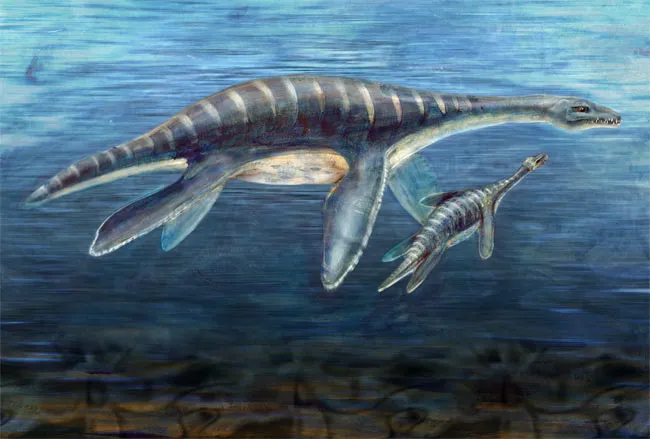
Ancient sea monsters had more than just sharp teeth and fearsome size on their side. They were able to chase down prey thanks to an even, warm body temperature that kept their muscles humming even in cold water, a new study finds.
Researchers analyzed fossilized teeth of three groups of reptiles that lived from 251 million to 65 million years ago in the Mesozoic era. The chemical makeup of the teeth differed subtly from those of cold-blooded fishes that lived during the same times and places, suggesting the reptiles retained heat like modern tuna and some species of shark (and unlike today’s crocodiles and alligators).
"The only way to maintain a constant and high body temperature is that the animal is able to produce internal heat by its organs," said study researcher Christophe Lecuyer of the University of Lyon in France. "It was probably very useful for them to dive in deep waters to track prey and also to have access to environments where normal reptiles cannot go."
The finding helps explain why these large reptiles – dolphin-shaped icthyosarus, sea lion-like plesiosaurs and elongated mosasaurs – were such successful predators, snapping up fish, mollusks and smaller reptiles. By maintaining a relatively warm body temperature, the biochemical reactions powering their muscles would have operated more efficiently.
Although the exact temperature of the animals is up for debate, Lecuyer and his colleagues peg them at between 95 degrees Fahrenheit (35 degrees Celsius) and 102 degrees F (39 degrees C), or in the range of modern dolphins and whales.
Researchers had already judged that icthyosaurs and plesiosaurs must have had a high metabolic rate because they have the body structure of "cruisers," swimming the ocean for food like sharks. Mosasaurs are thought to have been ambush predators, lying in wait for prey, which would have required less of an ability to regulate heat. The microscopic structure of the reptiles' bones also suggested they were different from typical reptiles.
In the new study, Lecuyer and his colleagues measured the ratio of two oxygen isotopes (oxygen atoms with different numbers of neutrons) in fossilized tooth enamel. In fish, the lower the temperature of the water they grew in, the less of the lighter oxygen-16 isotope in their teeth and the more oxygen-18 is present. By taking fish from different latitudes, the researchers could reconstruct the temperature of the waters they grew in.
Get the world’s most fascinating discoveries delivered straight to your inbox.
If the reptiles were cold-blooded, their teeth should have shown a similar pattern with water temperature, sine their bodies essentially take on the temperature of the surroundings. Instead the ratio of oxygen isotopes for icthyosaurs and plesiosaurs was largely the same regardless of latitude.
The new result "suggests that icthyosaurs and plesiosaurs could maintain a constant body temperature just like in tunas," said paleontologist Ryosuke Motani of the University of California, Davis, who wrote a commentary published alongside the study in the journal Science. "[It] backs up the suspicion we had from before," he said. "Both of them were supposed to be cruisers."
To maintain body temperature, the reptiles might have had blubber or specialized circulatory systems, Motani writes.
The isotope ratios for mosasaurs were slightly closer to those of fish, suggesting their body temperatures were influenced somewhat by the water temperature around them, meaning they could actually get hotter than icthyosaurs and plesiosaurs depending on the water temperature. Motani said such an intermediate state makes sense for an ambush predator that didn't have to swim as much.
Motani said the researchers might have overestimated the temperatures of the reptiles. He said that some ancient fossils are known to lose oxygen-18 over time, for unknown reasons. Correcting for this potential loss, he estimates temperatures of around 75 degrees F (24 degrees C) for icthyosaurs and plesiosaurs, or roughly the temperature of living tuna, and up to 97 degrees F (36 degrees C) for mosasaurs.
- Dangers in the Deep: 10 Scariest Sea Creatures
- Top 10 Beasts and Dragons: How Reality Made Myth
- 25 Amazing Ancient Beasts