













Ancient Oversized Armadillo-Like Species Discovered
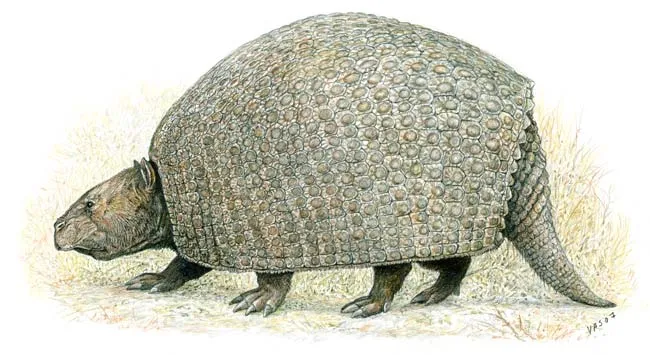
A partial skeleton discovered high in the Andes in northern Chile represents a new species of an armadillo-like mammal that lived 18 million years ago.
The specimen was collected in 2004, but only after examining the fossil and comparing it with other similar species did scientists identify it as a new species. "When we collected this fossil, we had no idea that it would turn out to be a new species," said lead researcher Darin Croft of Case Western Reserve University in Ohio. "We knew that it would be an important specimen, given its completeness, but it was only after careful comparison to other known species that we realized how unusual it was."
The new species, named Parapropalaehoplophorus septentrionalis, belongs to a group of now-extinct mammals called glyptodonts that are most closely related to modern armadillos.
Unlike armadillos, which sport some jointed, movable plates, glyptodonts were armored with mostly immovable plates. And while P. septentrionalis weighed about 200 pounds (90 kilograms), some of the largest members of the group tipped the scales at 4,000 pounds (1,814 kilograms).
The finding, detailed in the December issue of the Journal of Vertebrate Paleontology, adds another name to the so-called Chucal Fauna, a group of about 18 mammal species discovered in Chile's Salar de Surire region.
Studies of this and other Chucal mammals, including marsupials and rodents, along with plant fossils, suggest northern Chile was open grassland with relatively few trees when P. septentrionalis lived, the researchers say. At the time, the Andes region was 3,000 feet (914 meters) above sea level, just one-fourth the mountain range's current height.
"Our sites are now located more than 14,500 feet above sea level, but when these animals were alive the region was at much lower elevations," said co-author John Flynn, a paleontologist of the American Museum of Natural History in New York. "That means that the Chucal fossils give us a unique insight into the timing and rate of uplift of the high Andes."
Get the world’s most fascinating discoveries delivered straight to your inbox.
- Top 10 Amazing Animal Abilities
- Image Gallery: Creatures of the Wild
- 10 Amazing Things You Didn't Know About Animals
Jeanna Bryner is managing editor of Scientific American. Previously she was editor in chief of Live Science and, prior to that, an editor at Scholastic's Science World magazine. Bryner has an English degree from Salisbury University, a master's degree in biogeochemistry and environmental sciences from the University of Maryland and a graduate science journalism degree from New York University. She has worked as a biologist in Florida, where she monitored wetlands and did field surveys for endangered species, including the gorgeous Florida Scrub Jay. She also received an ocean sciences journalism fellowship from the Woods Hole Oceanographic Institution. She is a firm believer that science is for everyone and that just about everything can be viewed through the lens of science.