













Tomorrow's Robots Could Have Whiskers
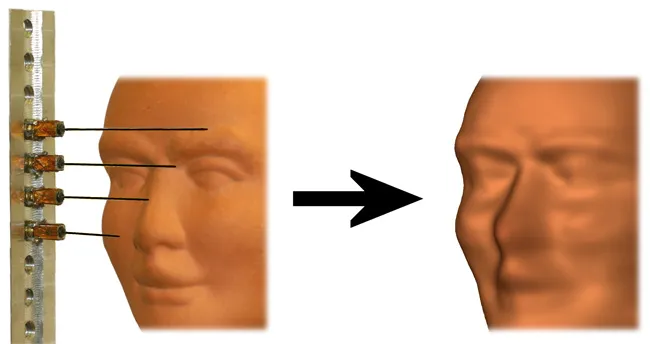
Taking tips from both land and sea animals, researchers have crafted arrays of robotic whiskers that can create accurate, 3D images of objects [image / video].
The tactile devices could be used to enhance the vision and maneuverability of land-based robots, autonomous underwater vehicles and perhaps robots on Mars.
"Whiskers on planetary rovers might be able to figure out topography and surface texture of the ground, and that's important to know if a rover is about to get caught in sand," said co-researcher Mitra Hartmann of Northwestern University in Evanston, Illinois.
Animal sense
Rats rely on whiskers to determine everything from the shape and texture of nearby predators to the relative size of an underground burrow. Also called vibrissae, the long hairs dot their cheeks in a square-grid pattern [photo].
A rat constantly whisks these hairs backward and forward, about seven or eight times per second, hitting objects that bend the whiskers to various degrees [illustration]. By whisker-tapping an object several times at different places, the rat can put together a 3D image in its brain.
Seals sport much larger whiskers, and instead of using a whisking motion they rely on the water pushing against each hair. The seal's bending whiskers help the animal determine direction of water flow or whether a juicy fish just swam by.
Get the world’s most fascinating discoveries delivered straight to your inbox.
Robot whiskers
Whiskers of both these creatures lack any sensors along their lengths, so the scientists wondered how the animals decipher where along each whisker an object has brushed.
Using computer simulations and a lab experiment, Hartmann and Joseph Solomon, also of Northwestern University, discovered the animals can calculate how the twisting, or torque force at the base of each whisker changes. If that force increases, it signals the object is close to the whisker base.
So they constructed rat whiskers out of spring-steel wires and seal whiskers from thick plastic strips and equipped each with a gauge at its base to measure torque. Tests of the robotic hairs churned out nearly dead-on images of an object.
"That's the third dimension that's been mysterious for almost a century now," Hartmann told LiveScience.
- Images: Cutting-Edge Robots
- Roach Robot Feels Its Way Around
- The Top 10 Animal Senses Humans Don't Have
- Eek! Robo-Rats Make Their Own Rules
- Robot Mouse Has Real Whiskers
Jeanna Bryner is managing editor of Scientific American. Previously she was editor in chief of Live Science and, prior to that, an editor at Scholastic's Science World magazine. Bryner has an English degree from Salisbury University, a master's degree in biogeochemistry and environmental sciences from the University of Maryland and a graduate science journalism degree from New York University. She has worked as a biologist in Florida, where she monitored wetlands and did field surveys for endangered species, including the gorgeous Florida Scrub Jay. She also received an ocean sciences journalism fellowship from the Woods Hole Oceanographic Institution. She is a firm believer that science is for everyone and that just about everything can be viewed through the lens of science.