













Roach Robot Feels Its Way Around

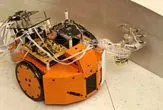
As if the world needs more roaches, engineers are now building a robotic version.
Most robotic vehicles sent into dangerous situations rely on cameras or sonar to navigate. Neither method works every time. The new mechanical creature uses a wiggly cockroach-like antenna to feel its way around, mimicking the behavior of the bug.
Noah Cowan, an assistant professor of mechanical engineering at Johns Hopkins University, drew inspiration from real roaches, which move deftly through dark rooms with varied surfaces. The key, Cowan said, is the cockroach's antennae, which alert them to obstacles by touch.
The robotic roach. Credit: JHU/Will Kirk
Undergraduate student Owen Loh has built on Cowan's earlier work, developing a complex antenna that can allow a machine to scurry along walls, turn corners, and avoid obstacles.
Engineers seem to have a thing with creepy crawlers. A similar robotic mouse, unveiled last month, uses sensors to navigate rooms.
The antenna is made of cast urethane, a flexible rubber-like substance, encased in a clear plastic sheath. Embedded in the urethane are six strain gages, sensors that change resistance as they are bent.
"We've calibrated the antenna so that certain voltages correspond to certain bending angles that occur as the antenna touches the wall or some other object," Loh said.
Get the world’s most fascinating discoveries delivered straight to your inbox.
This data is fed to a robotic controller, enabling the machine to sense its position in relation to the wall and to maneuver around obstacles. Another cool thing: To disable this roach, all you have to do is remove the battery.
