The vast underwater wilderness of the deep sea may be largely unexplored by humans, but it's still incredibly polluted, a new study finds.
Researchers made the finding by using baited traps to capture tiny crustaceans in the Mariana Trench in the western Pacific Ocean — the deepest known spot on Earth — and the Kermadec Trench, which sits off the northeastern coast of New Zealand.
Surprisingly, pollution concentrations in the crustaceans plucked from the Mariana Trench were 50 times higher than those in crabs found in paddy fields fed by the Liaohe River, one of the most polluted rivers in China, the researchers wrote in the study. [In Photos: World's Most Polluted Places]
"The only Northwest Pacific [Ocean] location with values comparable to the Mariana Trench is Suruga Bay (Japan), a highly industrialized area," the researchers wrote in the study.
Humans know more about the surface of the moon than they do about the ocean floor. To learn more, the scientific team studied the hadal zone, "the last major marine ecological frontier," which encompasses the area 3.7 miles to 6.8 miles (6 kilometers to 11 km) under the water's surface, the researchers said.
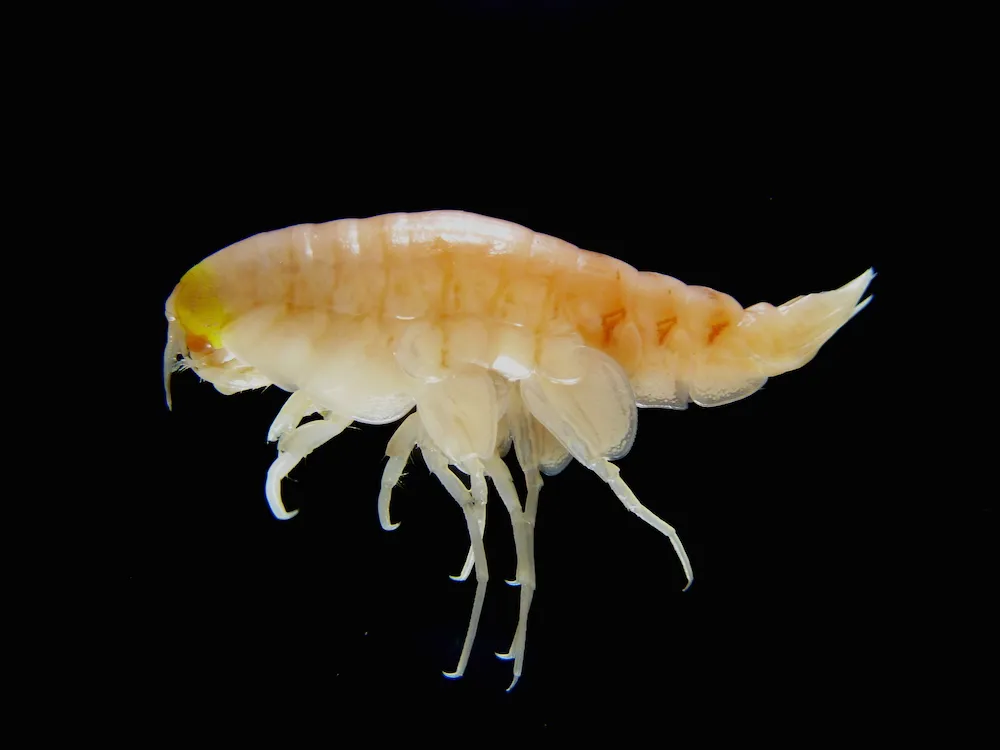
Hirondellea gigas live in the deepest depths of the Mariana Trench in the western Pacific Ocean.
(Image credit: Alan Jamieson/Newcastle University)
The hadal zone includes deep-sea trenches. People usually assume that deep-sea trenches are pristine, but in reality, these trenches are the dustbins of the ocean, collecting debris as it slowly sinks to the ocean floor, the researchers said.
To get a better idea of the pollutants there, the researchers set baited traps for teeny crustaceans, called amphipods, that live and scavenge in deep-sea trenches. The scientists analyzed the amphipods' fatty tissues for levels of persistent organic pollutants (POPs), which can disrupt hormones in living beings.
Sign up for the Live Science daily newsletter now
Get the world’s most fascinating discoveries delivered straight to your inbox.
POPs can enter the environment through industrial accidents and discharges, leakage from landfills or incomplete incineration, the researchers said. Two POPs of great concern are polychlorinated biphenyls (PCBs, used as dielectric fluid) and polybrominated diphenyl ethers (PBDEs, used as flame retardants), according to the scientists.
"The salient finding was that PCBs and PBDEs were present in all samples across all species at all depths in both trenches," the researchers wrote in the study.
The amphipods in the Mariana Trench had higher PCB levels than did the amphipods in the Kermadec Trench, but it's unclear why. One idea is that the Mariana PCBs come from the nearby North Pacific Subtropical Gyre — more commonly known as the Great Pacific Garbage Patch — the researchers said. The patch is about the size of Texas, and formed when millions upon millions of plastic and garbage fragments got trapped in a vortex between ocean currents, Live Science reported previously.
The results show that human-caused contamination can be found at the far reaches of the Earth, even in the Mariana Trench, which is deeper than Mount Everest is tall, the researchers said.
The findings are "disturbing," said Katherine Dafforn, a senior research associate in the School of Biological, Earth and Environmental Sciences at the University of New South Wales in Australia. Dafforn was not involved in the new study but wrote an accompanying editorial about it.
"This is significant since the hadal trenches are many miles away from any industrial source," Dafforn wrote in the opinion piece. "[It] suggests that the delivery of these pollutants occurs over long distances despite regulation since the 1970s."
Laura is the managing editor at Live Science. She also runs the archaeology section and the Life's Little Mysteries series. Her work has appeared in The New York Times, Scholastic, Popular Science and Spectrum, a site on autism research. She has won multiple awards from the Society of Professional Journalists and the Washington Newspaper Publishers Association for her reporting at a weekly newspaper near Seattle. Laura holds a bachelor's degree in English literature and psychology from Washington University in St. Louis and a master's degree in science writing from NYU.