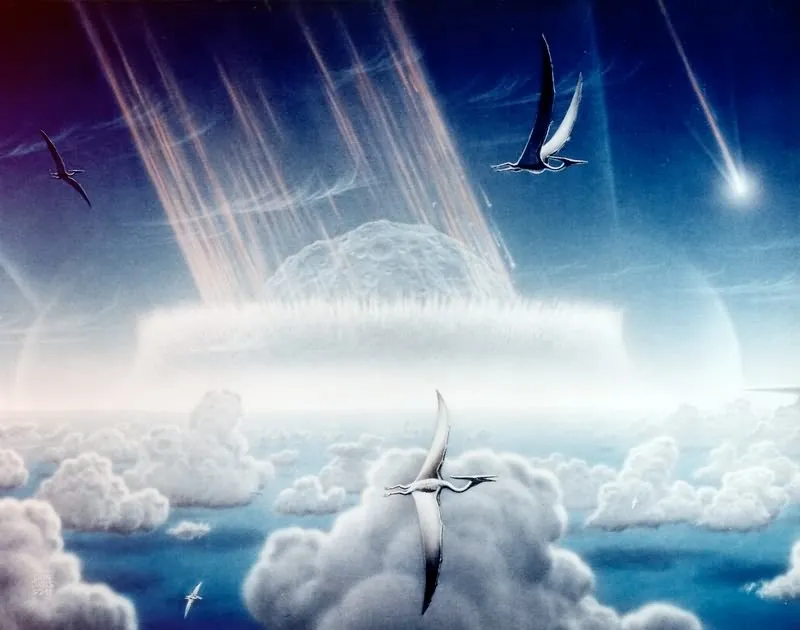
The catastrophic asteroid crash blamed for the demise of the dinosaurs also left a gaping scar in the Earth. That sprawling crater made 65.5 million years ago may hold the answers to many mysteries surrounding the space-rock event.
Now, scientists plan to drill 5,000 feet (1,500 meters) below the surface of the Chicxulub crater in Mexico to bring up a giant core — and delve 10 million to 15 million years into the past. The endeavor would result in the first offshore core taken from near the center of the crater, which is named for a nearby seaside village located on the Yucatán Peninsula.
An international team of scientists met last week in Mérida, Mexico, located within the 125-mile-wide (200 kilometers) Chicxulub crater, to discuss their plans for the drilling project, slated to start in spring 2016. [Crash! The 10 Biggest Impact Craters on Earth]
Why now? "The Chicxulub impact crater has been a remarkable scientific opportunity for the 20 years since it's been discovered," said Sean Gulick, of The University of Texas at Austin Institute for Geophysics. And, for the first time, scientists have subsurface images from the offshore part of the crater, so they can pinpoint a spot for sampling. They chose a spot along the crater's peak ring — a ring of mountainlike structures around the center of the crater.
Topological features of the Chicxulub crater can be seen in this gravity map (red and yellow indicate high gravity, while green and blue are gravity lows).
(Image credit: NASA)
By sampling there, the researchers can get a clearer picture of ancient biological and geological processes.
Scientists think that, when a big rock smashes into Earth at high enough velocities, the collision causes the crust temporarily to act sort of like a liquid, first forming a so-called transient crater (like the indentation that forms on a lake surface after a rock is thrown in), and the center rebounds, or splashes, upward and then outward. "We think the peak ring is the record of the material that rebounded and splashed outward," Gulick told Live Science.
All of these ideas are based on models and aren't necessarily what happened. "We've never gotten a rock back from a peak ring to know if that's correct," Gulick said.
Sign up for the Live Science daily newsletter now
Get the world’s most fascinating discoveries delivered straight to your inbox.
The researchers also hope to find details about the process that weakened the granite of the crust to get it to flow like a liquid, Gulick noted. "We don't understand that process," he said.
Chicxulub is also the only impact crater on Earth linked to a mass extinction event. As such, the samples could provide more information about that extinction and what came after it. More recent layers of rock could yield traces of life, which would provide clues about how long it took for life to return to the area, he said.
The roughly $10 million project is a collaboration between the European Consortium for Ocean Research Drilling (part of the International Ocean Discovery Program) and the International Continental Scientific Drilling Program.
Gulick and Joanna Morgan, of Imperial College London, will lead the team of scientists.
Jeanna Bryner is managing editor of Scientific American. Previously she was editor in chief of Live Science and, prior to that, an editor at Scholastic's Science World magazine. Bryner has an English degree from Salisbury University, a master's degree in biogeochemistry and environmental sciences from the University of Maryland and a graduate science journalism degree from New York University. She has worked as a biologist in Florida, where she monitored wetlands and did field surveys for endangered species, including the gorgeous Florida Scrub Jay. She also received an ocean sciences journalism fellowship from the Woods Hole Oceanographic Institution. She is a firm believer that science is for everyone and that just about everything can be viewed through the lens of science.