













Libyan Archaeology Threatened by Years of Conflict

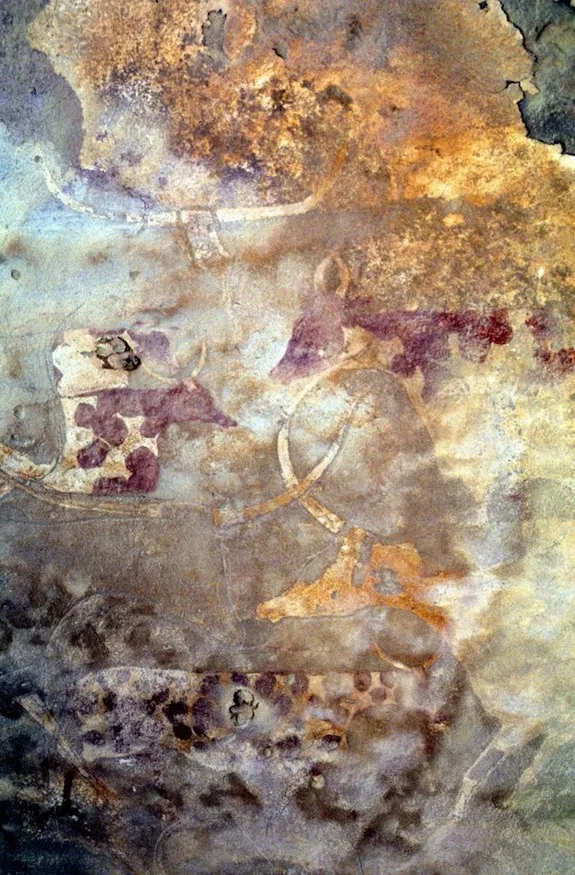
When war erupted in Libya in early 2011, Savino di Lernia and several other Italian archaeologists were stranded in the Sahara Desert. They had been studying Libya's prehistory at the Messak plateau in the southwest corner of Libya, which is home to some of the world's oldest rock art. As violence in the country escalated, the researchers took shelter in an isolated oil camp before they were eventually evacuated to safety on an Italian military aircraft.
At first, di Lernia and many of his colleagues were optimistic about the future of archaeology in Libya after years of neglect under dictator Moammar Gadhafi. But today, di Lernia has trouble imagining what fieldwork will look like in the war-torn country.
Years after the conflict began, Libya is still unstable. The United Nations was holding talks in Geneva this week to attempt to unify the two rival governments in control of Libya since Gadhafi's dramatic downfall. Meanwhile, ISIS extremists have taken power in parts of the country, such as Derna, a city in the east, where the group Human Rights Watch has documented violent forms of abuse, including executions and floggings.
Alongside reports of human atrocities, there has been a steady stream of reports detailing the threats to Libya's cultural resources, from ideological destruction to unchecked development. In 2013, for example, there was construction equipment sitting at the Hellenic city of Cyrene, one of five UNESCO World Heritage Sites in Libya, ready to clear the way for houses. Another World Heritage Site, Ghadamès — a city sometimes called "the pearl of the desert" that was once home to the Romans and the Berbers — suffered rocket attacks in 2012. The same year, ultraconservative Islamists reportedly destroyed Sufi shrines and graves in Tripoli that don't conform to their beliefs. In 2011, robbers pulled off one of the biggest archaeological heists, stealing a hoard of nearly 8,000 ancient coins from a bank vault in Benghazi. [The 7 Most Mysterious Archaeological Finds on Earth]
"I'm afraid if nothing happens, this will be a disaster for generations of Libyan archaeologists — and for universal heritage," di Lernia told Live Science. Today (Jan. 28), he published a commentary in the journal Nature to try to raise awareness about the situation within the scientific community. "It's very difficult to keep the light on Libya in this moment," di Lernia said.
Over the last four years, di Lernia, who is a professor at the Sapienza University of Rome, and his colleagues have been able to publish new research based on the wealth of material they collected in past field seasons. They've shown that dairy farms existed in a once-green Sahara. They have also analyzed Stone Age burials in the desert region.
Though access to the southeastern part of Libya has been restricted since 2011, di Lernia used to be able to travel to Tripoli. But as the fighting between Libya's two governments worsened over the past year, di Lernia wasn't able to get to Libya at all. From afar, it's difficult for international observers to assess the damages in the country.
Get the world’s most fascinating discoveries delivered straight to your inbox.
"From time to time, I succeed in talking to my friends there, and they say that all sites are in danger, all sites are at risk," di Lernia said. "We don't know what's going on in many places. We don't know what's going on in the museums."
In other conflict zones, such as Syria, archaeologists have turned to satellite imagery to assess damage to cultural heritage sites. Those images show that places like Apamea, a Roman city and once-thriving tourist attraction for Syria, has been turned into a moonscape because of the holes gouged out by looters. But the same approach might not work in Libya, di Lernia said, as satellites can't detect more subtle damages, such as graffiti that's been reportedly painted over rock art in the Tadrart Acacus mountains, near the Messak plateau.
Di Lernia used to spend months at a time at the Messak plateau, but he can’t imagine long archaeological field seasons resuming in Libya anytime soon. In Nature, he put forth a host of recommendations to rekindle research, calling for more support for museum, university and lab-based research. Di Lernia said he'd like to see more museum collections go online, and a Web-based library for rock art sites. He also wants to see international universities provide support and funding for Libyan students and scientists to train and work overseas.
"The only way to keep Libyan archaeology alive is to do lab research, desk research, working on the Internet and working on the digitization of cultural heritage in Libya," di Lernia said. "The situation in Libya is a part of a wider picture, I'm afraid. Probably we have to rethink our capacity to do research within this political framework."
Follow Megan Gannon on Twitter. Follow us @livescience, Facebook & Google+. Original article on Live Science.
