













Sun's Glint Lights Up World's Deepest Lake (Photo)

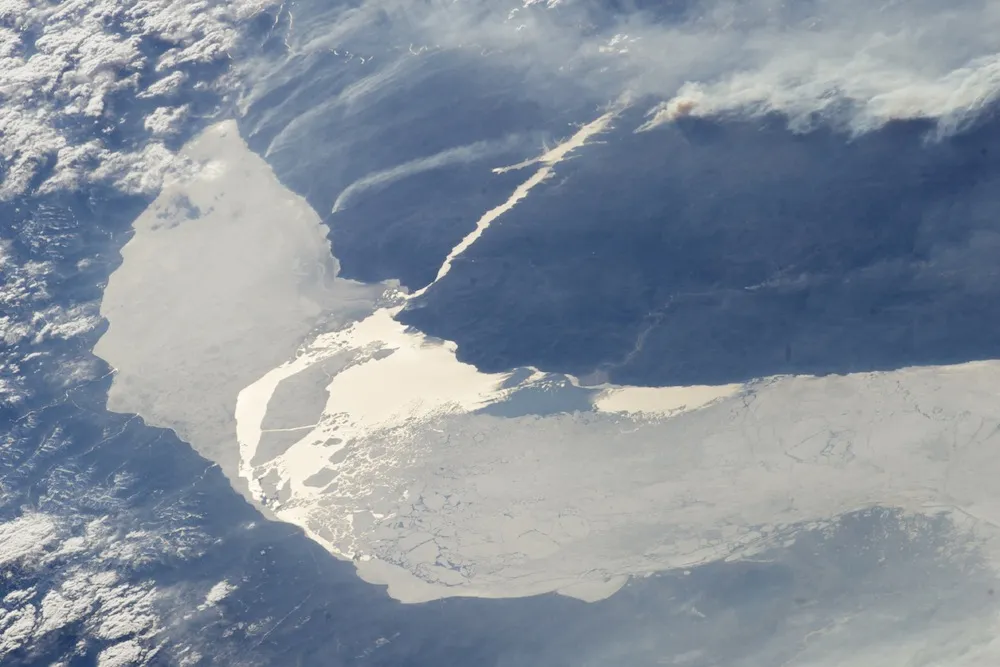
Russia's Lake Baikal is the deepest lake in the world, but its beauty is skin-deep in a new astronaut photograph.
The lake image, taken by a crew member aboard the International Space Station, shows the southern half of the lake, which is mostly covered by ice. A melted portion catches the sun, creating a silvery, mirrorlike surface. This phenomenon is called sunglint, according to NASA's Earth Observatory.
Sunglint is a literal trick of the light — sun reflects directly off the surface of the water toward the observer. It can happen in rivers, lakes and on the open ocean, and the color of the sunglint depends on the roughness of the water surface, among other factors, according to Earth Observatory. [101 Stunning Images of Earth from Space]
One of a kind
Lake Baikal is a UNESCO World Heritage site. Its depths stretch down some 5,577 feet (1,700 meters) — twice as deep as the tallest building in the world, Dubai's Burj Khalifa, is high. The lake is also the world's oldest, dating back about 25 million years, according to UNESCO.
Lake Baikal is also the single largest reservoir on Earth. It contains 20 percent of the fresh, unfrozen water on the planet, and has a rare and diverse ecosystem to match. According to UNESCO, the lake is home to 1,340 animal species and 570 plants. Of these, 745 animals and 150 plants are found nowhere else on Earth.
Perhaps the cutest of these is the Baikal seal (Pusa sibirica), also known as the nerpa. This seal is the only pinniped that lives only in freshwater, according to the Seal Conservation Society. Adults are silver-grey, and pups are a fuzzy, fluffy white. Weighing in around 155 pounds (70 kilograms) max, Baikal seals are some of the smallest pinnipeds on the planet.
Get the world’s most fascinating discoveries delivered straight to your inbox.
Less adorable, but no less amazing, is the golomyanka, a bizarre translucent fish that is more than one-third oil by weight. The fish have no scales and, because of their unique bodies, can move from Lake Baikal's depths to its shallows without suffering damage from changes in water pressure. The fish are the main prey of the Baikal seal.
Threats and challenges
Despite its storied status, Lake Baikal is not immune to the threat of human activity. Baikal seals are hunted, which may be contributing to declining numbers of the species. Pollution also threatens the lake, particularly agricultural runoff and discharge from nearby industrial plants, according to the Seal Conservation Society.
The lake is also a repository of gas hydrates, which are essentially dissolved gases locked inside solid crystals of water. Lake Baikal hosts huge amounts of methane trapped in these structures in its depths, making it a popular place for research into how to extract these gas hydrates as an alternative source of energy.
There are currently no plans to extract these gas hydrates from Lake Baikal, but similar structures are also found in the oceans and in permafrost. This fact has led to additional concerns about climate change, as melting ice could release large amounts of methane, a potent greenhouse gas.
Follow Stephanie Pappas on Twitter and Google+. Follow us @livescience, Facebook & Google+. Original article on Live Science.

Stephanie Pappas is a contributing writer for Live Science, covering topics ranging from geoscience to archaeology to the human brain and behavior. She was previously a senior writer for Live Science but is now a freelancer based in Denver, Colorado, and regularly contributes to Scientific American and The Monitor, the monthly magazine of the American Psychological Association. Stephanie received a bachelor's degree in psychology from the University of South Carolina and a graduate certificate in science communication from the University of California, Santa Cruz.