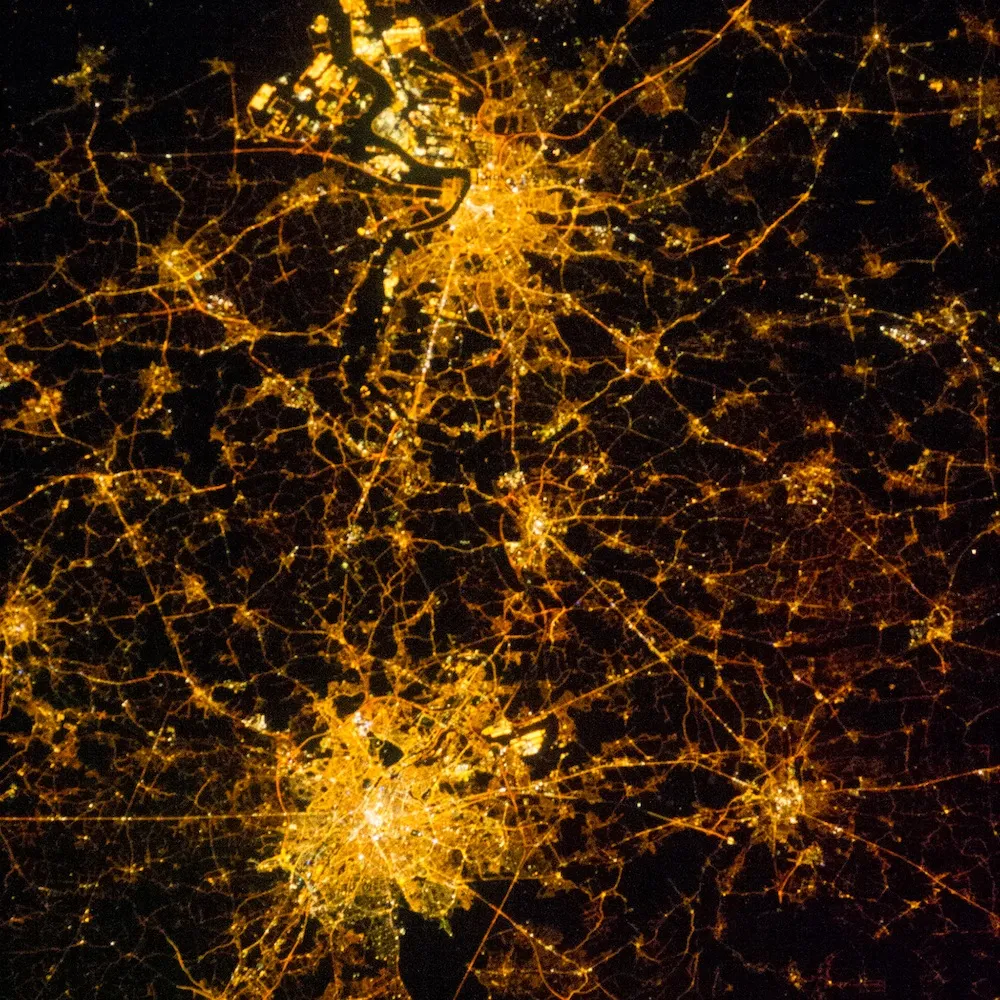
Europe's Night Lights Seen from Space (Photo)
Get the world’s most fascinating discoveries delivered straight to your inbox.
You are now subscribed
Your newsletter sign-up was successful
Want to add more newsletters?
Delivered Daily
Daily Newsletter
Sign up for the latest discoveries, groundbreaking research and fascinating breakthroughs that impact you and the wider world direct to your inbox.
Once a week
Life's Little Mysteries
Feed your curiosity with an exclusive mystery every week, solved with science and delivered direct to your inbox before it's seen anywhere else.
Once a week
How It Works
Sign up to our free science & technology newsletter for your weekly fix of fascinating articles, quick quizzes, amazing images, and more
Delivered daily
Space.com Newsletter
Breaking space news, the latest updates on rocket launches, skywatching events and more!
Once a month
Watch This Space
Sign up to our monthly entertainment newsletter to keep up with all our coverage of the latest sci-fi and space movies, tv shows, games and books.
Once a week
Night Sky This Week
Discover this week's must-see night sky events, moon phases, and stunning astrophotos. Sign up for our skywatching newsletter and explore the universe with us!
Join the club
Get full access to premium articles, exclusive features and a growing list of member rewards.
The lights of Brussels and Antwerp take center stage in a new astronaut photograph snapped from the International Space Station.
Taken on March 5, the nighttime image shows Belgium's capital and largest city, Brussels. About 1.2 million people make their home there, with an additional 600,000 or so living in the greater metropolitan area. An extra-bright spot on the northeast edge of the city is the Brussels airport, according to NASA's Earth Observatory.
North of Brussels is Antwerp, a city of about 480,000 people. The Scheldt River, visible as a dark meander in the image, runs west of the city.
City lights can be frustrating for astronomers, because light pollution drowns out views of the stars. Even remote telescopes are affected, and energy-saving LEDs, which emit blue light, cause more problems than traditional yellow streetlights.
Excess nighttime light also alters animal behavior. Light pollution has deterred sea turtles from nesting on brightly lit beach spots in Israel, according to a March 2013 study in the journal Biological Conservation. Both insect- and fruit-eating bats also prefer deep darkness to night light. A study in the March issue of the Journal of Applied Ecology found that fruit bats may be dazzled by artificial light. Light pollution could thus stymy reforestation in tropical forests, because bats are major seed-spreaders in Central America.
There are some oases of darkness remaining, however. In 2013, the International Dark-Sky Association named Death Valley National Park a "dark sky park." Inside the park, sky objects are visible that can only be seen from the darkest spots on the planet.
Follow Stephanie Pappas on Twitter and Google+. Follow us @livescience, Facebook & Google+. Original article on Live Science.
Get the world’s most fascinating discoveries delivered straight to your inbox.

Stephanie Pappas is a contributing writer for Live Science, covering topics ranging from geoscience to archaeology to the human brain and behavior. She was previously a senior writer for Live Science but is now a freelancer based in Denver, Colorado, and regularly contributes to Scientific American and The Monitor, the monthly magazine of the American Psychological Association. Stephanie received a bachelor's degree in psychology from the University of South Carolina and a graduate certificate in science communication from the University of California, Santa Cruz.