













Trees Have Internal Clocks Too, Study Finds

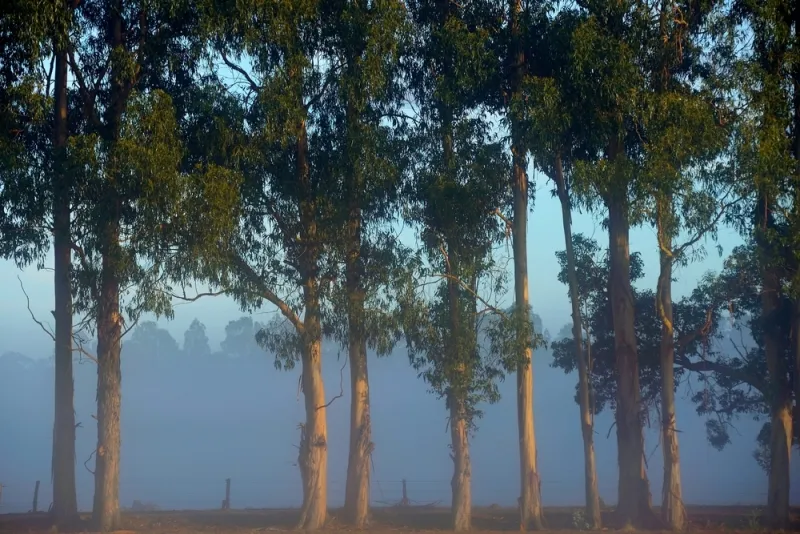
Like human bodies, some trees have internal clocks that coordinate the activities of their cells with the cycles of day and night, a new study finds.
Scientists knew of these circadian rhythms in leaves, but the new study is the first to demonstrate them in whole trees. In the study, the researchers looked at the Tasmanian blue gum tree, and found it appears to use its internal clock to regulate its intake of water. These cycles could affect models of climate change, the scientists say.
"It had never been shown that the circadian rhythm of the leaf affected the whole tree," said study researcher Rubén Díaz Sierra, a physicist at the National University of Distance Education in Spain. "If it works for the tree, it works for the whole forest," he added.
Díaz Sierra's colleagues monitored trees in special "whole-tree chambers" as part of the Hawkesbury Forest Experiment near Sydney, Australia — a broader experiment to study how Australia's eucalypt forests will respond to changes in atmospheric carbon dioxide and climate. These chambers enable researchers to control the air temperature, humidity and amount of light the trees are exposed to, although these parameters were allowed to vary in this study. [Nature's Giants: Tallest Trees on Earth]
The researchers measured how much water vapor they lost through small openings in the their leaves called stomata. The scientists compared these values during overcast nights, when the environment stays mostly constant throughout the evening, with nights that saw dramatic changes in temperature and humidity.
Water loss declined in the six hours after dusk, but increased noticeably during the six hours before dawn, even on nights when temperature and humidity remained constant. Because the environment wasn't changing, the increase can only be explained by the biological clock, said study researcher Víctor Resco de Dios of the University of Western Sydney in Australia.
Artificial neural networks — machine-learning models inspired by the brain — were used to determine just how much the circadian rhythms affected the opening of stomata and the trees' water use.
Get the world’s most fascinating discoveries delivered straight to your inbox.
The findings carry important implications for models of climate change. "Right now, the models don't take into account the time of the day," Díaz Sierra said, adding that if the time of day affects trees' carbon-dioxide consumption, it would alter models of how climate change will affect ecosystems.
Still, Díaz Sierra expects some resistance to the notion that whole trees display circadian rhythms. There's still a lot of work to do with other plants, he said. "But if it works on small plants on the leaves, why not the whole tree?" he said.
Follow Tanya Lewis on Twitter and Google+. Follow us @livescience, Facebook & Google+. Original article on LiveScience.com.
Editor's Note: This article was updated at 9:07 am ET Friday, July 19, to remove references to measuring carbon dioxide intake (the study measured only water loss, not carbon dioxide intake).
