













Can 'Walking Palm Trees' Really Walk?

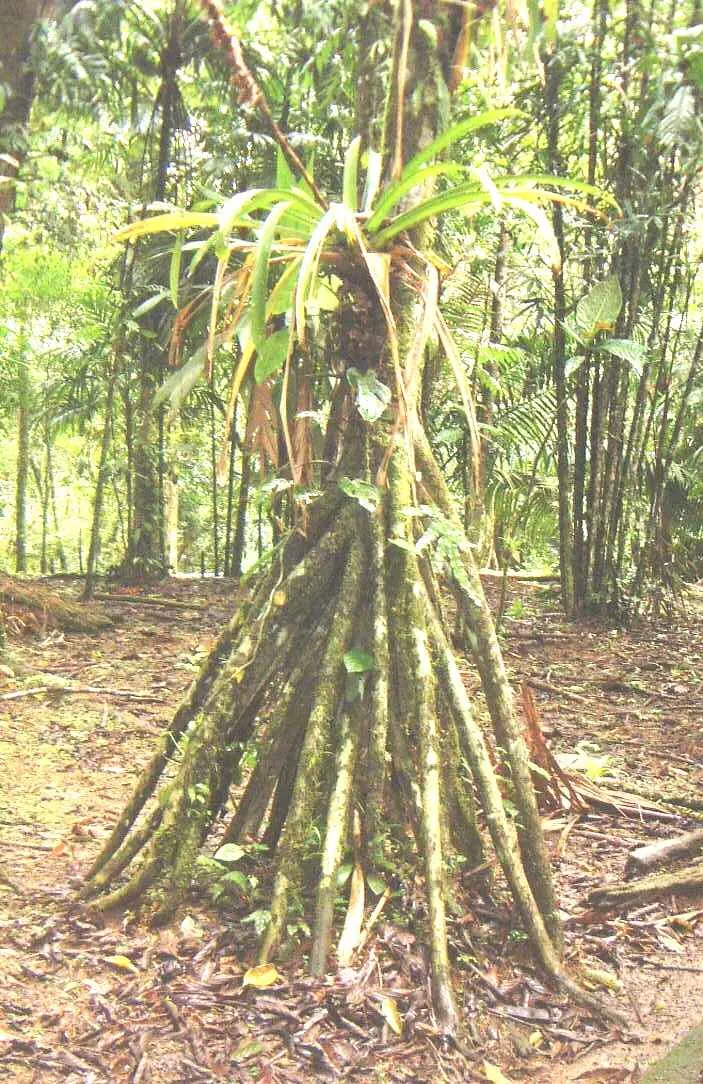
Anyone who has ever seen the peculiar carnivorous Venus flytrap plant gobble up a fly knows that plants can take on some decidedly unplantlike behavior. Trees, as we all know, are pretty stationary: they stay more or less where you plant them, and no one worries about finding a tree wandering around a park or back yard.
There is one unique exception, some say: the so-called walking palm tree(Socratea exorrhiza) found in Latin America. Many people believe it can literally walk around (more or less). This is because of its unusual root system; while most trees have one trunk, the palm splits into many smaller roots a few feet off the ground, giving it the appearance of many little legs.
The amazing ambulatory ability of the walking tree has been told by rainforest guides to tourists for years, and appears in many sources as an amazing plant adaptation. As journalist Sherry Seethaler writes in her book "Curious Folks Ask 2" (2011, FT Press): "Screenwriters searching for the perfect B-movie plant protagonist could take inspiration from the walking palm, found in the rainforests of Central and South America. The tree slowly 'walks' from shade to sunlight by growing new roots toward the light and allowing the old roots interfering with its wanderlust to die."
A tree that walks in search of the sun is a fascinating, bizarre story. Alas, it's also not true; the tree is real enough, but it doesn't walk — or even stumble. It sits where it sprouted, not moving except under the force of wind (or an axe).
Biologist Gerardo Avalos, director of the Center for Sustainable Development Studies in Atenas, Costa Rica, is one of the world's top experts on the Socratea exorrhiza. His 2005 analysis of the plant and its roots (published in the journal Biotropica) shows that, contrary to popular belief (and its name), the walking tree can't walk because its roots don't move. A few roots on one side or another may die off, but the trunk itself remains, well, rooted to the spot.
"My paper proves that the belief of the walking palm is just a myth," Avalos told Life's Little Mysteries."Thinking that a palm tree could actually track canopy light changes by moving slowly over the forest floor … is a myth that tourist guides find amusing to tell visitors to the rainforest."
Follow Life's Little Mysteries on Twitter @llmysteries, then join us on Facebook.
Get the world’s most fascinating discoveries delivered straight to your inbox.
Benjamin Radford is deputy editor of Skeptical Inquirer science magazine and author of Scientific Paranormal Investigation: How to Solve Unexplained Mysteries. His Web site is www.BenjaminRadford.com.
