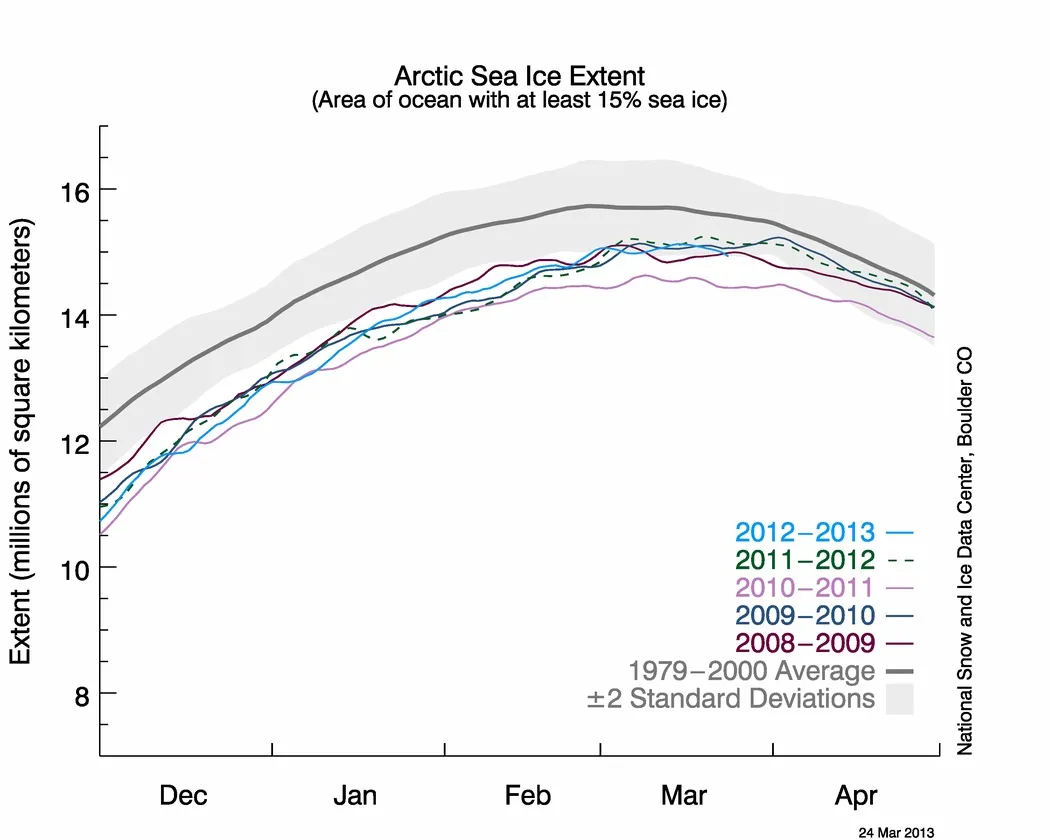
The graph above shows Arctic sea ice extent as of March 24, 2013, along with daily ice extent data for the previous five years. 2012 to 2013 is shown in blue, 2011 to 2012 in green, 2010 to 2011 in pink, 2009 to 2010 in navy, and 2008 to 2009 in purple. The 1979 to 2000 average is in dark gray.
It may be time to retire the groundhog and start tracking Arctic sea ice for a better prediction of late-winter weather.
On March 15, the Arctic sea ice reached its maximum extent ― the most ice the frigid North would see this year, according to the National Snow & Ice Data Center (NSIDC) in Boulder, Colo. Changes in Arctic ice, and its total extent, may be affecting weather further south, scientists think.
The ice covered 5.84 million square miles (15.13 million square kilometers), the sixth-lowest area on record since 1979. Most of the ice was young, first-year ice, freshly frozen. The Arctic also has multiyear ice, frozen year-round, which is stiffer and thicker, and contains much less brine than first-year ice does. However, its slice of the total ice pie has been shrinking in recent years.
During the 2012 to 2013 winter season, the sea ice grew a record 4.53 million square miles (11.72 million square km). This massive growth was primarily due to last year's missing ice: A record-low ice minimum in September 2012 meant more ocean was exposed, leaving a greater area uncovered to refreeze this winter, the NSIDC said in a statement.
The big swings between summer and winter ice indicate a shift toward a more pronounced seasonal cycle in the Arctic, according to the NSIDC.
The shift is changing the ratio of thin, first-year ice to thick, multiyear ice, which is more resistant to summer melting and winter storms. First-year ice increasingly dominates the Arctic ice pack, the NSIDC said.
Multi-year Arctic ice in 1980. The bright white central mass shows the perennial sea ice. The larger light blue area shows the full extent of the winter sea ice including the average annual sea ice during the months of November, December and January.
(Image credit: NASA)
Multi-year Arctic ice in 2012. The bright white central mass shows the perennial sea ice. The larger light blue area shows the full extent of the winter sea ice including the average annual sea ice during the months of November, December and January.
(Image credit: NASA)
This year, the relatively fragile first-year ice was buffeted by a powerful Arctic storm in February, extensively fracturing the ice. Cracking from storms happens every year. This year, however, the rifts extended from Canada to Alaska ― although they quickly refroze.
Sign up for the Live Science daily newsletter now
Get the world’s most fascinating discoveries delivered straight to your inbox.
Less Arctic ice also means more of the ocean and atmosphere can warm from the sun. Scientists think this warming shifts the jet stream, steering cold storm systems further south. March brought freezing temperatures and strong winter storms to the United States, Europe and Russia.
Becky Oskin covers Earth science, climate change and space, as well as general science topics. Becky was a science reporter at Live Science and The Pasadena Star-News; she has freelanced for New Scientist and the American Institute of Physics. She earned a master's degree in geology from Caltech, a bachelor's degree from Washington State University, and a graduate certificate in science writing from the University of California, Santa Cruz.