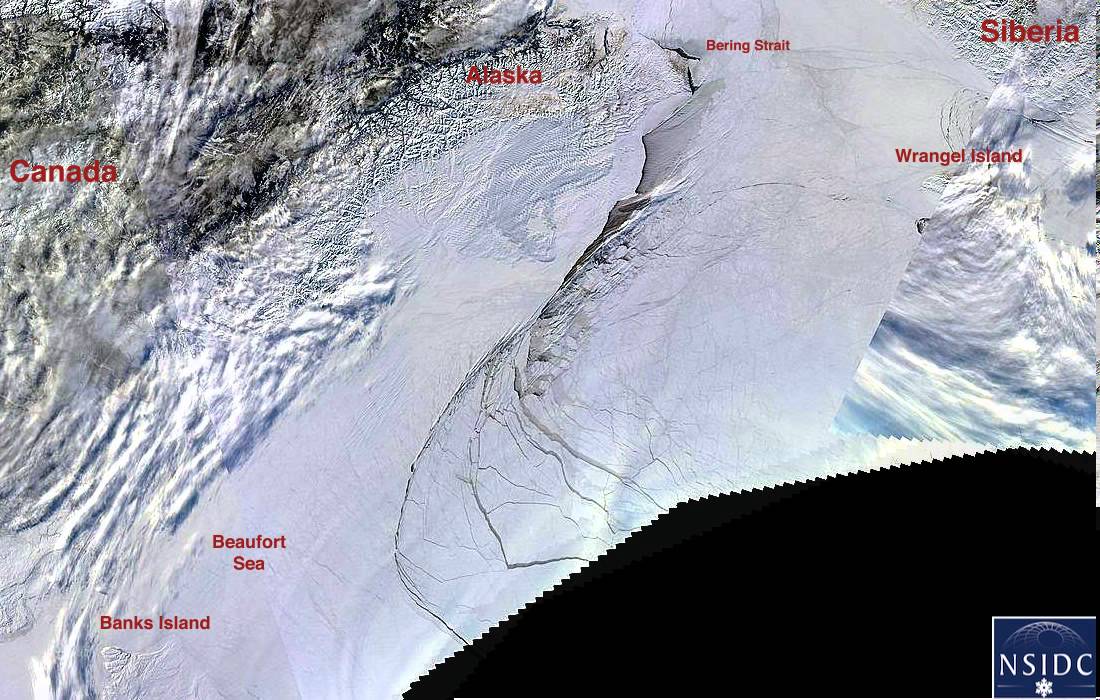
Though every day brings more sunlight, February is still one of the coldest months in the Arctic. The sea ice in the Arctic Ocean is now nearing its winter maximum, but the effects of a February storm markedly illustrate the changes that have happened with the Arctic sea ice cover under the effects of climate change.
In past decades, winter meant thick, years-old pack ice would extend over much of the Arctic Ocean. But the modern Arctic's thinner ice cover is more easily pushed by wind, according to Jennifer Francis, an atmospheric scientist at Rutgers University. Other factors, such as global warming, weather patterns and solar heating, also play a role in the loss.
As the Feb. 8 storm passed over the North Pole, it created a strong offshore ice motion, according to the National Snow and Ice Data Center (NSIDC). The fracturing progressed through relatively weak, thin, year-old pack ice during February, as seen in a series of images from the NSIDC.
Latest Videos FromLive Science
Similar patterns were observed in early 2011 and 2008, but the 2013 fracturing is quite extensive, the NSIDC said in a statement. The fractured area extends through the Beaufort Sea from Ellesmere Island in the Canadian Arctic to Barrow, Alaska.
The overall February ice extent remains below average, in part due to warmer-than-average temperatures, the NSIDC said. The average sea ice cover in February was 5.66 million square miles (14.66 million square kilometers), the seventh-lowest on record for the month.
Overall, the Arctic has lost more than 606,000 square miles (1.57 million square km) of winter sea ice since 1979, an area slightly smaller than Alaska, the biggest state.
Email Becky Oskin or follow her @beckyoskin. Follow us @OAPlanet, Facebook or Google+. Original article on LiveScience's OurAmazingPlanet.