It's quick and easy to access Live Science Plus, simply enter your email below. We'll send you a confirmation and sign you up for our daily newsletter, keeping you up to date with the latest science news.
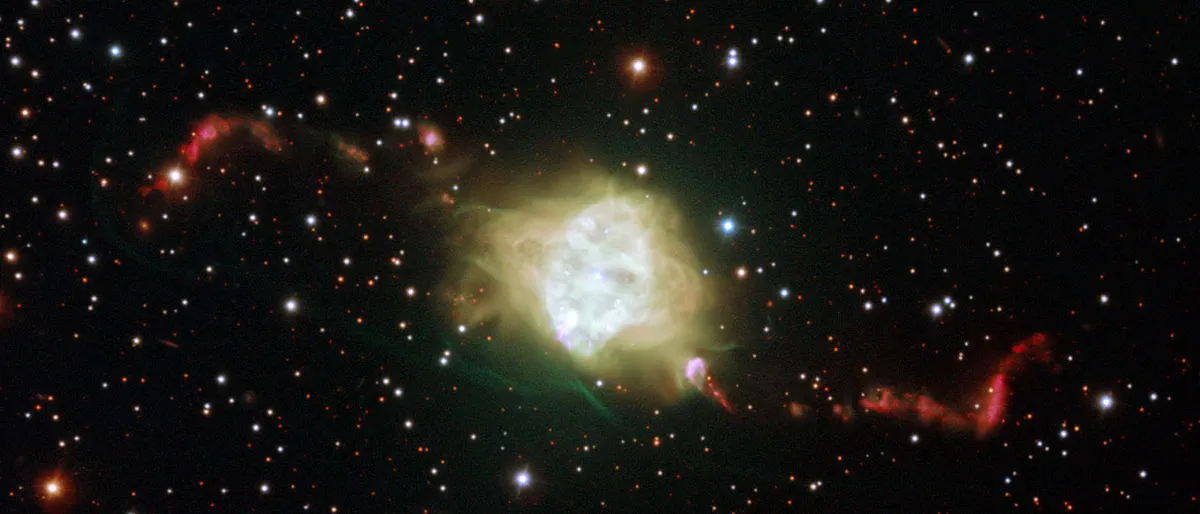
This ESO Very Large Telescope image shows the planetary nebula Fleming 1 in the constellation of Centaurus (The Centaur). New observations suggest that a very rare pair of white dwarf stars lies at the heart of this object, with their orbital motions explaining the nebula's remarkably symmetric jet structures. Image released Nov. 8, 2012.
A pair of stars orbiting one another inside a planetary nebula appear to be the cosmic powerhouse behind the oddball nebula's spectacular jets, scientists say.
The discovery stands to settle a long-running debate over the shape of jets streaming from the planetary nebula Fleming 1. Those jets, which appear oddly knotted and curved, are powered by the orbital interactions of the binary stars, the new study found. Their gas is shared between the bigger star and its much smaller companion.
"This is a big project to understand strange, asymmetric shapes of planetary nebulas," said study leader Henri Boffin, a Chile-based astronomer with the European Southern Observatory. According to scientists, 80 percent of planetary nebulas have lopsided shapes.
Despite their name, planetary nebulas have nothing to do with planets. They are the swan song of dying white dwarf stars that are close to the size of Earth's sun — between one and eight times its mass, Boffin told SPACE.com. [Photos: Amazing Nebulas in Deep Space]
An artist's view of how the spectacular jets of planetary nebulas like Fleming 1 are sculpted by the interactions of binary stars. Image released Nov. 8, 2012.
(Image credit: ESO/L. Calcada)
Finessing Fleming 1 observations
Boffin's team used the Very Large Telescope in northern Chile to look at Fleming 1 in the southern constellation Centaurus. The planetary nebula is named after Williamina Fleming, a maid-turned-astronomer for the Harvard College Observatory, who discovered the nebula in 1910.
For decades astronomers wondered about the strange shapes of gas surrounding the nebula. Boffin and his colleagues combined new observations with computer models to confirm that binary white dwarf stars were at work.
Sign up for the Live Science daily newsletter now
Get the world’s most fascinating discoveries delivered straight to your inbox.
Most binary stars orbit each other every few hundred or few thousand years, but a look at Fleming 1's spectrum revealed its stars are a lot faster than that. Rapidly changing lines in the spectrum showed the stars whip around each other every 1.2 days.
"It's a very close binary system," Boffin said, adding that other systems already discovered have similar orbital periods.
The stars in Fleming 1 once shared a common envelope of gas that surrounded the system. This is common in some kinds of binary star systems, Boffin said. However, that envelope is not there now.
The research is detailed in the Nov. 9 edition of the journal Science.
Faucet of gas jets
This wide-field view shows the sky around planetary nebula Fleming 1 in the constellation of Centaurus (The Centaur). This view was created from images forming part of the Digitized Sky Survey 2. Image released Nov. 8, 2012.
(Image credit: ESO/Digitized Sky Survey 2. Acknowledgement: Davide De Martin)
Originally, the two stars in Fleming were far apart. The bigger star evolved late in life from a red giant to a humongous "asymptotic giant branch" star. At this point it had the combined width of several hundreds of solar disks.
Gas streaming off this massive star then flowed toward the much smaller star nearby, a cooling white dwarf. It was at this point that jets of gas, like water from a faucet, "turned on" and began streaming out material away from the stars.
Boffin said this period was just a snapshot in time in the lifetime of a star, lasting only 5,000 to 10,000 years.
Ejecting the envelope
Over time, the giant star lost all its gas and became a white dwarf. The gas enveloped both of the stars, pushing them closer together.
As the stars drew closer, the envelope of gas was ejected and the jet "faucets" turned off.
Boffin's team suggested the process at Fleming 1 is common among binary star systems in planetary nebulas, but he added that more observations will be needed to firm up the theory.
"This is the first time we've seen these jets fresh out of the oven," Boffin said.
"One of them is still shredding the envelope, which is why we can only infer [its creation] by numerical simulations and the theory of the formation. ... There are still many things that are not clear."
Elizabeth Howell was staff reporter at Space.com between 2022 and 2024 and a regular contributor to Live Science and Space.com between 2012 and 2022. Elizabeth's reporting includes multiple exclusives with the White House, speaking several times with the International Space Station, witnessing five human spaceflight launches on two continents, flying parabolic, working inside a spacesuit, and participating in a simulated Mars mission. Her latest book, "Why Am I Taller?" (ECW Press, 2022) is co-written with astronaut Dave Williams.