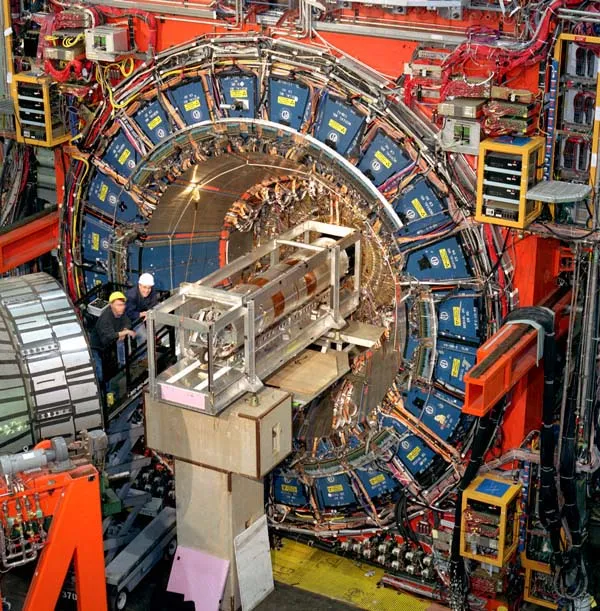
The CDF detector, about the size of a three-story house, weighs about 6,000 tons. It recrods the "debris" emerging from each high-energy proton-antiproton collision produced by the Tevatron.
High-speed collisions at a giant atom smasher have produced what physicists say is a new particle, a heavier relative of the familiar neutron.
The particle is called the neutral Xi-sub-b. When it's formed in the Fermilab Tevatron particle accelerator in Batavia, Ill., the neutral Xi-sub-b lasts just a mere instant before decaying into lighter particles. Scientists at Fermilab uncover these ephemeral particles by racing particles around a 4-mile (6.3 km) ring at near light speed. When the particles collide, the outpouring of energy disintegrates them into other particles.
Baryons are particles made of three quarks.
(Image credit: Fermilab)
Physics theory called the Standard Model predicted that the neutral Xi-sub-b should exist, but this is the first time researchers have seen it firsthand. The particle is a baryon, meaning it consists of three fundamental particles called quarks. Protons and neutrons, which make up the nucleus of atoms, are baryons. Protons contain two "up" quarks and one "down," while neutrons have two "down" quarks and an "up."
The newly discovered particle contains a strange quark, an up quark and a bottom quark. The bottom quark is called a heavy bottom quark, making the neutral Xi-sub-b about six times heavier than a proton or neutron. [Read Wacky Physics: The Coolest Little Particles in Nature]
Measuring the properties of tiny particles like the neutral Xi-sub-b, allows physicists to understand how quarks interact to form matter, according to Fermilab. Physics models predict that several more baryons have yet to be discovered.
Earlier this year, Fermilab scientists thought they'd discovered another never-before-seen particle. That discovery turned out to be a fluke, however.
The researchers have submitted a paper that summarizes the details of its Xi-sub-b discovery to the journal Physical Review Letters.
Sign up for the Live Science daily newsletter now
Get the world’s most fascinating discoveries delivered straight to your inbox.
Follow LiveScience for the latest in science news and discoveries on Twitter @livescienceand on Facebook.
For the science geek in everyone, Live Science offers a fascinating window into the natural and technological world, delivering comprehensive and compelling news and analysis on everything from dinosaur discoveries, archaeological finds and amazing animals to health, innovation and wearable technology. We aim to empower and inspire our readers with the tools needed to understand the world and appreciate its everyday awe.