
-
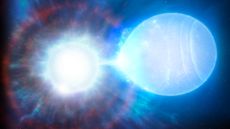 Rare quadruple supernova on our 'cosmic doorstep' will shine brighter than the moon when it blows up in 23 billion years
A pair of white dwarfs, located just 150 light-years from Earth, appears doomed to die in a type 1a supernova that will shine brighter than anything currently visible in the night sky. But humanity — and our planet — will be long gone before this happens.
cosmology -
 Mysterious, repeating radio bursts from space may finally have an explanation
By searching sparsely populated regions of the galaxy, astronomers have for the first time found the source of a kind of signal that has puzzled them for years.
astronomy -
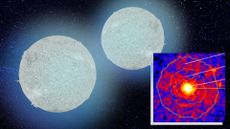 Cosmic crime scene reveals ancient supernova aftermath of dead star merger
A "guest star," briefly seen in 1181, was created by colliding dead stars, according to new simulations that may finally solve an 800-year-old cosmic mystery.
astronomy -
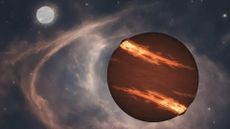 James Webb telescope makes ultra-rare detection of 2 planets orbiting dead stars
The James Webb Space Telescope has detected two alien planets orbiting white dwarfs, the collapsed husks of once-mighty stars. The discovery offers a hint of what our solar system will look like after the sun's eventual demise.
exoplanets -
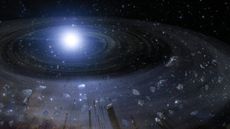 Never-before-seen rocks found in these exoplanet graveyards
Researchers studying the atmospheres of white dwarfs have discovered previously unknown rock types which made up the exoplanets that once surrounded the stellar remnants.
exoplanets -
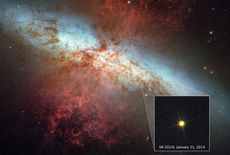 Dying white dwarf stars may explode like a nuclear bomb
When a white dwarf star explodes as a supernova, it may be detonating like a nuclear weapon on Earth, a new study finds.
astronomy -
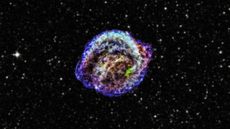 Radioactive 'snowflakes' act like the tiniest nuclear bombs in the universe
Tiny snowflakes of radioactive uranium that trigger massive nuclear blasts might explain some of the universe's more mysterious star explosions.
cosmology -
 Physicists trap ultracold plasma in a magnetic bottle for the 1st time
Scientists want to use it to learn more about the sun and nuclear fusion.
physics-mathematics -
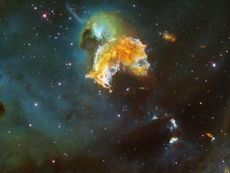 How do stars die?
Surprisingly, the fate of a star is easy to predict. All you need to know is how big it is.
astronomy


1
2