Get the world’s most fascinating discoveries delivered straight to your inbox.
You are now subscribed
Your newsletter sign-up was successful
Want to add more newsletters?
Join the club
Get full access to premium articles, exclusive features and a growing list of member rewards.
An account already exists for this email address, please log in.
Rare quadruple supernova on our 'cosmic doorstep' will shine brighter than the moon when it blows up in 23 billion years
A pair of white dwarfs, located just 150 light-years from Earth, appears doomed to die in a type 1a supernova that will shine brighter than anything currently visible in the night sky. But humanity — and our planet — will be long gone before this happens.
A pair of circling white dwarf stars located on our "cosmic doorstep" are doomed to explode in a rare, quadruple supernova that will shine 10 times brighter than the moon in the night sky, a new study suggests.
However, this super-bright spectacle will not happen for about 23 billion years, meaning that humanity will not be around to see it — and there would not be a moon left to compare it to if we were.
White dwarves are the compact, shriveled cores of once-mighty stars that have expelled their outer gas layers into space. In the new study, published April 4 in the journal Nature Astronomy, researchers revealed that WDJ181058.67+311940.94, a white dwarf binary star system located just 150 light-years from Earth, is destined to die as a type 1a supernova — one of the most powerful types of stellar explosions. The study team first discovered the superdense stars, along with 33 other white dwarf binaries, in another study released in July 2024.
The white dwarfs have a combined mass of around 1.56 times the sun's mass — a record high for this type of system — despite both being around the same size as Earth. They currently orbit each other every 14 hours, but over time, this will reduce to around 30 or 40 seconds as they draw ever closer together. When this happens, mass from one star will fall onto its partner and trigger the pair's cataclysmic demise.
"When I first spotted this system with a very high total mass on our galactic doorstep, I was immediately excited," study lead author James Munday, a doctoral candidate at the University of Warwick in England who also led the 2024 study, said in a statement. "Discovering that the two stars are separated by just 1/60th of the Earth-Sun distance, I quickly realised that we had discovered the first double white dwarf binary that will undoubtedly lead to a type 1a supernova."
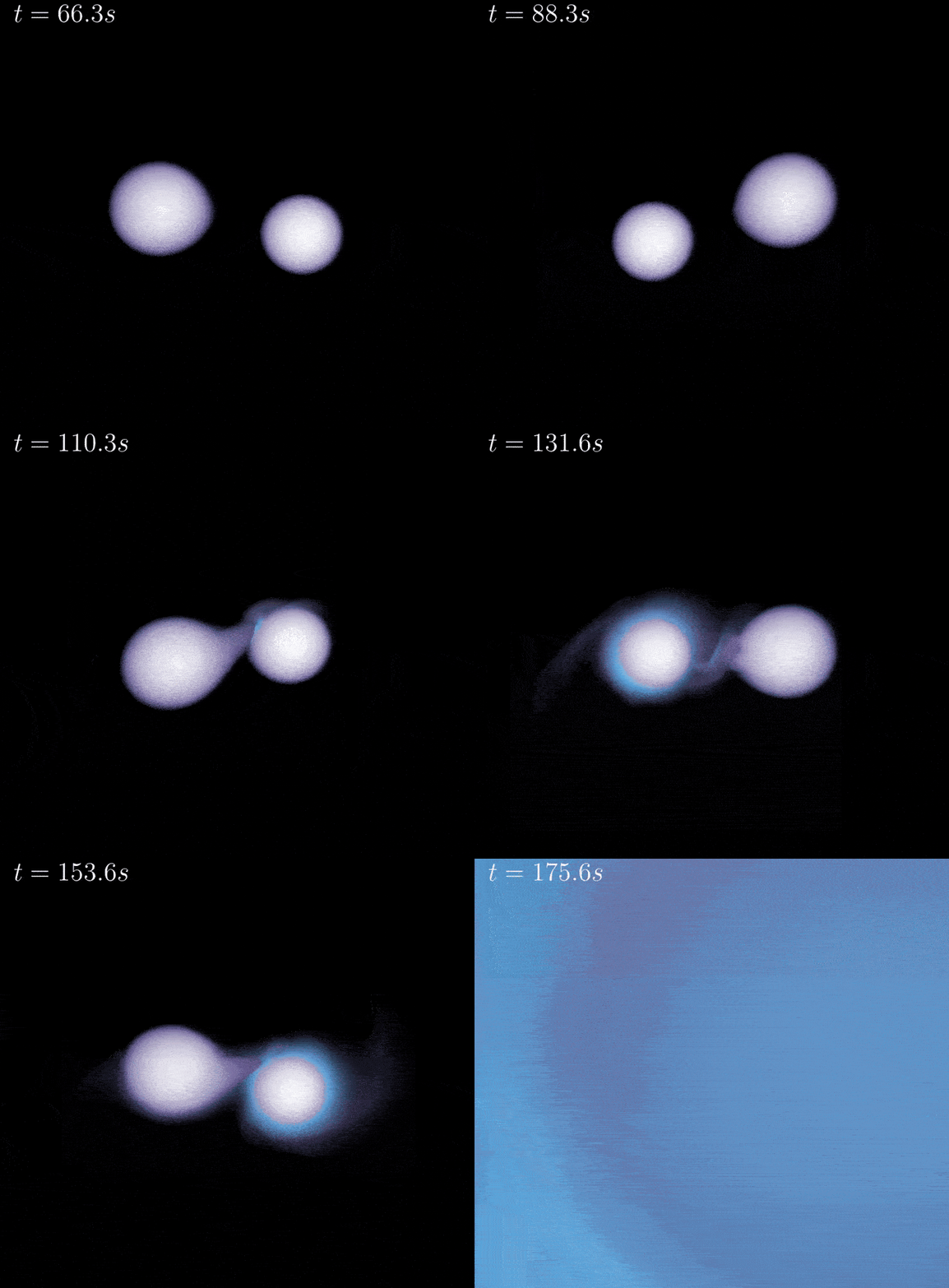
Simulations show how the supernova's multiple detonations will be triggered when the white dwarfs get close enough to one another.
(Image credit: Dr. Ruediger Pakmor, Scientific Staff, Max Planck Institute for Astrophysics)
The supernova will consist of four separate explosions. The first will happen on the surface of the mass-gaining white dwarf, which will then trigger the star's core to explode. The ejecta from these two blasts will in turn trigger a pair of similar explosions on the other white dwarf.
Sign up for the Live Science daily newsletter now
Get the world’s most fascinating discoveries delivered straight to your inbox.
The researchers predict that the explosions will occur around 22.6 billion years from now, which is more than 1.6 times the current age of the universe. The researchers wrote that the fallout would not damage Earth if it were to happen today. But when the supernova finally does blow, our planet will likely have been long ago destroyed by the expansion of our own dying sun, and our moon along with it.
If we could see it, the explosion is estimated to have an apparent magnitude of minus 16, which is around 200,000 times brighter than Jupiter appears in the night sky, the researchers wrote.
Standard candles
Type 1a supernovas are rare, but the ones we have found are often referred to as "standard candles." This is because the explosions' bright light can be used to measure the distance between Earth and their host galaxies, which, in turn, can help researchers calculate the true expansion rate of the universe, which is currently a major goal for cosmologists.
It has long been suspected that most type 1a supernovas are triggered by white dwarf binaries exploding in a similar way to WDJ181058.67+311940.94. However, until now, this has never been proven, and researchers have struggled to find systems that they can confidently conclude will end up exploding in this way.
This new discovery, so close to home, gives researchers hope that there are plenty more type 1a progenitors waiting to be found.
"This is [a] very significant discovery," study co-author Ingrid Pelisoli, an astronomer at the University of Warwick who specializes in white dwarfs, said in the statement. "Finding such a system on our galactic doorstep is an indication that they must be relatively common, otherwise we would have needed to look much further away, searching a larger volume of our galaxy, to encounter them."
"Our survey searching for type 1a supernova progenitors is still ongoing and we expect more exciting discoveries in the future," Pelisoli added. "Little by little, we are getting closer to solving the mystery of the origin of type 1a explosions."
Harry is a U.K.-based senior staff writer at Live Science. He studied marine biology at the University of Exeter before training to become a journalist. He covers a wide range of topics including space exploration, planetary science, space weather, climate change, animal behavior and paleontology. His recent work on the solar maximum won "best space submission" at the 2024 Aerospace Media Awards and was shortlisted in the "top scoop" category at the NCTJ Awards for Excellence in 2023. He also writes Live Science's weekly Earth from space series.
You must confirm your public display name before commenting
Please logout and then login again, you will then be prompted to enter your display name.