Get the world’s most fascinating discoveries delivered straight to your inbox.
You are now subscribed
Your newsletter sign-up was successful
Want to add more newsletters?
Join the club
Get full access to premium articles, exclusive features and a growing list of member rewards.
An account already exists for this email address, please log in.
2 'new stars' have exploded into the night sky at once — potentially for the first time in history
Astronomers have spotted another never-before-seen "nova" blaze to life in the night sky. This may be the first time that simultaneous stellar explosions have been visible to the naked eye in recorded history.
Astronomers have spotted two bright "new stars" shining simultaneously in the night sky: V572 Velorum (left) and V462 Lupi (right). This may be the first time that more than one nova has been visible to the naked eye at once.
A second "new star" has unexpectedly appeared in the night sky, less than two weeks after a near-identical point of light first burst into view without warning.
These never-before-seen "stars" are made of light coming from rare stellar explosions known as classical novas. Scientists believe this may be the first time in recorded history that more than one of these luminous outbursts have been visible with the naked eye at the same time.
The first nova, dubbed V462 Lupi, was initially spotted June 12 shining in the Lupus constellation, after its progenitor star suddenly became more than 3 million times brighter than normal. Then, on June 25, multiple astronomers detected another nova, dubbed V572 Velorum, within the Vela constellation, according to EarthSky.org. Astronomers normally expect to see a classical nova once a year at most, and more than one of these explosions shining simultaneously is almost unheard of.
"This is without question an extremely rare event, if not an historical one," Stephen O'Meara, an astronomer and author who has been scouring historical records for similar examples, told Spaceweather.com. "I have yet to find an occurrence of two simultaneous nova appearing at the same time."
The last time we came close to simultaneous novas visible to the naked eye was in 1936, when V630 Sgr and V368 Aql were spotted within a few weeks of one another, O'Meara added. However, "they were not at maximum brightness at the same time."
Both the new novas are located within constellations in the southern sky. These charts show the approximate locations (red rings) of V462 Lupi in Lupus (left) and V572 Velorum in Vela (right).
(Image credit: IAU/Wikimedia, edited by Live Science)
V462 Lupi's brightness peaked on June 20, when it reached an apparent magnitude of +5.5. The star has since dimmed slightly but remains above the +6 magnitude threshold for naked eye visibility. V572 Velorum is even brighter, peaking at +4.8 on June 27. (A smaller magnitude signifies a brighter object; for example, the moon has an apparent magnitude of -12.7.)
Sign up for the Live Science daily newsletter now
Get the world’s most fascinating discoveries delivered straight to your inbox.
Astrophotographer Eliot Herman snapped the novas using a remotely operated camera in Chile (see above). V572 Velorum, which was photographed on June 27, shines with brilliant blue-white light, while V462 Lupi has a purple hue in an image captured on June 26. Novas gradually turn red before disappearing because the longer blue-colored wavelengths of light fade from view first.
Both the Lupus and Vela constellations are in the southern sky, making the new novas easier to spot from the Southern Hemisphere. However, V462 Lupi can be seen from North America, just after sunset and close to the southern horizon. Vela can sometimes be seen from the southern parts of North America, including Mexico, California and Texas, meaning some people in these regions could spot V572 Velorum for themselves. But it is much less likely.
The objects are technically bright enough to be seen with the naked eye. However, they will be easier to spot if you have a decent telescope or a pair of stargazing binoculars, especially if you are viewing them from the Northern Hemisphere.
Stellar explosions
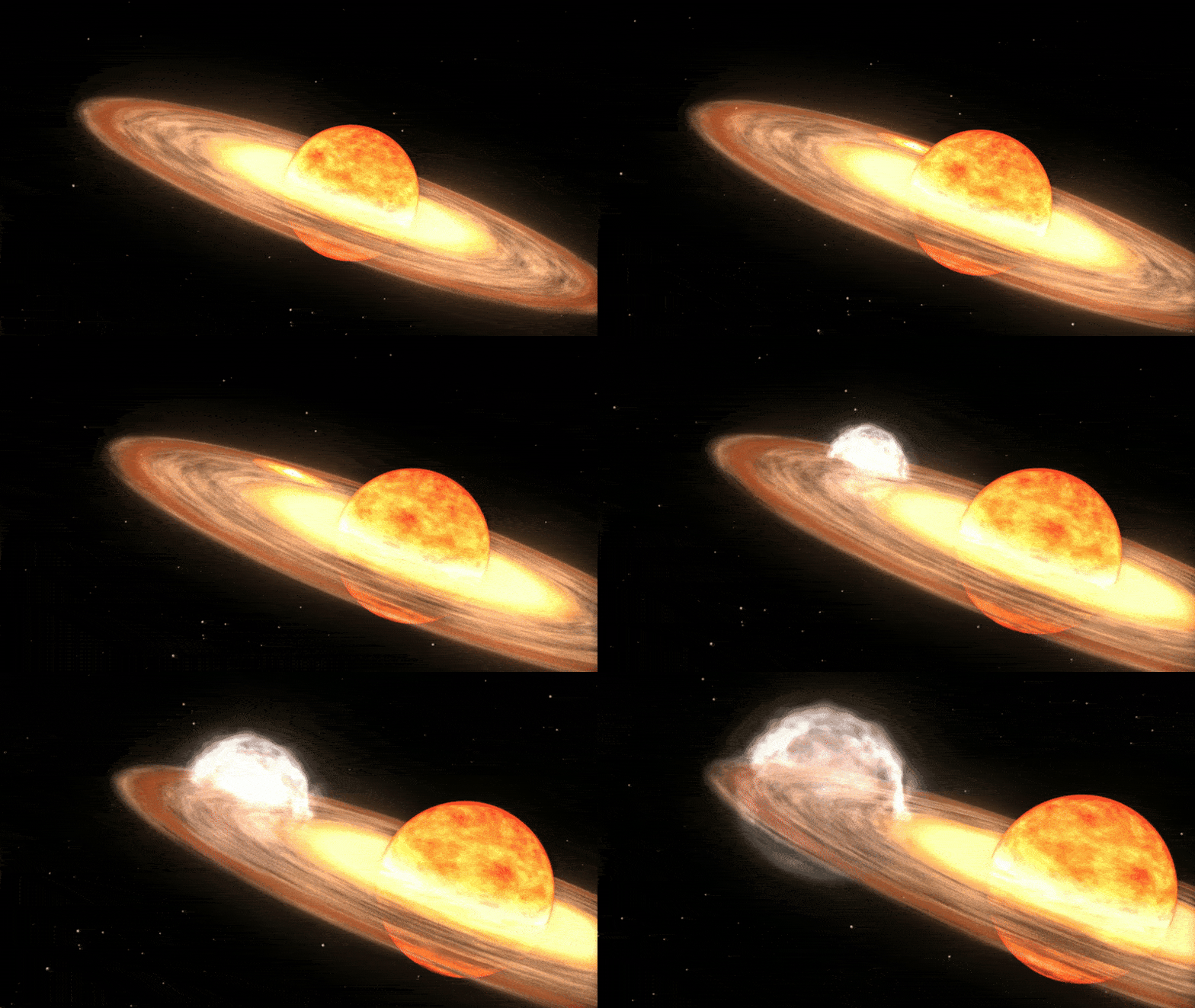
Nova's occur when too much stolen stellar material falls onto a white dwarf in a binary star system. This artist's illustration is based on the "Blaze Star," T Coronae Borealis.
(Image credit: NASA/Goddard Space Flight Center)
Unlike supernovas, which are so powerful that they completely rip stars apart, a nova only affects the outer layers of a star.
Classical novas, such as V462 Lupi and V572 Velorum, occur in a specific type of binary system, where a more massive white dwarf star is pulling material away from its larger partner. When enough material has been accreted onto the dwarf star's surface, the pressure builds up and triggers an explosion that burns up most of the stolen gas and shoots pulses of bright light into space, which can sometimes be seen from Earth.
Some novas are recurring events, blowing their top at regular intervals: For example, the long-awaited T Coronae Borealis nova, also known as the "Blaze Star," lights up our skies roughly every 80 years. However, astronomers have been predicting that the Blaze Star will reappear imminently for the last 15 months, and it is yet to emerge, which shows that it is not an exact science.
As this is the first recorded appearance of V462 Lupi and V572 Velorum, it's not known if or when they will explode again in the future. Both of them will likely fade from view in the coming weeks.
Constellations quiz: Can you name all the animals, objects and mythological figures hiding in the night sky?
Harry is a U.K.-based senior staff writer at Live Science. He studied marine biology at the University of Exeter before training to become a journalist. He covers a wide range of topics including space exploration, planetary science, space weather, climate change, animal behavior and paleontology. His recent work on the solar maximum won "best space submission" at the 2024 Aerospace Media Awards and was shortlisted in the "top scoop" category at the NCTJ Awards for Excellence in 2023. He also writes Live Science's weekly Earth from space series.
You must confirm your public display name before commenting
Please logout and then login again, you will then be prompted to enter your display name.