Get the world’s most fascinating discoveries delivered straight to your inbox.
You are now subscribed
Your newsletter sign-up was successful
Want to add more newsletters?
Join the club
Get full access to premium articles, exclusive features and a growing list of member rewards.
An account already exists for this email address, please log in.
Elusive 'Blaze Star' nova could finally appear in our skies this week after multiple false alarms
Skygazers have been waiting for over a year to see a recurrent nova that creates a temporary, super-bright star every 80 years or so. A new study suggests that it could finally happen this week — but nothing is certain.
Roughly every 80 years, a new star appears in the night sky when a white dwarf star repeatedly explodes in the T CrB system, around 3,000 light-years from Earth.
A bright new star could emerge in the night sky later this week if a distant star system erupts as expected, data suggests. However, scientists have been predicting the imminent arrival of this spectacle since early last year, suggesting this long-awaited phenomenon is much harder to predict than previously realized.
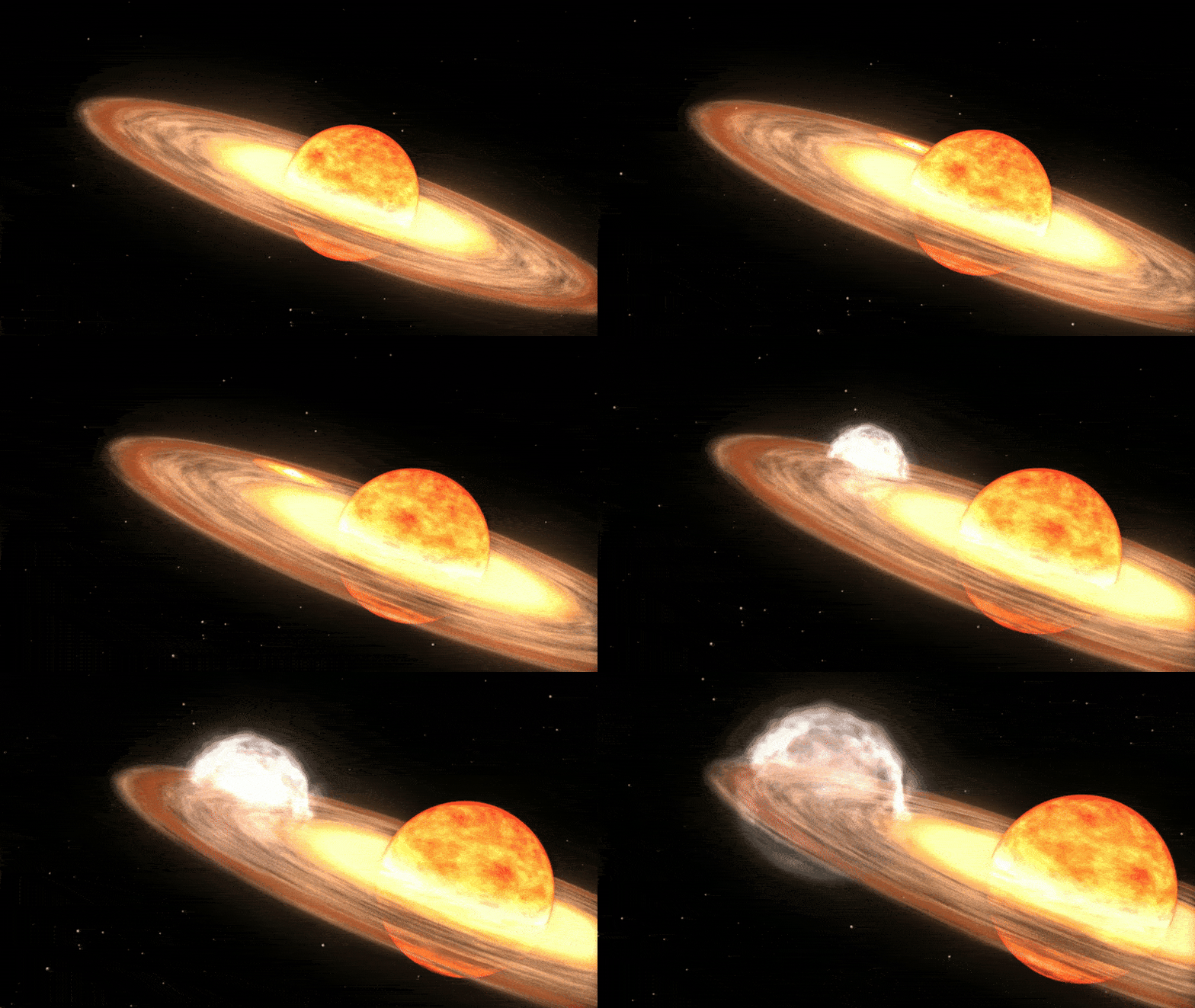
These flashes come from a binary star system made up of a hefty red giant circling a super-dense white dwarf that's around the same size as Earth. The smaller star is slowly stripping hydrogen gas from its partner and will eventually devour it over millions of years. However, as material falls onto the white dwarf, some of it accumulates on its surface until the pressure gets so great that it ignites in a powerful, super-bright blast. (This type of cyclical blast is called a nova — not to be confused with a supernova, in which a large star explodes completely, leaving only a shriveled core behind.)
TCrB, also known as the "Blaze Star," last appeared in our skies in 1946 but has been recorded at multiple points throughout history, potentially dating back as far as 1217. By looking at the past outbursts, scientists have determined that the nova explodes roughly every 80 years, meaning it is due to appear anytime now. However, we have already had multiple false alarms predicting exactly when it will appear.
Hopes of the nova's imminent appearance were first raised in late 2023, when the T CrB system dimmed, just like it did before the 1946 appearance. But the hype around the once-in-a-lifetime spectacle really took off in 2024, first in March and then again in August, as different researchers claimed it was close to happening. Ever since, stargazers have been waiting for the Blaze Star to appear — but it has remained elusive.
The Blaze Star nova is triggered when too much stolen hydrogen accumulates on the surface of the white dwarf in the T CrB system.
(Image credit: NASA/Goddard Space Flight Center)
However, another study, published October last year in the journal Research Notes of the American Astronomical Society, a lone researcher proposed a different set of likely dates for the celestial spectacle after analyzing the finer details of its previous iterations.
Sign up for the Live Science daily newsletter now
Get the world’s most fascinating discoveries delivered straight to your inbox.
The first potential window for the Blaze Star's appearance is marked as beginning on Thursday (March 27), the study's author Jean Schneider, an astronomer at the Paris Observatory in France, wrote in the paper. However, if we do not see the nova within around a week of this date, we will have to wait for more than seven months for the stellar explosion to appear, he claimed.
In reality, the T CrB system has already exploded again, and we are just waiting for the light of the next blast to reach us as it travels 3,000 light-years across the space between it and us.
When will the nova appear?
The Blaze Star is hard to pin down because the amount of time between each of its recorded appearances can either increase or decrease by around 1.4 years on average, and there is no pattern suggesting which way it will swing. As a result, researchers have had to rely on monitoring the T CrB system for changes in brightness to predict its next appearance.
However, in the newest study, Schneider reanalyzed the time differences between eruptions and found that each gap is almost perfectly divisible by the orbital period between the red giant and white dwarf stars, which circle one another every 228 days. Following this rule, the next nova should appear around March 27. But if it does not show, the next dates for its potential arrival are 228 days later, on Nov. 10, followed by June 25, 2026 and Feb. 8, 2027.
Bizarrely, there is no clear reason why any known recurrent nova would follow this pattern. "These 'predictions' are only empirical extrapolations," Schneider wrote. "There is at this point, no physical explanation behind them."
However, Schneider postulates that if there were a hidden third star in the T CrB system, then there would be a specific point in each orbit where a third star is also closest to the white dwarf. At this point, there could be an extra helping of material being dumped on the super-dense star, which may be what triggers the explosion. However, this is unproven.
How to see the Blaze Star
Predicting exactly when the nova will reappear is tricky. But what researchers do know for certain is where the Blaze Star will appear once the light from T CrB finally reaches us, because its position in our sky is fixed.
The Blaze Star will appear in the Corona Borealis and will be visible to the naked eye for several days.
(Image credit: NASA)
The temporary star will shine in the Corona Borealis constellation, which translates to "the Northern Crown" in Latin. This constellation is not very large. However, it is sandwiched between the larger Hercules and Boötes constellations, which are much easier to find and contain specific stars that can be used as guides to find the nova when it appears, according to Live Science's sister site Space.com.
The exact locations of these constellations in the night sky depend on where you are on Earth and the time of year when the nova emerges. But they can be easily found using websites such as TheSkyLive.com.
The star will have an apparent magnitude of +2, which is roughly equal to the brightness of the North Star. As a result, it will be one of the brightest objects in the night sky and visible to the naked eye. However, if you have a backyard telescope or stargazing binoculars, you will be able to see it for several more days after it disappears from everyone else's view.
Harry is a U.K.-based senior staff writer at Live Science. He studied marine biology at the University of Exeter before training to become a journalist. He covers a wide range of topics including space exploration, planetary science, space weather, climate change, animal behavior and paleontology. His recent work on the solar maximum won "best space submission" at the 2024 Aerospace Media Awards and was shortlisted in the "top scoop" category at the NCTJ Awards for Excellence in 2023. He also writes Live Science's weekly Earth from space series.
You must confirm your public display name before commenting
Please logout and then login again, you will then be prompted to enter your display name.