
-
 What is quantum superposition?
Quantum superposition is a phenomenon in which a tiny particle can be in two states at the same time — but only if it is not being directly observed.
17 Commentsquantum -
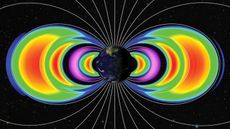 Earth grew an extra, never-before-seen 'radiation belt' after last year's supercharged solar storm — and it's probably still there
Data collected from a once-defunct NASA satellite show that Earth grew two extra radiation belts following a supercharged geomagnetic storm in May 2024, including a never-before-seen structure that is "likely still there today," researchers say.
space -
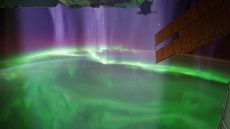 Potentially deadly 'chirping waves' detected in baffling location near Earth, and scientists are stumped
Chorus waves are mysterious, chirping signals produced by spiraling plasma inside our planet's magnetic field. But a new detection suggests scientists may understand less about them than first thought.
space -
 Extremely rare, black 'anti-auroras' paint luminous 'letter E' above Alaska
A "bizarre" E-shaped aurora was recently photographed dancing in the sky above Alaska. The unusual light show was caused by rare black auroras, a.k.a. anti-auroras, which catapult charged particles from the sun back out of Earth's atmosphere and into space.
the-sun -
 Scientists detect the most powerful cosmic rays ever — and their unknown source could be close to Earth
New research reports the most powerful cosmic rays ever detected. Because the rays lose energy as they travel through space, their detection at high energies means they are likely coming from sources relatively close to Earth.
space -
 World's fastest microscope can see electrons moving
Scientists have created the world's fastest microscope, which they hope will answer fundamental questions about how electrons behave.
physics-mathematics -
 Physicists find superconductor behavior at temperatures once thought 'impossible'
Scientists have observed an unexpected new behavior in a superconducting material. If physicists can figure out the cause, it could help them to find room-temperature superconductors.
quantum-physics -
 Bismuth is so strongly repelled from magnets, it levitates. How?
The element bismuth can "float" between magnets due to magnetic levitation. What's the science behind this phenomenon?
chemistry -
 Is copper magnetic?
The reason for copper's unique properties comes down to the configuration of its electrons.
chemistry


