Get the world’s most fascinating discoveries delivered straight to your inbox.
You are now subscribed
Your newsletter sign-up was successful
Want to add more newsletters?
Join the club
Get full access to premium articles, exclusive features and a growing list of member rewards.
An account already exists for this email address, please log in.
Neutron star collisions could briefly trap a bunch of cosmic ghosts
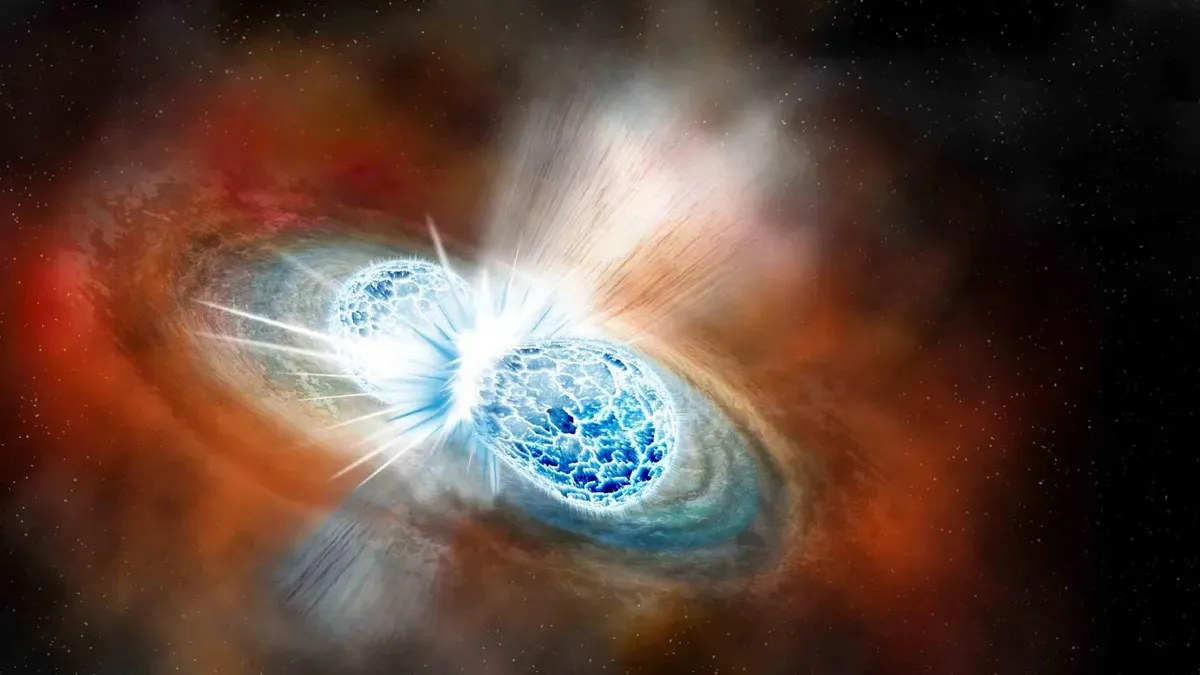
New research suggests that colliding neutron stars can briefly "trap" ghostly particles called neutrinos, which could reveal new secrets about some of space's most extreme events.
When it comes to "busting" cosmic ghosts, only the most extreme objects in the universe may be up to the task: neutron stars.
Scientists have performed simulations of collisions between these ultradense and dead stars, showing that such powerful events may be able to briefly "trap" neutrinos, otherwise known as "ghost particles." The discovery could help scientists better understand neutron star mergers as a whole, which are events that create environments turbulent enough to forge elements heavier than iron. Such elements can't even be created at the hearts of stars — and this includes the gold on your finger and the silver around your neck.
Neutrinos are considered to be the "ghosts" of the particle zoo due to their lack of charge and incredibly small mass. These characteristics mean they very rarely interact with matter. To put that into perspective, as you read this sentence, more than 100 trillion neutrinos are streaming through your body at near-light speed, and you can't feel a thing.
These new simulations of neutron star mergers were performed by Penn State University physicists, and ultimately showed that the point at which these dead stars meet (the interface) becomes incredibly hot and dense. In fact, it becomes extreme enough to ensnare a bunch of those "cosmic ghosts."
At least for a short time, anyway.
Despite their lack of interaction with matter, neutrinos created in the collision would get trapped at that neutron-star-merger interface and become much hotter than the relatively cold hearts of the colliding dead stars.
This is referred to as the neutrinos being "out of thermal equilibrium" with the cold neutron star cores. During this hot phase, which lasts around two to three milliseconds, the team's simulations indicated neutrinos can interact with merging neutron star matter, in turn helping to reestablish thermal equilibrium.
Sign up for the Live Science daily newsletter now
Get the world’s most fascinating discoveries delivered straight to your inbox.
"Neutron stars before the merger are effectively cold. While they may be billions of degrees, Kelvin, their incredible density means that this heat contributes very little to the energy of the system," team leader David Radice, an assistant professor of physics, astronomy and astrophysics in the Eberly College of Science at Penn State, said in a statement. "As they collide, they can become really hot. The interface of the colliding stars can be heated up to temperatures in the trillions of degrees Kelvin. However, they are so dense that photons cannot escape to dissipate the heat; instead, we think they cool down by emitting neutrinos."
Setting cosmic ghost traps
Neutron stars are born when a massive star with at least eight times the mass of the sun runs out of the fuel needed for nuclear fusion at its core. After that fuel supply ends, the star can no longer support itself against the inward push of its own gravity.
This kickstarts a series of core collapses that trigger the fusion of heavier elements, which then procure even heavier elements. This chain ends when the dying star's heart is filled with iron, the heaviest element that can be forged in the core of even the most massive stars. Then, the gravitational collapse happens again, triggering a supernova blast that blows away the outer layers of the star and most of its mass.
Instead of forging new elements, this final core collapse forges an entirely new state of matter unique to the interiors of neutron stars. Negative electrons and positive protons are forced together, creating an ultradense soup of neutrons, which are neutral particles. An aspect of quantum physics called "degeneracy pressure" prevents these neutron-rich cores from collapsing further, though this can be overcome by stars within enough mass that completely collapse — to birth black holes.
An illustration shows the death of a massive star in a supernova explosion that birthed a neutron star or black hole.
(Image credit: ESO/L. Calçada)
The result of this series of collapses is a dense dead star, or neutron star, with between one and two times the mass of the original star — crammed into a width of around 12 miles (20 kilometers). For context, the matter that comprises neutron stars is so dense that if a tablespoon of it were brought to Earth, it would weigh about as much as Mount Everest. Perhaps more.
These extreme stars don't always live (or die) in isolation, however. Some binary star systems contain two stars massive enough to birth neutron stars. As these binary neutron stars orbit around each other, they emit ripples in the very fabric of space and time called gravitational waves.
As these gravitational waves echo out from neutron star binaries, they carry away with them angular momentum. This results in the loss of orbital energy in the binary system and causes the neutron stars to draw together. The closer they orbit, the faster they emit gravitational waves — and the more rapidly their orbits tighten further. Eventually, the gravity of the neutron stars takes over, and the dead stars collide and merge.
This collision creates "sprays" of neutrons, enriching the environment around the merger with free versions of these particles These can be "grabbed" by the atoms of elements in this environment during a phenomenon called the "rapid capture process" (r-process). This creates superheavy elements that undergo radioactive decay to create lighter elements that are still heavier than iron. Think gold, silver, platinum, and uranium. The decay of these elements also creates a blast of light astronomers call a "kilonova."
The first moments of neutron star collisions
Neutrinos are also created during the first moments of a neutron star merger as neutrons are ripped apart, the team says, creating electrons and protons. And the researchers wanted to know what could be happening during these initial moments. To glean some answers, they created simulations that use a huge amount of computing power to model the merger of binary neutron stars and the physics associated with such events.
A simulation of a binary neutron star merger. Neutrinos created in the hot interface between the merging stars can be briefly trapped and remain out of equilibrium with the cold cores of the merging stars for 2 to 3 milliseconds.
(Image credit: David Radice / Penn State)
The Penn State team's simulations revealed for the first time that, for a brief moment, the heat and density generated by a neutron star collision are enough to trap even neutrinos, which in all other circumstances have earned their ghostly nicknames.
"These extreme events stretch the bounds of our understanding of physics, and studying them allows us to learn new things," Radice added. "The period where the merging stars are out of equilibrium is only two to three milliseconds, but like temperature, time is relative here; the orbital period of the two stars before the merge can be as little as one millisecond.
"This brief out-of-equilibrium phase is when the most interesting physics occurs. Once the system returns to equilibrium, the physics is better understood."
The team thinks the precise physical interactions that occur during neutron star mergers could influence light signals from these powerful events that could be observed on Earth.
"How the neutrinos interact with the matter of the stars and eventually are emitted can impact the oscillations of the merged remnants of the two stars, which in turn can impact what the electromagnetic and gravitation wave signals of the merger look like when they reach us here on Earth," team member Pedro Luis Espino, a postdoctoral researcher at Penn State and the University of California, Berkeley, said in the statement. "Next-generation gravitation-wave detectors could be designed to look for these kinds of signal differences. In this way, these simulations play a crucial role, allowing us to get insight into these extreme events while informing future experiments and observations in a kind of feedback loop.
"There is no way to reproduce these events in a lab to study them experimentally, so the best window we have into understanding what happens during a binary neutron star merger is through simulations based on math that arises from Einstein's theory of general relativity."
Robert Lea is a science journalist in the U.K. who specializes in science, space, physics, astronomy, astrophysics, cosmology, quantum mechanics and technology. Rob's articles have been published in Physics World, New Scientist, Astronomy Magazine, All About Space and ZME Science. He also writes about science communication for Elsevier and the European Journal of Physics. Rob holds a bachelor of science degree in physics and astronomy from the U.K.’s Open University