Get the world’s most fascinating discoveries delivered straight to your inbox.
You are now subscribed
Your newsletter sign-up was successful
Want to add more newsletters?
Join the club
Get full access to premium articles, exclusive features and a growing list of member rewards.
An account already exists for this email address, please log in.
Fallout from NASA's asteroid-smashing DART mission could hit Earth — potentially triggering 1st human-caused meteor shower
A new study suggests that millions of tiny space rock fragments, which were ejected from the 2022 collision between asteroid Dimorphos and NASA's DART spacecraft, may be on a collision course with Earth and Mars.
Millions of tiny space rock fragments may be on a collision course with Earth and Mars after NASA deliberately crashed a probe into a far-away asteroid two years ago, a new study reveals. The celestial shrapnel, which could start hitting our planet within a decade, poses no risk to life on Earth — but it could trigger the first ever human-caused meteor showers.
On Sept. 26, 2022, NASA's Double Asteroid Redirection Test (DART) spacecraft purposefully collided with the asteroid Dimorphos, smashing right into the middle of the space rock at around 15,000 mph (24,000 km/h). The epic impact, which occurred more than 7 million miles (11 million kilometers) from Earth, was the first test of humanity's capability to redirect potentially hazardous asteroids that pose a threat to our planet.
The mission was a major success. Not only did DART alter Dimorphos' trajectory — shortening its trip around its partner asteroid Didymos by around 30 minutes — it also completely changed the shape of the asteroid. It demonstrated that this type of action, known as the kinetic impactor method, was a potentially viable option for protecting our planet from dangerous space rocks.
But in the new study, which was uploaded Aug. 7 to the preprint server arXiv and has been accepted for publication in The Planetary Science Journal, researchers turned their attention to Dimorphos' smaller fragments.
The researchers used a NASA supercomputer to analyze data collected by the European Space Agency's Light Italian Cubesat for Imaging of Asteroids (LICIACube) spacecraft, which flew alongside DART as the spacecraft smashed into Dimorphos. They then simulated the initial trajectory and velocities of 3 million fragments. This revealed that many of the asteroid pieces will likely reach Mars or the Earth-moon system.
Get the world’s most fascinating discoveries delivered straight to your inbox.
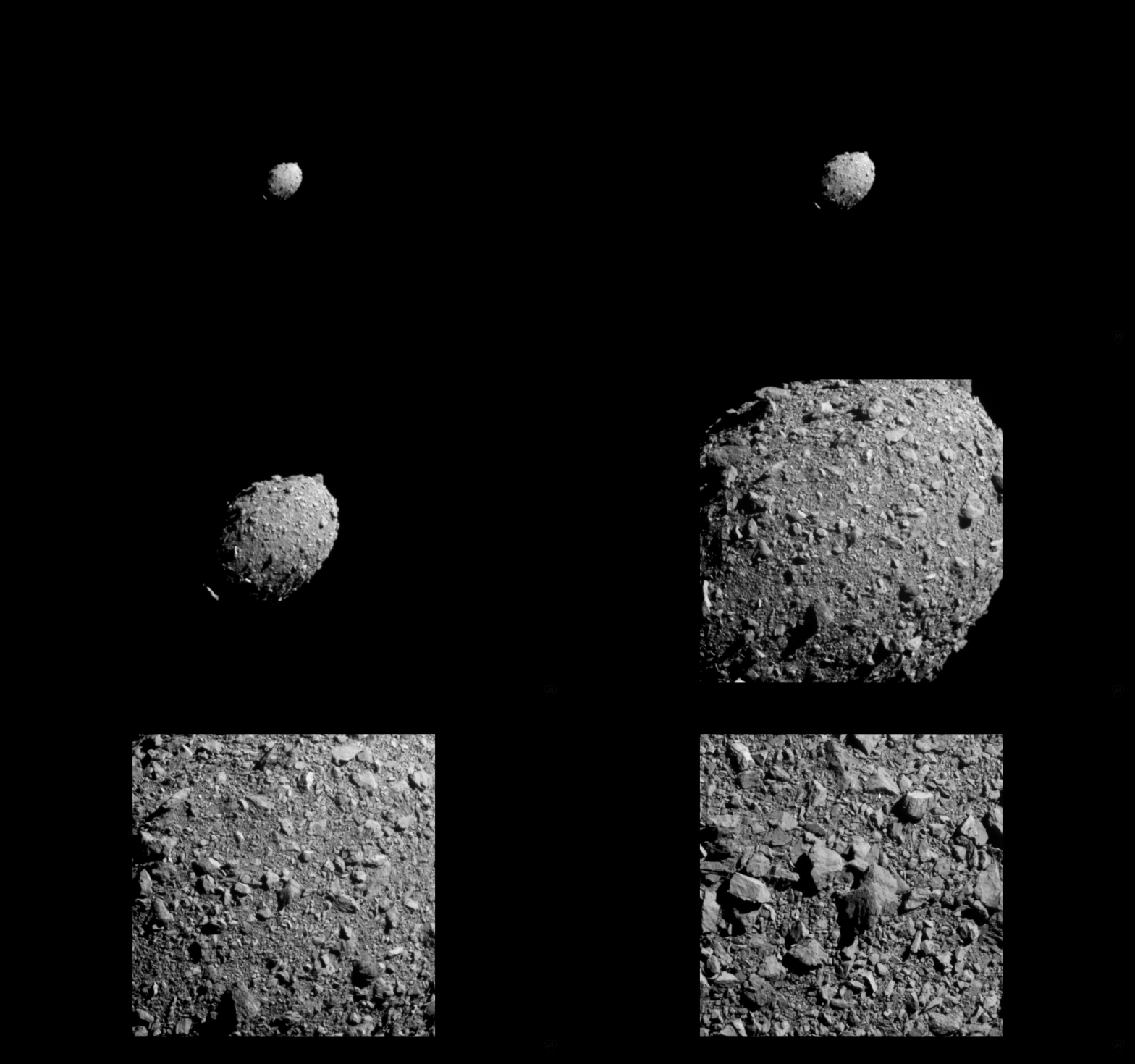
DART's final moments before it crashed into Dimorphos's surface.
(Image credit: John Hopkins University Applied Physics Laboratory)
The ejected fragments are harmless because of their diminutive size — between 0.001 inches (30 micrometers) and 4 inches (10 centimeters) across. But their arrival in Earth's atmosphere could trigger a new light show in the night sky.
"If these ejected Dimorphos fragments reach Earth, they will not pose any risk," study lead author Eloy Peña-Asensio, an aerospace engineer and astrophysicist at the Polytechnic Institute of Milan in Italy, told Universe Today. "Their small size and high speed will cause them to disintegrate in the atmosphere, creating a beautiful luminous streak in the sky."
Dozens of larger rock fragments (circled) were spotted in the aftermath of the DART/Dimorphos collision. But none are currently headed for Earth.
(Image credit: NASA, ESA, David Jewitt (UCLA))
However, there is still some uncertainty about when these fragments will reach us or when they will be visible.
The smallest fragments, which are likely traveling at speeds up to 3,350 mph (5,400 km/h), could reach us within seven years but will likely be too tiny to create any shooting stars in the sky, researchers wrote in the paper. But the larger fragments, which could be spotted as they burn up in the atmosphere, are moving more than four times slower and might not arrive for more than 30 years.
If and when these larger fragments arrive, they could create a brand new meteor shower, which the researchers have preemptively nicknamed the "Dimorphids." However, we won't know if this will really happen until these pieces start getting much closer to our planet.
Harry is a U.K.-based senior staff writer at Live Science. He studied marine biology at the University of Exeter before training to become a journalist. He covers a wide range of topics including space exploration, planetary science, space weather, climate change, animal behavior and paleontology. His recent work on the solar maximum won "best space submission" at the 2024 Aerospace Media Awards and was shortlisted in the "top scoop" category at the NCTJ Awards for Excellence in 2023. He also writes Live Science's weekly Earth from space series.