













Longstanding physics mystery may soon be solved, thanks to Einstein and quantum computing
The nature of quantum entanglement remains an outstanding problem in physics. But Albert Einstein's theories, along with insights from quantum computing, could finally put the mystery to rest.


The year 2025 marks the 100th anniversary of the birth of quantum mechanics. In the century since the field's inception, scientists and engineers have used quantum mechanics to create technologies such as lasers, MRI scanners and computer chips.
Today, researchers are looking toward building quantum computers and ways to securely transfer information using an entirely new sister field called quantum information science.
But despite creating all these breakthrough technologies, physicists and philosophers who study quantum mechanics still haven't come up with the answers to some big questions raised by the field’s founders. Given recent developments in quantum information science, researchers like me are using quantum information theory to explore new ways of thinking about these unanswered foundational questions. And one direction we're looking into relates Albert Einstein's relativity principle to the qubit.
Quantum computers
Quantum information science focuses on building quantum computers based on the quantum "bit" of information, or qubit. The qubit is historically grounded in the discoveries of physicists Max Planck and Einstein. They instigated the development of quantum mechanics in 1900 and 1905, respectively, when they discovered that light exists in discrete, or "quantum," bundles of energy.

Qubits could give quantum computers, such as IBM's Q System One, a significant advantage over classical computers.
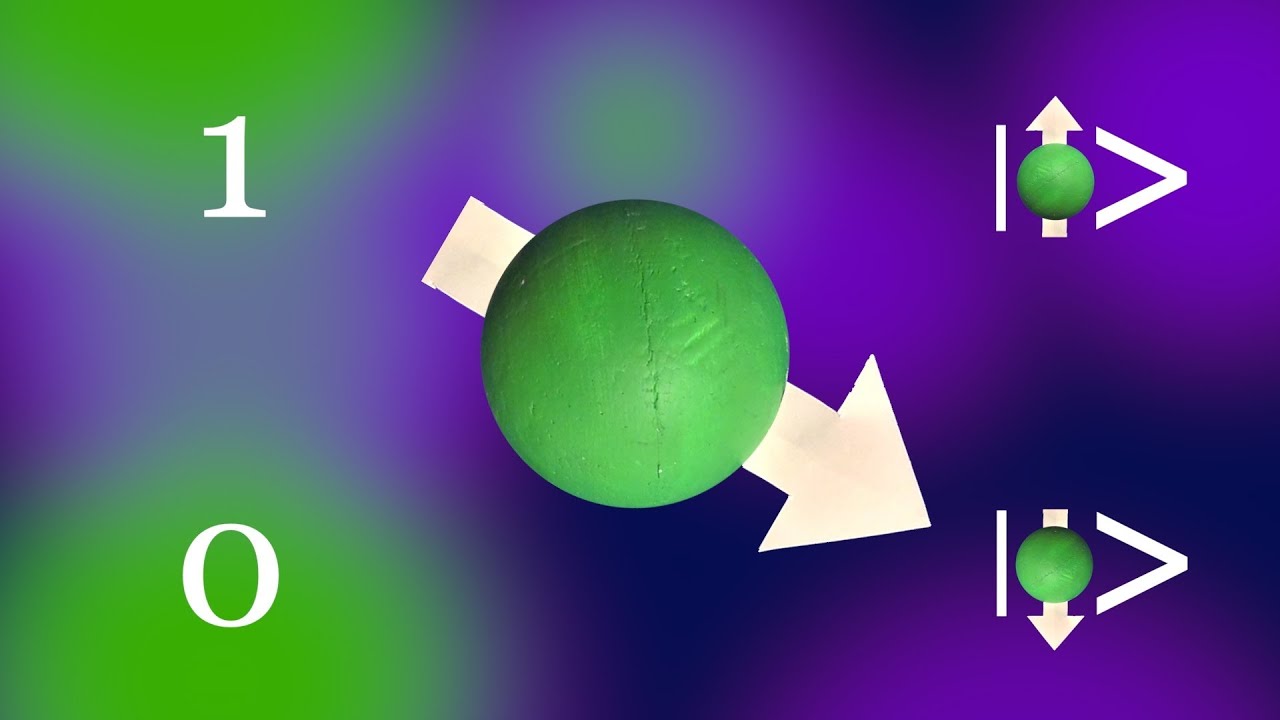
A computer based on a quantum bit rather than a classical bit could have a significant computing advantage. And that's because a classical bit produces a binary response — either a 1 or a 0 — to only one query.
In contrast, the qubit produces a binary response to infinitely many queries using the property of quantum superposition. This property allows researchers to connect multiple qubits in what's called a quantum entangled state. Here, the entangled qubits act collectively in a way that arrays of classical bits cannot.
Get the world’s most fascinating discoveries delivered straight to your inbox.
That means a quantum computer can do some calculations much faster than an ordinary computer. For example, one device reportedly used 76 entangled qubits to solve a sampling problem 100 trillion times faster than a classical computer.
But the exact force or principle of nature responsible for this quantum entangled state that underlies quantum computing is a big unanswered question. A solution that my colleagues and I in quantum information theory have proposed has to do with Einstein's relativity principle.
Quantum information theory
The relativity principle says that the laws of physics are the same for all observers, regardless of where they are in space, how they're oriented or how they're moving relative to each other. My team showed how to use the relativity principle in conjunction with the principles of quantum information theory to account for quantum entangled particles.
Quantum information theorists like me think about quantum mechanics as a theory of information principles rather than a theory of forces. That's very different than the typical approach to quantum physics, in which force and energy are important concepts for doing the calculations. In contrast, quantum information theorists don't need to know what sort of physical force might be causing the mysterious behavior of entangled quantum particles.
That gives us an advantage for explaining quantum entanglement because, as physicist John Bell proved in 1964, any explanation for quantum entanglement in terms of forces requires what Einstein called "spooky actions at a distance."
That's because the measurement outcomes of the two entangled quantum particles are correlated — even if those measurements are done at the same time and the particles are physically separated by a vast distance. So, if a force is causing quantum entanglement, it would have to act faster than the speed of light. And a faster-than-light force violates Einstein's theory of special relativity.
Many researchers are trying to find an explanation for quantum entanglement that doesn't require spooky actions at a distance, like my team's proposed solution.
Classical and quantum entanglement
In entanglement, you can know something about two particles collectively — call them particle 1 and particle 2 — so that when you measure particle 1, you immediately know something about particle 2.
Imagine you're mailing two friends, whom physicists typically call Alice and Bob, each one glove from the same pair of gloves. When Alice opens her box and sees a left-hand glove, she'll know immediately that when Bob opens the other box he will see the right-hand glove. Each box and glove combination produces one of two outcomes, either a right-hand glove or a left-hand glove. There's only one possible measurement — opening the box — so Alice and Bob have entangled classical bits of information.
But in quantum entanglement the situation involves entangled qubits, which behave very differently than classical bits.
Qubit behavior
Consider a property of electrons called spin. When you measure an electron's spin using magnets that are oriented vertically, you always get a spin that's up or down, nothing in between. That's a binary measurement outcome, so this is a bit of information.
If you turn the magnets on their sides to measure an electron's spin horizontally, you always get a spin that's left or right, nothing in between. The vertical and horizontal orientations of the magnets constitute two different measurements of this same bit. So, electron spin is a qubit — it produces a binary response to multiple measurements.
Quantum superposition
Now suppose you first measure an electron's spin vertically and find it is up, then you measure its spin horizontally. When you stand straight up, you don't move to your right or your left at all. So, if I measure how much you move side to side as you stand straight up, I'll get zero.
That's exactly what you might expect for the vertical spin up electrons. Since they have vertically oriented spin up, analogous to standing straight up, they should not have any spin left or right horizontally, analogous to moving side to side.
Surprisingly, physicists have found that half of them are horizontally right and half are horizontally left. Now it doesn't seem to make sense that a vertical spin up electron has left spin (-1) and right spin (+1) outcomes when measured horizontally, just as we expect no side-to-side movement when standing straight up.
But when you add up all the left (-1) and right (+1) spin outcomes you do get zero, as we expected in the horizontal direction when our spin state is vertical spin up. So, on average, it's like having no side-to-side or horizontal movement when we stand straight up.
This 50-50 ratio over the binary (+1 and -1) outcomes is what physicists are talking about when they say that a vertical spin up electron is in a quantum superposition of horizontal spins left and right.
Entanglement from the relativity principle
According to quantum information theory, all of quantum mechanics, to include its quantum entangled states, is based on the qubit with its quantum superposition.
What my colleagues and I proposed is that this quantum superposition results from the relativity principle, which (again) states the laws of physics are the same for all observers with different orientations in space.
RELATED STORIES
If the electron with a vertical spin in the up direction were to pass straight through the horizontal magnets as you might expect, it would have no spin horizontally. This would violate the relativity principle, which says the particle should have a spin regardless of whether it's being measured in the horizontal or vertical direction.
Because an electron with a vertical spin in the up direction does have a spin when measured horizontally, quantum information theorists can say that the relativity principle is (ultimately) responsible for quantum entanglement.
And since there is no force used in this principle explanation, there are none of the "spooky actions at a distance" that Einstein derided.
With quantum entanglement's technological implications for quantum computing firmly established, it's nice to know that one big question about its origin may be answered with a highly regarded physics principle.
This edited article is republished from The Conversation under a Creative Commons license. Read the original article.

I have published papers on dark matter, dark energy, general relativity, and quantum mechanics in American Journal of Physics, Classical & Quantum Gravity, Foundations of Physics, International Journal of Modern Physics D, General Relativity and Gravitation, Studies in History & Philosophy of Modern Physics, International Journal of Quantum Information, Entropy, and Scientific Reports. I also published two books with Oxford UP, "Beyond the Dynamical Universe" in 2018 and "Einstein's Entanglement: Bell Inequalities, Relativity, and the Qubit" in 2024. I have been teaching physics at Elizabethtown College since 1988.