













'A direct relationship between your sense of sight and recovery rate': Biologist Kathy Willis on why looking at nature can speed up healing
Biologist Kathy Willis spoke to Live Science about how touching wood makes us calmer, why looking at a picture of a savanna is calming and how walking through a forest changes our gut microbes.


The practice of forest bathing is a mindful, meditative experience where we allow our senses to become attuned to nature by spending time walking through woodlands. Numerous studies have shown that immersing ourselves in the natural world in this way can have significant health benefits, but could we ever bring this practice to a clinical setting? Could nature immersion provide alternative and effective treatments to patients suffering from a wide range of ailments?
The answer to that question is the subject of the new book "Good Nature" by Kathy Willis, a professor of biodiversity at the University of Oxford. In it, she draws on the available evidence to show not just the health benefits of being surrounded by nature, but also the quantitative data that shows how doctors could prescribe time in the natural environment when forming treatment plans for their patients.
By exploring how different forms of nature interact with the body, she discovers how touching wood makes us calmer, the long lasting effects of walking through a pine forest, and why urban sounds are so annoying.
In this interview, she spoke to Live Science about what made her investigate the impact of nature, how looking at savannas can make us feel more relaxed, and why we should be filling our houses with spider plants.
Related: 'The prescription is nature': How satellites can show us the healing effects of nature
Alexander McNamara: Why did you first explore the impact nature had on health?
Kathy Willis: I was working on a large intergovernmental project looking at the ecosystem services provided by nature when I kept coming across this paper that really piqued my interest. It showed that gallbladder operation patients who could look out the window and see trees had less drugs for pain and they recovered much faster than those who looked onto brick walls.
Get the world’s most fascinating discoveries delivered straight to your inbox.
I was interested in the fact that it wasn't that the trees were cleaning the air and the air was better, therefore the people were better. It was that there was a direct relationship between your sense of sight and recovery rate. It seemed to be some mechanism happening in the body that was resulting in faster recovery rates and less pain, related to seeing nature.
And that's where the whole journey for me started, thinking about what is going on, how does that work?
AM: I guess we take it for granted that we see all the plants and nature around us, but we overlook that as well as a psychological impact on us, it can actually have a physiological one too.
KW: Yes, with this study it was showing a direct physiological response to seeing green and I was interested to know what happened in the body to actually make them recover faster. But then I started to look at the other senses. What happens when we smell, when we hear, when we touch nature? And what's the medical evidence to show that it does [cause] a change?
What came through from this is that absolutely, there are significant changes that occur in our bodies when our senses interact with particular types of nature, but also it's an automatic response. We have nothing to do with it. So for example it'll be a change in your hormone levels, your adrenaline hormone will go down or your heart rate variability is enhanced.
These are the sort of things that if you want to convince a medic you can't say you just feel generally better, you have to give them quantitative evidence that shows what's happening. That's what I'm trying to do [with the book].
AM: So what is the mechanism for that in my body when I look at something green?
KW: When you look at the color green —and green and white leaves in particular are good — we've got three pathways that are affected through that visualization. The first ones affect the autonomic nervous system, so your heart rate and your blood pressure goes down. The second one is your endocrine system — your hormones — and for example you get a change in your salivary amylase levels, which is one that shows stress levels are reduced. The third one is your psychological index, which is the sort of thing that a psychiatrist will do to show people feel much calm and a lot less anxious.
AM: Is this response something that we have evolved?
KW: It may well be, and it's quite interesting because we have a particular response to different shapes of horizons. Think about an open landscape with a few oak trees, or a conifer outline, which is very pointy, versus a very angled and squared urban outline. What studies have shown is that when we look at the horizon, our eyes are picking out the fractal dimension [the complexity of an image's detail], and we automatically tend to go for fractal dimensions which are mid complexity [1.3]. I've done it many times with audiences, and people put their hand up to say which horizon makes them feel most relaxed. People always choose the more open landscape with a few scattered trees on it, which is 1.3.

A savanna, naturally broken up by trees, is the landscape that people are drawn to over urban or tropical landscapes.
Those tree shapes are reminiscent of savanna [landscape], and there was a really nice study where they showed photos of different landscapes to teenage children and young adults from West Africa. They would live their whole life in tropical rainforest and hadn't traveled, and yet they still picked the open savanna landscape as the one that they most liked.
AM: I guess all the senses must be impacted in some way by just being surrounded by nature?
KW: Yes, but the point is that it's not all nature, it's specific types. The chapter that most surprised me was the one on smell. Before I started researching smell, I just assumed you walk somewhere, breathe in a nice scent and then breathe it out again. But actually, when you breathe in a plant scent, those molecules are volatile organic compounds [VOCs] that pass across your lung membrane into your blood. So if you walk in a pine forest you have higher levels of pinene in your blood and that is interacting with the same biochemical pathways as taking a prescription drug for [a] particular thing [such as anxiety].
Really interesting studies have been done when you breathe in, particularly from the Cupressaceae family and the cedar family. [In experiments, when people inhale VOCs from these trees] it not only reduces their adrenaline hormone, but elevates the natural killer cells in their blood. And the natural killer cells are the things that attack cancers or viruses.
There's a lovely study published in Oncotarget, a cancer journal. [In it] they had looked at people who lived close to Cupressaceae forest versus those who live further away — the ones that live beside the forests were much healthier, with much less occurrences of many autoimmune type diseases. [Also] they entered a group into a Cupressaceae forest and measured their nature killer cells. After the five-hour walk, they had really elevated natural killer cells in their bloods [but] even more important was that seven days later, they still had greatly elevated natural killer cells in their bloods. So there's not only short-term, but also long-term benefits.

Katherine Willis CBE is professor of biodiversity at the University of Oxford.
AM: Are there any benefits to having artificial plants instead of the real ones?
There's not been that many studies done on it, but there was a lovely one on Japanese schoolchildren where they were given a planter with real pansies in it. After they viewed it for 10 minutes, they said they felt calmer [and the researchers] said their blood pressure went down. Then they did the same [with] artificial plants, the ones made from a sort of polyester, and they're really, really convincing, but they got none of the benefits.
I think what it's showing is that it's not just sight, it must also be smell, subconsciously. The difference we get from smell is huge, and it's such an interesting and often completely ignored sense.
AM: Are there any other bodily systems that are affected by nature?
KW: We're learning so much about the gut and the gut flora, and how [it is affected by] going into a more biodiverse environment. Even just walking on the edge of the park, the more biodiversity you have at different levels, the higher the environmental diversity of that microbiome. And when you're in it, in the same way as smell, your body takes on the signature of the environment it's in.
They showed it beautifully with Finnish nursery children. In a study, [they observed children playing in] three nursery playgrounds, one had concrete, one had matting, and in the third one soil brought in from the Boreal forest. Over 28 days, the children played in the different areas, and then [the researchers] measured their gut microbiome, their skin [microbiome] and then they measured the inflammatory markers in their blood.
Those that played in the Boreal forest [soil] saw a completely new gut microbiome after 28 days, but not only that, these children also had this statistically significant reduction in inflammatory markers.
And then they showed the same with adults who had a green wall in their office versus no green wall. These plants and this biodiversity is seeding the environment that these people are in and they are adopting that signature as a result of it.
Given only 7% of our flora is inherited, the rest is driven by the environment, wherever we are, we should all really be heading towards the bushy edges.
RELATED STORIES
AM: If we can't get outside so easily, are there any particular things we can do to bring nature into our homes?
KW: I think Victorians were much better at this than we are now but it's having a lot more plants around — live plants in your sitting room or in your study.
Even a vase of roses on your desk. There's been studies showing that [even] non-scented roses — so you're just seeing the flower of white and yellow roses — lower your blood pressure. Why not have a vase of roses on the desk? These are the sorts of things we can all do. We don't need to wait for someone to prescribe us.
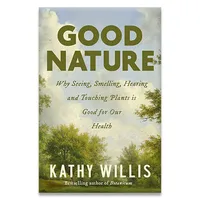
"Good Nature: Why Seeing, Smelling, Hearing, and Touching Plants is Good for Our Health" will be released on Dec. 3, 2024, and is available to preorder on Amazon for $29.95
Read an extract from "Good Nature", where Willis explores how satellites can show us the healing effects of nature.

Alexander McNamara is the Editor-in-Chief at Live Science, and has more than 15 years’ experience in publishing at digital titles. In 2024 he was shortlisted for Editor of the Year at the Association of British Science Writers awards for his work at Live Science. He has previously worked at New Scientist and BBC Science Focus.