

-
 'Twins! She has another baby': Sea monster from Chile had 2 buns in the oven, rare fossil reveals
An ichthyosaur was pregnant with twins when she died, a fossil from Cretaceous Chile reveals.
extinct-species -
 2,200-year-old grave in China contains 'Red Princess of the Silk Road' whose teeth were painted with a toxic substance
Archaeologists in China have discovered a unique burial of a woman whose teeth had been painted with cinnabar, with a toxic red substance that contains mercury.
21 Commentsancient-china -
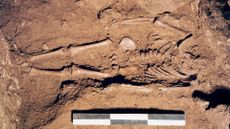 17,000-year-old remains of blue-eyed baby boy unearthed in Italy
The well-preserved remains of a baby boy who died 17,000 years ago in what is now Italy reveal that he had blue eyes, dark skin and curly hair.
archaeology -
 In a 1st, DNA analysis reveals identity of captain cannibalized during ill-fated Franklin expedition
Scientists have discovered the identity of a cannibalized victim who sailed on the doomed Northwest Passage expedition of 1845 to 1848.
archaeology -
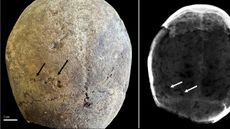 Cocaine found in mummified brains reveal that New World drug came to Italy 200 years earlier than thought
Researchers unexpectedly found traces of cocaine in the mummified brain tissue of 17th-century people buried in a crypt in Milan.
archaeology -
 Paleo-Arabic inscription on rock was made by Prophet Muhammad's companion before he converted, study finds
The writing is only the second confirmed inscription whose attribution connects to Muhammad.
middle-east -
 1,600-year-old Hun burial in Poland contains 2 boys, including one with a deformed skull
Archaeologists in Poland used DNA to identify a double burial that contained the skeletons of two boys who were unrelated.
archaeology -
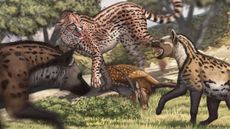 Huge cheetah that roamed China 1 million years ago would have stood face to face with a tiger
Extinct colossal cat Acinonyx pleistocaenicus was the biggest species of cheetah to have ever lived, scientists reveal.
extinct-species -
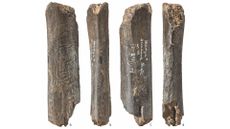 130,000-year-old Neanderthal-carved bear bone is symbolic art, study argues
The carved bear bone is one of the earliest human-made artifacts with "symbolic culture" unearthed in Europe.
neanderthals -
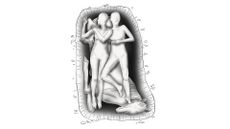 Roman-era skeletons buried in embrace, on top of a horse, weren't lovers, DNA analysis shows
A new analysis of a double burial in Austria has revealed that a skeletal couple weren't lovers but likely an embracing mother and daughter.
archaeology -
 2,500-year-old skeletons with legs chopped off may be elites who received 'cruel' punishment in ancient China
The amputated legs of skeletons belonging to two men who lived in ancient China suggests that they were punished for alleged crimes 2,500 years ago.
archaeology -
 'Exceptional' prosthesis of gold, silver and wool helped 18th-century man live with cleft palate
Archaeologists in Poland have found the 300-year-old remains of a man who had a prosthetic that helped him live with a condition called cleft palate.
archaeology -
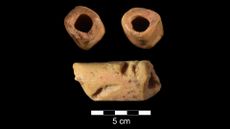 13,000-year-old bone bead is the oldest of its kind in the Americas
Some of the 1st Americans crafted a bone bead nearly 13,000 years ago, making it the oldest of its kind on record in the Western Hemisphere.
archaeology -
 Headless skeletons in China represent the largest known headhunting massacre from Neolithic Asia
Headless skeletons from a 4,100-year-old massacre in China are from victims of the largest known 'headhunt' from Neolithic Asia.
archaeology -
 Mucus-loving gut bug could be key for controlling cholesterol, lab study finds
A study conducted in lab dishes and mice finds that mucus-eating bacteria found in the human gut could be key for controlling cholesterol.
health -
 'Groundhog Day' syndrome made a man feel like he was reliving the same events
A man was convinced that the same events kept happening. The delusion was likely a complication of Alzheimer's.
alzheimers-dementia -
 All butterflies evolved from ancient moths in North America 100 million years ago
Scientists have revealed how butterflies evolved and took over the world in a new tree of life.
insects -
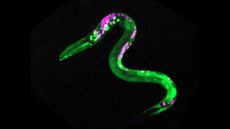 Worms and humans both get 'the munchies,' despite 500 million years of evolutionary separation
Researchers found that roundworms gobble down high-calorie foods when exposed to a compound that acts on the same brain receptor as THC.
neuroscience


