

-
 Quantum data beamed alongside 'classical' data in a single fiber-optic connection for the 1st time
Scientists have transmitted quantum data and conventional internet data through the same fiber-optic channel for the first time.
communications -
 Unique transistor 'could change the world of electronics' thanks to nanosecond-scale switching speeds and refusal to wear out
A new material can withstand 'billions' of electrical cycles without wearing out — and scientists say it could transform electronics within 10 to 20 years.
electronics -
 'Crazy idea' memory device could slash AI energy consumption by up to 2,500 times
By performing computations directly inside memory cells, CRAM will dramatically reduce power demands for AI workloads. Scientists claim it's a solution to AI's huge energy consumption.
computing -
 World's 'best-performing' quantum computing chip could be used in machines by 2027, scientists claim
New ion-trap chip eschews lasers for an integrated circuit that can be mass produced in existing semiconductor factories.
quantum -
 Razor-thin crystalline film 'built atom-by-atom' gets electrons moving 7 times faster than in semiconductors
Scientists observed record-breaking electron mobility — seven times higher than in conventional semiconductors — with a material made from the same elements as quartz and gold.
electronics -
 AI speech generator 'reaches human parity' — but it's too dangerous to release, scientists say
Microsoft's VALL-E 2 can convincingly recreate human voices using just a few seconds of audio, its creators claim.
artificial-intelligence -
 Computer inspired by Japanese art of paper-cutting has no electronics and stores data in tiny cubes
The new mechanical computer uses 64 physical cubes to represent binary bits and is inspired by kirigami — the Japanese art of paper-folding and cutting.
computing -
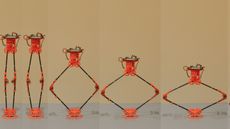 This robot could leap higher than the Statue of Liberty — if we ever build it properly
Engineers say they have created a design for a robot capable of jumping 400 feet into the air — and it could one day be heading for space.
robotics -
 X-ray vision chip gives phones 'Superman' power to view objects through walls
Researchers have developed an imaging chip for mobile devices that uses high-frequency radio waves to ‘see’ through objects.
electronics -
 DARPA's military-grade 'quantum laser' will use entangled photons to outshine conventional laser beams
Prototype quantum photonic-dimer laser uses entanglement to bind photons and deliver a powerful beam of concentrated light that can shine through adverse weather like thick fog.
engineering -
 'Quantum-inspired' laser computing is more effective than both supercomputing and quantum computing, startup claims
The desktop-sized LPU100 eschews traditional electronics and qubits in favor of lasers, and it can reportedly perform complex AI calculations in nanoseconds.
computing -
 China creates its largest ever quantum computing chip — and it could be key to building the nation's own 'quantum cloud'
China’s supersized superconducting chip looks to match the performance of industry leaders like IBM and will be used to help scale up the performance of quantum computers globally.
quantum -
 New invention transforms any smartphone or TV display into a holographic projector
Scientists have developed a method for creating 3D holograms using "incoherent light" emitted from mobile devices — turning iPhone 14 Pro into a projector.
mixed-reality -
 Charging future EVs could take seconds with new sodium-ion battery tech
A new type of hybrid sodium-ion battery that offers both high capacity and rapid-charging capabilities could power mobile devices, electric vehicles and space tech.
engineering


